


Bioterrorism - Emergency Preparedness and Response
Preparedness
On this page:
Protecting Workers in a Bioterrorism Incident
Communicating during a Bioterrorism Emergency
Special Circumstances in a Bioterrorism Incident
Suspicious Packages
Sheltering in Place and Evacuation
Personal Protective Equipment
If you are Exposed to a Bioterrorism Agent
Protecting Workers in a Bioterrorism Incident
- Employers must comply with applicable OSHA requirements to protect their workers from exposure to biological hazards. Additionally, OSHA encourages all employers to adopt a safety and health program. Safety and health programs, known by a variety of names, are universal interventions that can substantially reduce the number and severity of workplace injuries and alleviate the associated financial burdens on U.S. workplaces. Many states have requirements or voluntary guidelines for workplace safety and health programs. Numerous employers in the United States already manage safety using safety and health programs. Most successful safety and health programs are based on a common set of key elements. These include management leadership, worker participation, and a systematic approach to finding and fixing hazards. OSHA's Recommended Practices for Safety and Health Programs page contains more information.
Employers should ensure that workers know workplace procedures and how to operate during an emergency.
A bioterrorism incident may consist of a release of a highly dangerous and exotic agent. In these emergency situations, employers have a duty to keep their workers safe during and after a biological incident within or around the workplace. The following are recommendations to prepare for a bioterrorism emergency:
- Make a workplace emergency plan, complete with meet up points, evacuation routes, and designated individual(s) to maintain order and cooperation.
- Develop an emergency communications plan to stay connected with other facilities (if applicable), emergency communication services (local emergency alert system), and local law enforcement, fire, and emergency medical services.
- Build an emergency supply kit, including items such as non-perishable food (meal ready to eat), water, and a battery powered or hand crank flashlight. For additional help building an emergency supply kit, please visit https://www.ready.gov/build-a-kit.
During a bioterrorism incident, employers and workers can take the following measures:
- Always remain calm. Understand that in emergency situations, there is a high risk of mass panic and misinformation.
- Frequently check mass media communications (TV, radio, internet) for official news, including signs and symptoms of disease, areas in danger, information regarding where and how to seek medical attention, or if medications or vaccinations are being distributed.
- If you become aware of an unusual and suspicious substance, distance yourself immediately.
- Follow instructions from emergency response staff designated by your employer or emergency response workers from local, state, or federal authorities.
- Notify and seek medical attention immediately if you demonstrate symptoms of disease.
In certain situations (e.g., Anthrax letters of 2001), people may be alerted to potential exposure of an unknown or known agent. Be aware and pay attention to official instructions via radio, television, and emergency alert systems, and follow directions on how to proceed.
Communicating during a Bioterrorism Emergency
Communications are important to any business operation. Consider all forms of communication (verbal or written) and the communication systems (e.g., telephones, text messaging, radios, internet services) needed to support them. Consider the following actions as part of your communications plan:
Train workers assigned specific notification tasks and establish a chain-of-command during an emergency.
Post emergency telephone numbers near each telephone, on workplace bulletin boards, and in other conspicuous locations.
Maintain an updated list of addresses and telephone numbers of key emergency response workers (both internal and external of the worksite).
Report and remain in contact with local law enforcement, fire departments, emergency medical services, and public health officials at all times during a bioterrorism emergency.
Understand that workers will count on their employers for direction and guidance.
Special Circumstances in a Bioterrorism Incident
In the event of a bioterrorism incident, special circumstances may apply at the local, state, or federal levels, especially during a widespread outbreak or a bioterrorist attack. Employers should become familiar with these circumstances, including existing local and state emergency management systems operations, and how they could directly affect their workplace and workers.
Local
If a bioterrorism incident affects a large city or county, local elected officials (e.g., mayor, county executive officer) may declare a local public health emergency in conjunction with local public health authorities. Under these conditions, local health authorities may exercise powers vested under such a declaration. For example, a local health department may implement isolation and/or recommend social distancing measures.
State
A governor of an affected state or territory may declare an official state of public health emergency, which grants broad exercise of power to address an emergency situation within the limits of state statutes. Examples of such powers under a state of public health emergency may include the management and control of:
- Allocation and distribution of health care supplies (e.g., antibiotics and vaccines).
- Allocation and distribution of materials and supplies (e.g., personal protective equipment).
- Medical resources and access to healthcare facilities (e.g., to prevent social unrest and mass surges of "worried well" seeking medical attention and supplies).
- Establishment of quarantines and containing potentially infected individuals, or other social distancing measures.
- Safe management and disposal of infectious waste and human remains.
- Fair compensation of imminent domain (seizure of property for state purposes under emergency circumstances).
- Necessary destruction of property (e.g., contaminated environment from a biological release).
Federal
To prevent interstate disease transmission in a widespread bioterrorism emergency, the U.S. Department of Health and Human Services (HHS) may take appropriate federal actions through authorities granted by:
- Centers for Disease Control and Prevention (CDC) regulations for Interstate Quarantine (42 CFR part 70).1
- CDC regulations for Foreign Quarantine (42 CFR part 71).2
- U.S. Food and Drug Administration (FDA) regulations for Control of Communicable Diseases (21 CFR part 1240).3
Suspicious Packages
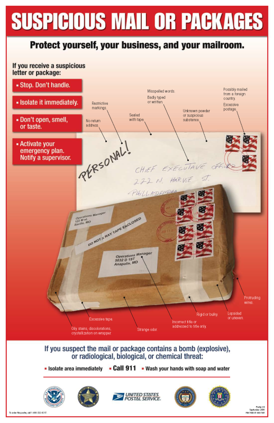
The U.S. Postal Service poster Suspicious Letters or Packages illustrates some of the characteristics of a suspicious letter or package.
Suspicious packages containing dangerous biological materials could be delivered to the workplace. Ensure that employers and workers are aware of proper procedures on the handling and reporting of a suspicious package. Look out for details that are out of the ordinary, such as unexpected mail from a foreign country. Additionally, be aware of the following characteristics:
- Unfamiliar or no return address provided
- Restrictive markings
- Incorrect title or addressed to title only (i.e., not to a specific person by name)
- Protruding wires
- Rigid or bulky; lopsided or uneven
- Strange odor or substance within the package
- Excessive postage and misspelled words
- Stains, discoloration, and leaking from within package
- Contents include a threatening note or an object that cannot be identified
If you are concerned about a package or letter that you have received:
- Isolate the area immediately
- Do not handle, shake, smell, or taste
- Leave letter or package where it is and notify workers in the immediate area
- Do not use cell phones, pagers, or two-way radios near suspicious packages
- Evacuate everyone out of the room and close the door
- Call 9-1-1 once safely evacuated from the area that the package is located
- Wash hands with soap and water
- Alert building security or superintendent
- Relocate and wait in a safe place until police, fire, or response teams arrive
The U.S. General Service Administration Mail Center Security Guide provides general advice and recommends protective measures to help mail and package workers assess, prevent, and respond to several types of mail-related threats including biological threats.
Sheltering-in-Place and Evacuating
In the event of a bioterrorism incident, two key actions can help protect workers and others in a place of business: taking shelter (i.e., sheltering in place) and evacuating to safety. Employers should plan for both possibilities. It is critical to communicate about, and regularly practice, both types of plans (i.e., conduct shelter-in-place drills and evacuation exercises) to ensure that all workers understand their roles and responsibilities during an emergency. It is also useful to evaluate drills and exercises and to use findings (often called "lessons learned") to improve future performance and response capabilities.
OSHA recommends following all shelter-in-place and evacuation instructions provided by local emergency response authorities, which may be communicated via television, radio, or internet sources. If a bioterrorism agent or other biological contaminant is released into the environment—whether accidentally or intentionally, local authorities may direct people to remain indoors when it is safer than evacuating. Always follow the guidance of emergency response personnel and broadcast instructions and evacuate or seek medical treatment immediately if directed to do so.
Building owners and facilities management should maintain or adjust HVAC systems to adequately prepare for sheltering-in-place during a biological agent emergency. High-efficiency particulate air (HEPA) filters are useful against biological incidences. Workplaces with modern central heating and cooling systems equipped with HEPA filters should provide a safe level of protection from outside biological contaminants. However, if the HVAC system is the source or distributor of the biological contaminant, have a building or facilities manager anticipate and prepare for a shutdown to prevent contaminated air from re-circulating. For more information, see the National Institute for Occupational Safety and Health (NIOSH) document, Guidance for Protecting Building Environments from Airborne Chemical, Biological, or Radiological Attacks.
Evacuation from a building or workplace is the most common protective measure against biological incidents; although, it may not be the best action in all situations. If a biological incident covers a large geographical area, sheltering-in-place would be considered the safest protective action in this case.
When no guidance is available about whether to shelter-in-place or evacuate, workers and employers may have to assess the situation and decide on their own what to do. OSHA's Getting Started – Evacuation and Sheltering-in-Place page provides additional information that may help workers and employers anticipate and prepare for such decisions.
OSHA's Evacuation Plans and Procedures eTool is an informative resource for business owners and employers about evacuation and shelter-in-place plans. The eTool can be applied to biological agent emergency situations, and can help identify exit routes and shelter locations, account for workers and visitors, and get assistance in developing or improving evacuation, sheltering-in-place, and other emergency plans.
For further information on sheltering-in-place, visit the Federal Emergency Management Agency (FEMA) Ready.gov shelter guide. The FEMA Preparedness Planning for Your Business website also provides other general preparedness tips for your business.
Personal Protective Equipment
OSHA requires employers to assess their workplaces to determine whether hazards are present or are likely to be present that require the use of personal protective equipment (PPE). If a hazard assessment shows biological hazards are present, or are likely to be present, employers must select and provide appropriate PPE. Details about employer responsibilities related to PPE, including requirements for certain types of PPE, are available on OSHA's Personal Protective Equipment Safety and Health Topics pages.
Under OSHA's PPE standards, employers must ensure that their workers have and properly use PPE, when necessary, based on the hazards present in the workplace. PPE can include respiratory protection, protective clothing, and protective barriers used to prevent or reduce worker exposure to chemicals (including oil), biological, radiological, and nuclear hazards (CBRN) and other hazards. PPE selection must reflect hazards that are present, or are likely to be present, and may need to be updated if conditions change. Even if biological hazards are not likely to be present, in the event of a bioterrorism event, a new hazard assessment would be needed to account for the biological hazards. When planning for worker PPE needs, employers should consider the full range of a particular hazard a worker may experience (e.g., respirator cartridges suitable for both chemical and particulate exposures even if workers may only need protection from particulates most of the time). Although employers who are not emergency responders may not naturally think about hazards present during emergency events, it is important that all employers remember to identify hazards that are likely to be present, and PPE that may be needed, in emergency conditions.
The following are some of the important steps employers should take with respect to PPE:
- Conduct a hazard assessment to determine what safety and health hazards workers are likely to encounter.
- Determine what PPE workers need.
- Provide the proper PPE to workers.
- Train workers in the proper use of PPE, including how to put it on and take it off correctly, and how to clean, maintain and dispose of it after or between uses.
- Ensure that PPE is used properly and whenever necessary.
- Provide medical exams and/or fit testing, as required by OSHA standards, prior to using certain types of PPE (e.g., respirators).
- Regularly review and update the PPE program as hazards change.
OSHA's Safety and Health Topics page on Personal Protective Equipment provides information on PPE for various hazards across a range of industries and links to relevant OSHA standards and more specific Safety and Health Topics web pages.
The OSHA Respiratory Protection Safety and Health Topics page provides information on what respirators are, how they work, and what is needed for a respirator to provide protection.
If You Are Exposed to a Bioterrorism Agent
In the event of confirmed or suspected exposure to a bioterrorism agent at a workplace, take the following actions:
- Move away quickly from the source(s) (e.g., letters, aerosol generator(s), explosive package(s)).
- Wash exposed skin with soap and water, promptly remove contaminated clothing, if permissible, and place it in a plastic bag and seal it, shower if necessary.
- Report on the incident to your supervisor and alert authorities.
- Check local media (radio, TV, internet, emergency alert system) for official instructions.
- Seek medical attention immediately if you show any symptoms of illness and it is safe to do so.
1 Authority: Secs. 215 and 311 of the Public Health Service (PHS) Act, as amended (42 U.S.C. 216, 243); section 361-369, PHS Act, as amended (42 U.S.C. 264-272); 31 U.S.C. 9701.
2 Authority: Secs. 215 and 311 of the Public Health Service (PHS) Act, as amended (42 U.S.C. 216, 243); sections 361-369, PHS Act, as amended (42 U.S.C. 264-272).
3 Authority: 42 U.S.C. 216, 243, 264, 271.