


- Standard Number:
OSHA requirements are set by statute, standards and regulations. Our interpretation letters explain these requirements and how they apply to particular circumstances, but they cannot create additional employer obligations. This letter constitutes OSHA's interpretation of the requirements discussed. Note that our enforcement guidance may be affected by changes to OSHA rules. Also, from time to time we update our guidance in response to new information. To keep apprised of such developments, you can consult OSHA's website at https://www.osha.gov.
February 26, 2026
- MEMORANDUM FOR:
- REGIONAL ADMINISTRATORS
STATE PLAN DESIGNEES - THROUGH:
- Amanda Wood Laihow
Principal Deputy Assistant Secretary - FROM:
- Erin P. Gilmore, Acting Director
Directorate of Enforcement Programs - SUBJECT:
- Interim Enforcement Guidance for Handrail and Stair Rail System Requirements under 1910.28(b) and 1910.29(f).
Purpose
The purpose of this memorandum is to provide interim enforcement guidance on certain handrail and stair rail system requirements under 29 CFR 1910.28(b) and 1910.29(f) to allow employers to comply with proposed changes until the effective date of any new final rule resulting from the 2021 Notice of Proposed Rulemaking (NPRM). This memorandum replaces the memorandum issued on September 23, 2019, on this subject.
Background
On November 18, 2016, OSHA published a final rule on Walking-Working Surfaces in the Federal Register (81 FR 82494). Since then, the Agency has received many questions and requests for interpretation as to when handrails are required on open staircases as well as to height requirements for handrails and stair rail systems.
OSHA provided compliance guidance regarding height requirements for handrails and stair rail systems under § 1910.29(f)(1) in a memorandum issued on September 23, 2019, which is now being archived and superseded by this memorandum. On May 20, 2021, OSHA published an NPRM (86 FR 27332), proposing changes to clarify the application of the handrail and stair rail system standards at 29 CFR 1910.28(b)(11)(ii) and 29 CFR 1910.29(f)(1). OSHA's requirements for when handrails and stair rail systems must be present on certain flights of stairs are contained in 29 CFR 1910.28(b)(11)(ii), which refers to Table D-2, Stairway Handrail Requirements. In the 2021 NPRM, OSHA explained that existing Table D–2 contains a formatting error that inadvertently omits several words from the cell in the table for a stairway with a width of less than 44 inches and two open sides. This cell currently states the requirements as "One stair rail system each open side," but OSHA intended the cell to state: "One stair rail system with handrail on each open side." OSHA proposed in the 2021 NPRM to correct this formatting error. However, OSHA also recognized that employers may have relied on the error in Table D-2 when installing stair rail systems less than 44 inches wide. To avoid the need to modify these already-installed systems, OSHA's 2021 proposed rule included an option to allow employers to follow existing requirements and not have a separate handrail for stair rail systems less than 44 inches wide that were installed before the effective date of any new final rule resulting from the 2021 NPRM. See 86 FR at 27333-34.
Additionally, OSHA's 2021 NPRM contains proposed revisions to 29 CFR 1910.29(f) to address stakeholder confusion regarding stair rail height requirements in 29 CFR 1910.29(f)(1)(iii)(A). This provision currently (per the 2016 final rule) provides that a combination handrail and stair rail system (i.e., where the top rail of a stair rail system also serves as a handrail) may only be used when: (1) The height of that stair rail system is not less than 36 inches and not more than 38 inches, as measured at the leading edge of the stair tread to the top surface of the top rail; and (2) The top rail of the stair rail system meets the other handrail requirements in 1910.29(f) (See 29 CFR 1910.29(f)(1)(iii)(A)-(B)). OSHA explained in the preamble to the 2016 Walking-Working Surfaces rule that 1910.29(f)(1)(iii)(A) is only applicable to combination stair rail systems installed before the effective date of the rule, January 17, 2017. However, installations at those height specifications were technically precluded by OSHA's previous standard, which mandated the top rail of a stair rail system to be between 30 and 34 inches. In light of confusion over this provision, OSHA's 2021 NPRM proposed revising 1910.29(f)(1)(iii)(A) to allow a combination handrail and stair rail system if the top rail is 30 to 38 inches in height and meets the other requirements in 1910.29(f). This provision would apply to systems installed before the effective date of any final rule resulting from the NPRM. See 86 FR at 27334.
Compliance Guidance
Citations for violations of §§ 1910.28(b)(11)(ii) and 1910.29(f)(1) will not be issued for handrails and stair rail systems installed prior to the effective date of any new final rule on these standards if the handrails and stair rail systems comply with the proposed requirements in the NPRM. Those requirements are summarized below.
- Citations under 29 CFR 1910.28(b)(11)(ii), Table D-2 (Published in 2016 in 81 FR 82494), will not be issued if stair rail systems1 are installed prior to the effective date of any new final rule and comply with the 2021 proposed rule:
- Flights of stairs less than 44 inches (1.1 m) wide with two open sides must have a stair rail system on each open side but are not required to have a separate handrail.2
- Citations under 29 CFR 1910.29(f)(1)(iii) will not be issued if the handrails and stair rail systems are installed prior to the effective date of any new final rule and comply with the compliance options in the 2021 proposed rule:
- The height of a stair rail system must be no less than 30 inches (76 cm), as measured from the leading edge of the stair tread to the top surface of the top rail. Where the top rail of a stair rail system is not less than 30 inches (76 cm) and not more than 38 inches (97 cm), it can also serve as a handrail, provided it meets the other handrail requirements of paragraph (f). [See Figure 1]
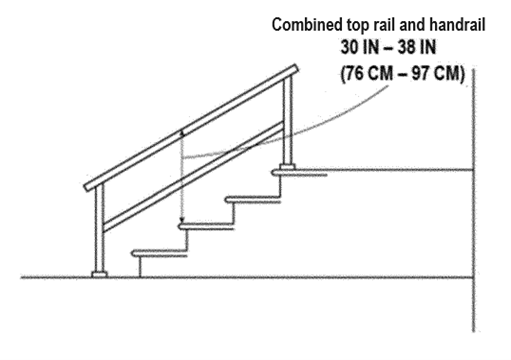
Figure 1 - When the top rail of a stair rail system exceeds 38 inches (97 cm) in height, (e.g., to meet the 42-inch minimum height requirement in current (2016 final rule) 1910.29(f)(1)(ii)(B), and a handrail is required by current (2016 final rule) Table D-2 in 29 CFR 1910.28(b)(11)(ii), the handrail must be separate from the top rail and no less than 30 inches (76 cm) and no more than 38 inches (97 cm) in height, as measured from the stair tread leading edge to the top surface of the handrail. [See Figure 2]
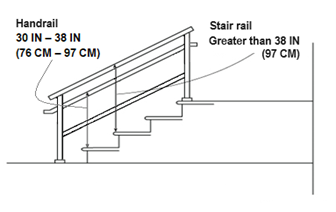
Figure 2 - The height of a stair rail system must be no less than 30 inches (76 cm), as measured from the leading edge of the stair tread to the top surface of the top rail. Where the top rail of a stair rail system is not less than 30 inches (76 cm) and not more than 38 inches (97 cm), it can also serve as a handrail, provided it meets the other handrail requirements of paragraph (f). [See Figure 1]
This guidance memorandum becomes invalid on the effective date of any final rule resulting from the 2021 NPRM. If you have any questions regarding the interim guidance, please contact Directorate of Enforcement Programs, Office of General Industry and Agricultural Enforcement at (202) 693-1850.
1Stair rail or stair rail system means a barrier erected along the exposed or open side of stairways to prevent employees from falling to a lower level (as defined in 29 CFR 1910.21).
2Handrail means a rail used to provide employees with a handhold for support (as defined in 29 CFR 1910.21).