


Emergency Preparedness
Evacuation Planning Matrix
Recent terrorist events in the United States underscore the importance of workplace evacuation planning. Consequently, OSHA developed this Evacuation Planning Matrix to provide employers with planning considerations and on-line resources that may help employers reduce their vulnerability to a terrorist act or the impact of a terrorist release. Terrorist incidents are not emergencies that OSHA expects an employer to reasonably anticipate. However, if a terrorist release does occur in or near your workplace, an effective evacuation plan increases the likelihood that your employees will reach shelter safely.
Since terrorism can impact employers and workers, OSHA is committed to strengthening workplace planning and preparedness so that employers and workers may better protect themselves and reduce the likelihood that they may be harmed in the event of a terrorist incident. OSHA continues to work with other Federal response agencies including the Federal Emergency Management Agency (FEMA), the Environmental Protection Agency (EPA), the U.S. Soldier Biological and Chemical Command (SBCCOM), the Centers for Disease Control and Prevention (CDC) and, within CDC, the National Institute for Occupational Safety and Health (NIOSH), to provide accurate, current information in this rapidly developing area of occupational safety and health.
Using OSHA's Evacuation Planning Matrix
The Matrix is not a compliance tool for conducting a comprehensive compliance evaluation of an emergency plan developed to comply with the Emergency Action Plan Standard (29 CFR 1910.38) or the Hazardous Waste Operations and Emergency Response Standard (29 CFR 1910.120(q)). Rather, this document covers the general aspects of emergency planning and includes broad questions to help employers review their existing plan in light of an indoor or outdoor terrorist release. The document also offers basic planning and preparedness measures for workplaces in each of three risk zones and on-line resources for assistance. After you complete the terrorism risk assessment, review the description of each risk zone to see where your workplace fits best, then examine the planning considerations for that zone.
NOTICE
OSHA offers this guidance to assist employers and workers who are interested in implementing plans and procedures that may reduce the likelihood of a terrorist incident and reduce the effect of a terrorist release, should a terrorist incident occur at a workplace. However, the guidance does not create legal obligations for employers or create rights for third parties. Legal obligations under the OSH Act are created by statute, regulations, and standards.
Note: If you do not have an emergency plan and want to determine whether OSHA requires you to have one, please see Does Your Facility Need an Emergency Action Plan?
Assessing the Risk of a Terrorist Release
Within this document, OSHA draws on the FBI definition of terrorism and defines terrorist release as the release of a chemical, biological, radiological or nuclear material (commonly identified as a Weapon of Mass Destruction (WMD)) or of another hazardous substance, performed as a violent act dangerous to human life and intended to further political or social objectives.
In order to use this evacuation guidance effectively, an employer must first assess the risk of a terrorist release in the workplace. The level of risk is a combination of workplace vulnerabilities, recognized threat, and anticipated consequences of the event. This kind of assessment is not a typical safety and health evaluation. However, guidance on conducting such an assessment is becoming more widely available. For many employers, Best Practices in Workplace Security, a homeland security guide developed by the State of South Carolina and available online at http://www.llr.state.sc.us/workplace/fullreport.pdf [PDF*], can offer valuable assistance. Its Worksite Risk Assessment List helps employers assess risk based on the following terrorism risk factors:
- uses, handles, stores or transports hazardous materials;
- provides essential services, e.g., sewer treatment, electricity, fuels, telephone, etc.;
- has a high volume of pedestrian traffic;
- has limited means of egress, such as a high rise complex or underground operations;
- is considered a high profile site, such as a water dam, military installation, or classified site; or
- is part of the transportation system, such as shipyard, bus line, trucking, airline.
If these risk factors apply to your work site and cannot be eliminated, you may face greater vulnerability to a terrorist release than other workplaces. To assess the potential threat and consequences of a terrorist release at or near your workplace, consult local law enforcement, the local FBI, and/or the local emergency planning committee (see EPA's LEPC database online at http://www.epa.gov/ceppo/lepclist.htm). You will need information provided by these agencies to complete your overall risk assessment and to determine which of the three risk zones noted below best characterizes your workplace.
Chemical facilities can use the US Department of Justice's Chemical Facility Vulnerability Assessment Methodology, online at http://www.ojp.usdoj.gov/nij/pubs-sum/195171.htm, to assess workplace vulnerabilities. Although this document also discusses threat and consequence assessment, you still will need input from local law enforcement, local FBI, and/or your local LEPCs to complete your evaluation.
OSHA Terrorist Release Risk Categories
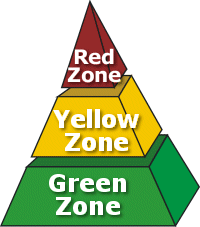
OSHA shows the zones in the shape of a pyramid to represent how the nation's workplaces appear to be distributed within the zones. Based on information currently available, the vast majority of American workplaces are at low risk for a terrorist release, i.e. are in the Green Zone. The questions, recommendations, and on-line resources in each risk zone build on the those in the zone below it. For example, the Yellow Zone includes both the information in the Green Zone and additional information for Yellow Zone workplaces.
Green Zone:
Workplaces that are not likely to be a target for a terrorist release because they are characterized by limited vulnerability, limited threat, and limited potential for significant impact (consequence).
Note: If the workplaces near you seem to be in a higher zone, you may wish to review and implement the planning/preparedness considerations in the Yellow Zone.
Yellow Zone:
Workplaces that may be targets because they are characterized by high vulnerability or high threat or a potentially significant impact (consequence), but not more than one of these.
Note: If the workplaces near you seem to be in a higher zone, you may wish to review and implement the planning/preparedness considerations in the Red Zone.
Red Zone:
Workplaces that are most likely to be targets because they are characterized by two or more of the following: high vulnerability, high threat, and potentially catastrophic impact (consequence). Such workplaces need to consider sheltering employees in place as well as evacuation, and may consider assigning some terrorist incident response roles to their own employees.
Note: The color-coded risk levels in this Matrix do not equate to the Threat Levels in the Homeland Security Advisory System developed by the Department of Homeland Security. However, employers that place themselves in the Yellow or Red risk levels may consider implementing sequential preparedness measures consistent with those listed in the Homeland Security Presidential Directive - 3 (describes Threat Levels) for federal agencies.
Limitations of Guidance
Because of the vast number and types of workplaces in the U.S., this Matrix provides broad information applicable to most workplaces. If you want to modify your plan to address specific considerations, you can get additional information from on-line resources identified. For additional information about workplace emergency planning, see OSHA's Emergency Response Technical Links webpage.
As a nation, our understanding of the risk of terrorist releases and the agents involved continues to evolve. It is likely that OSHA's recommendations for preparedness, training, and equipment also will evolve. OSHA remains committed to helping employers and workers protect themselves from the risk of terrorism in the workplace and is working closely with other Federal agencies to provide employers with current information and guidance.