Department of Labor Seal photos representing the workforce - digital imageryŠ copyright 2001 photodisc, inc.
Department of Labor Seal www.osha.gov  [skip navigational links] Search    Advanced Search | A-Z Index
OSHA Small Business > Small Business Handbook
Link to Printing InstructionsPrinting Instructions
 
Small Business Handbook

Small Business Safety and Health Management Series
OSHA 2209-02R 2005

Employers are responsible for providing a safe and healthful workplace for their employees. OSHA's role is to assure the safety and health of America's workers by setting and enforcing standards; providing training, outreach and education; establishing partnerships; and encouraging continual improvement in workplace safety and health.

About this Handbook

This handbook is provided to owners, proprietors and managers of small businesses by the Occupational Safety and Health Administration (OSHA), an agency of the U.S. Department of Labor. For additional copies of this publication, write to the U.S. Government Printing Office, (GPO), Superintendent of Documents, Mail Stop SDE, 732 N. Capitol Street, NW, Washington, DC 20401, or call the OSHA Publications Office at (202) 693-1888, or fax (202) 693-2498 for ordering information. Please note that the entire text of the Small Business Handbook is available on OSHA's website [PDF - 260 KB].

The handbook should help small business employers meet the legal requirements imposed by the Occupational Safety and Health Act of 1970 (the Act), and achieve an in-compliance status before an OSHA inspection. An excellent resource to accompany this information is OSHA's Safety and Health Program Management Guidelines, (54 Federal Register 3904-3916, January 26, 1989), also available on OSHA's website.

This handbook is not a legal interpretation of the provisions of the Act and does not place any additional requirements on employers or employees. Employers cannot be cited under the General Duty Clause in Section 5(a)(1) of the Act for failure to follow recommendations in this handbook.

The materials in this handbook are based upon Federal OSHA standards and other requirements in effect at the time of publication and upon generally accepted principles and activities within the job safety and health field. They should be useful to small business owners or managers and can be adapted easily to individual establishments.

It is important to point out that 24 states, Puerto Rico and the Virgin Islands operate their own OSHA-approved safety and health programs under Section 18 of the Act. While the programs in these State Plan States may differ in some respects from Federal OSHA, this handbook can be used by employers in any state because the standards imposed by State Plan States must be at least as effective as Federal OSHA standards. A list of states that operate their own safety and health programs can be found on OSHA's website.

Material in this publication is in the public domain and may be reproduced, fully or partially, without permission. Source credit is requested but not required.

This information will be made available to sensory impaired individuals upon request by voice phone (202) 693-1999 or teletypewriter (TTY) (877) 889-5627.


Please Note: The small business employer seeking information on procurement or contracting with the Department of Labor or OSHA should contact the Department of Labor's Office of Small Business Programs, 200 Constitution Avenue, NW, Room C-2318, Washington, DC 20210.

Contents

PREFACE
Office of Small Business Assistance
Cooperative Programs
State Plans
Office of Training and Education
OSHA's Website
Safety and Health Add Value

INTRODUCTION: The Value of a Safety and Health Management System
A Profit and Loss Statement
Developing a Profitable Strategy for Handling Occupational Safety and Health

A FOUR-POINT WORKPLACE PROGRAM: The Basis of a Plan
Using the Four-Point Program
MANAGEMENT COMMITMENT AND EMPLOYEE INVOLVEMENT
WORKSITE ANALYSIS
HAZARD PREVENTION AND CONTROL
TRAINING FOR EMPLOYEES, SUPERVISORS AND MANAGERS
Documenting Your Activities
Safety and Health Recordkeeping
INJURY/ILLNESS RECORDS
EXPOSURE RECORDS AND OTHERS

STARTING A SAFETY AND HEALTH MANAGEMENT SYSTEM: Creating a Plan
Decide to Start Now
Designating Responsibility
Ask for Help
Organize the Workplace
Start Gathering Specific Facts About Your Situation
Establish a Four-Point Safety and Health Program
Develop and Implement Your Action Plan

SELF-INSPECTION
Self-Inspection Scope
Self-Inspection Checklists
EMPLOYER POSTING
RECORDKEEPING
SAFETY AND HEALTH PROGRAM
MEDICAL SERVICES AND FIRST AID
FIRE PROTECTION
PERSONAL PROTECTIVE EQUIPMENT AND CLOTHING
GENERAL WORK ENVIRONMENT
WALKWAYS
FLOOR AND WALL OPENINGS
STAIRS AND STAIRWAYS
ELEVATED SURFACES
EXITING OR EGRESS - EVACUATION
EXIT DOORS
PORTABLE LADDERS
HAND TOOLS AND EQUIPMENT
PORTABLE (POWER OPERATED) TOOLS AND EQUIPMENT
ABRASIVE WHEEL EQUIPMENT GRINDERS
POWER-ACTUATED TOOLS
MACHINE GUARDING
LOCKOUT/TAGOUT PROCEDURES
WELDING, CUTTING AND BRAZING
COMPRESSORS AND COMPRESSED AIR
COMPRESSORS/AIR RECEIVERS
COMPRESSED GAS CYLINDERS
HOIST AND AUXILIARY EQUIPMENT
INDUSTRIAL TRUCKS - FORKLIFTS
SPRAYING OPERATIONS
ENTERING CONFINED SPACES
ENVIRONMENTAL CONTROLS
FLAMMABLE AND COMBUSTIBLE MATERIALS
HAZARDOUS CHEMICAL EXPOSURE
HAZARDOUS SUBSTANCES COMMUNICATION
ELECTRICAL
NOISE
FUELING
IDENTIFICATION OF PIPING SYSTEMS
MATERIALS HANDLING
TRANSPORTING EMPLOYEES AND MATERIALS
CONTROL OF HARMFUL SUBSTANCES BY VENTILATION
SANITIZING EQUIPMENT AND CLOTHING
TIRE INFLATION

ASSISTANCE IN SAFETY AND HEALTH FOR SMALL BUSINESSES
OSHA Assistance
OSHA'S OFFICE OF SMALL BUSINESS ASSISTANCE
ON-SITE CONSULTATION
OTHER COOPERATIVE PROGRAMS
VOLUNTARY PROTECTION PROGRAMS (VPP)
OSHA STRATEGIC PARTNERSHIP PROGRAM (OSPP)
OSHA ALLIANCE PROGRAM
States with Approved Plans
OSHA Publications
Other Sources of Assistance
VOLUNTARY PROTECTION PROGRAMS PARTICIPANTS' ASSOCIATION (VPPPA)
SMALL BUSINESS DEVELOPMENT CENTERS
NATIONAL INSTITUTE FOR OCCUPATIONAL SAFETY AND HEALTH (NIOSH)
WORKERS' COMPENSATION CARRIERS AND OTHER INSURANCE COMPANIES
TRADE ASSOCIATIONS AND EMPLOYER GROUPS
TRADE UNIONS AND EMPLOYEE GROUPS
THE NATIONAL SAFETY COUNCIL AND LOCAL CHAPTERS
PROFESSIONAL ASSOCIATIONS
SPECIFIC MEDICAL CONSULTATION
YOUR LOCAL LIBRARY
FINANCING WORKPLACE IMPROVEMENT
ADDITIONAL WEB PAGES OF INTEREST TO SMALL BUSINESSES

Appendix A: Overall Action Plan Worksheet

Appendix B: Model Policy Statements

Appendix C: Codes of Safe Practices

Appendix D: OSHA Job Safety and Health Standards, Regulations and Requirements

Appendix E: Small Business Regulatory Enforcement Fairness Act of 1996 (SBREFA)

OSHA Regional Offices

OSHA's Non-Retaliation Policy


PREFACE

American employers and workers want safe and healthful places in which to work. They want everyone on the job to go home whole and healthy each day. Determined to make that dream possible, OSHA is committed to assuring - so far as possible - that every working man and woman in the nation has safe and healthful working conditions. OSHA believes that providing workers with a safe workplace is central to their ability to enjoy health, security and the opportunity to achieve the American dream.

OSHA seeks to cut unnecessary rules, regulations and red tape. It is eliminating thousands of pages of outdated regulations and continues to rewrite standards in plain English. OSHA is paring down its regulatory agenda so that it more accurately reflects realistic goals that best serve the needs of American employers and employees.

Confronted by the realities and demands to keep pace with the workforce and problems of the future, OSHA is developing new strategies to reduce occupational fatalities, injuries and illnesses. Coupled with strong, effective and fair enforcement, OSHA strives to provide improved outreach, education and compliance assistance to America's employers and employees.


Office of Small Business Assistance

OSHA wants to provide quality service to our small business customers. In October 2002, OSHA created the Office of Small Business Assistance to provide small business direction, to facilitate information sharing and to help in finding and achieving regulatory compliance. The office also works to educate small businesses on using up-to-date tools and materials, and facilitates opportunities to comment on OSHA's regulatory agenda. The Office of Small Business Assistance maintains OSHA's specialized small business web pages found on OSHA's website.

The Office of Small Business Assistance can be contacted by telephone at (202) 693-2220 or by writing to: Director, Office of Small Business Assistance, 200 Constitution Avenue, N.W., Room N-3700, Washington, DC 20210.


Cooperative Programs

Years of experience show us that voluntary collaborative relationships between OSHA, the private sector and other government entities lead to improved safety and health. As a result, OSHA continues to expand its cooperative programs which currently include the free and confidential Consultation Program, the Voluntary Protection Programs, the Strategic Partnership Program and OSHA's newest addition, Alliances. For a more detailed description of each of these programs, please see pages 40- 42.

Small businesses are encouraged to investigate the full array of cooperative programs offered by OSHA. Participation can be on an individual company basis or through an industry association. Detailed information on each program is also available on OSHA's website, by contacting any OSHA office, or by calling (800) 321-OSHA.


State Plans

OSHA has important partnerships with the 24 states, Puerto Rico and the Virgin Islands that operate their own OSHA-approved safety and health programs. State workplace safety and health programs frequently lead the way in developing innovative approaches to making America's workplaces safer and healthier.

States that operate their own worker safety and health plans must provide worker protection that is "at least as effective as" the Federal program. However, because their standards and other procedures may vary, businesses should become familiar with their state regulations and agencies. See OSHA's website for a list of State Plan States.


Office of Training and Education

OSHA's Office of Training and Education provides training and instruction in all facets of occupational safety and health. OSHA's Training Institute, located in Arlington Heights, IL, provides training for OSHA compliance safety and health officers as well as for the general public and safety and health staff from other Federal agencies. In addition to OSHA's Training Institute, there are 32 additional education sites located throughout the country. These OSHA education centers operate in conjunction with universities, colleges and learning centers to conduct OSHA courses for the private sector and other Federal agencies, making safety and health training and education more accessible to those who need it. There are tuition fees for private sector students. For more information about OSHA's Training Institute, OSHA's education centers, or to obtain training catalogs with course schedules, write the OSHA Training Institute, 2020 South Arlington Heights Road, Arlington Heights, IL 60005 or call (847) 297-4810. The information is also fully accessible on the Internet at OSHA's website.

OSHA's Website

OSHA has made every effort to continuously expand and improve its website. OSHA's extensive website provides employers and employees with practical, easy-to-understand and up-to-date guidance on regulations, compliance assistance and learning how to identify and control hazards. Each OSHA cooperative program has individual web pages describing program elements and highlighting successes of the participants. Several pages are devoted to small business, technical links, news items, publication lists and an inventory of compliance assistance tools, including expert advisors and e-tools. E-tools are "stand-alone" interactive, web-based training tools on occupational safety and health topics. Regulations, standards, directives and interpretations relating to OSHA can be found as well. There is a Spanish version of the OSHA website, and many posters and some publications are also available in Spanish.

OSHA's web pages include MyOSHA, which allows users to create their own personalized OSHA web page with customized content and links. Quick Start is another tool on OSHA's Compliance Assistance web page that allows the user to identify many of the major OSHA requirements and guidance materials that apply to their individual workplaces or industry sectors.

Through its website, OSHA invites citizens to email questions that can be routed to appropriate agency officials for response. Any communication conducted via the "Contact Us" link on the OSHA website is considered an informational exchange rather than an official communication with the Department of Labor. For an official response to a question or concern, inquiries should be submitted in writing.

If you would like to receive regular updates from OSHA about new programs, tools, best practices and other useful information, subscribe to the agency's e-news memo, QuickTakes. QuickTakes is issued twice monthly to subscribers and is always available online. You can subscribe to OSHA's QuickTakes at OSHA's website.


Safety and Health Add Value

Addressing safety and health issues in the workplace saves the employer money and adds value to the business. Recent estimates place the business costs associated with occupational injuries at close to $170 billion-expenditures that come straight out of company profits.

When workers stay whole and healthy, the direct cost-savings to businesses include:

  • lower workers' compensation insurance costs;
  • reduced medical expenditures;
  • smaller expenditures for return-to-work programs;
  • fewer faulty products;
  • lower costs for job accommodations for
  • injured workers;
  • less money spent for overtime benefits.
Safety and health also make big reductions in indirect costs, due to:
  • increased productivity;
  • higher quality products;
  • increased morale;
  • better labor/management relations;
  • reduced turnover;
  • better use of human resources.
Employees and their families benefit from safety and health because:
  • their incomes are protected;
  • their family lives are not hindered by injury;
  • their stress is not increased.
Simply put, protecting people on the job is in everyone's best interest-our economy, our communities, our fellow workers and our families. Safety and health add value to businesses, workplaces and lives.

INTRODUCTION: The Value of a Safety and Health Management System

A Profit and Loss Statement


As a small business owner, you are, by nature, a risk taker. You wager your business acumen against larger, perhaps more heavily financed corporate groups and other free-spirited, self-employed individuals like yourself. There is excitement and challenge in such a venture, but to succeed you need good management information, an ability to be a good manager of people and the intelligence and inner strength to make the right decisions.

Thousands of workers die each year and many, many more suffer injury or illness from conditions at work. But how often does an owner or manager like you actually see or even hear about work-related deaths, serious injuries or illnesses in the businesses
with which you are familiar? How often has your business actually sustained this type of loss?

In most small businesses, the answer is rarely. For this reason, many owners or managers do not understand why there is controversy about the Occupational Safety and Health Administration (OSHA), job safety and health standards, inspections, citations, etc.

But others have learned why. Unfortunately, they have experienced a loss. These owner/managers will tell you that it is too late to do anything once a serious accident happens. They have learned that
prevention is the only real way to avoid this loss.

Reducing losses is a goal that you as an owner or manager share with us in OSHA. While we may see this goal in a slightly different light, it remains a common bond.

We have learned from small employers, like you, that you place a high value on the well-being of your employees. Like many small businesses, you may employ family members and personal acquaintances. And, if you don't know your employees
before they are hired, then chances are that the very size of your workplace will promote the closeness and concern for one another that small businesses value.

Assuming that you are committed to safe and healthful work practices, OSHA wants to work with you to prevent all losses. We believe that, when you make job safety and health a real part of your everyday operations, you will not lose in the long run. Investing in safety and health activity now will better enable you to avoid possible losses in the future.


Developing a Profitable Strategy for Handling Occupational Safety and Health

Nobody wants accidents to happen in his or her business. A serious fire, a permanent injury, or the death of an employee or owner can cause the loss of profit or even an entire business. To prevent such losses, you don't have to turn your business upside down. You may not have to spend a lot of money, either. You do need to use good business sense and apply recognized prevention principles.

There are reasons why accidents happen. Something goes wrong somewhere. It may take some thought, and maybe the help of friends or other trained people, to figure out
what went wrong, but an accident always has a cause-a reason why. Once you know why an accident happened, it is possible to prevent future incidents. You need some basic facts and perhaps some help from others who already know some of the answers. You also need a plan-a plan to prevent accidents.

Not all dangers at your worksite depend on an accident to cause harm, of course. Worker exposure to toxic chemicals or harmful levels of noise or radiation may happen in conjunction with
routine work as well as by accident. You may not realize the extent of the exposure or harm that you and your employees face. The effect may not be immediate. You need a plan that includes prevention of these health hazard exposures and accidents. You need a safety and health management system.

It is not difficult to develop such a plan. Basically, your plan should address the types of accidents and health hazard exposures that could happen in your workplace. Because each workplace is different, your program should address your specific needs and requirements.

There are four basic elements to all good safety and health programs. These are as follows:


1. Management Commitment and Employee Involvement. The manager or management team leads the way, by setting policy, assigning and supporting responsibility, setting an example and involving employees.

2.Worksite Analysis. The worksite is continually analyzed to identify all existing and potential hazards.

3. Hazard Prevention and Control. Methods to prevent or control existing or potential hazards are put in place and maintained.

4.Training for Employees, Supervisors and Managers. Managers, supervisors and employees are trained to understand and deal with worksite hazards.

Regardless of the size of your business, you should use each of these elements to prevent workplace accidents and possible injuries and illnesses.

Developing a workplace program following these four points is a key step in protecting you and your workers' safety and health. If you already have a program, reviewing it in relation to these elements should help you improve what you have.

Following this four-point approach to safety and health in your business may also improve efficiency. It may help you reduce insurance claims and other costs. While having a safety and health plan based on these four elements does not guarantee compliance with OSHA standards, the approach will help you toward full compliance and beyond.

It will certainly give you a way to express and document your good faith and commitment to protecting your workers' health and safety.

This approach usually does not involve large costs. Developing a health and safety protection plan does not have to be expensive and generally does not require additional employees, especially in smaller businesses. Safety and health can be integrated into your other business functions with modest effort on your part.

The key to the success of a safety and health plan is to see it as a part of your business operation and to see it reflected in your day-to-day operations. As you implement the plan and incorporate it into your business culture, safety and health awareness will become second nature to you and your employees.

The next section provides short descriptions and illustrations of each element. Since most employers, like you, are pressed for time, these descriptions will assist you in getting started on your own approach.


A FOUR-POINT WORKPLACE PROGRAM: The Basis of a Plan

The Four-Point Workplace Program described here is based upon the Safety and Health Program  Management Guidelines issued by OSHA in January 1989. (For a free copy of the guidelines, go to OSHA's website, write to OSHA Publications, U.S. Department of Labor, P.O. Box 37535, Washington, DC 200013-7535, or call (202) 693-1888.) Although voluntary, these guidelines represent OSHA's policy on what every worksite should have in place to protect workers from occupational hazards. The guidelines are based heavily on OSHA's experience with its Voluntary Protection Programs (VPP), which recognize excellence in workplace safety and health management. For more information on these guidelines and OSHA's cooperative programs, contact OSHA's Office of Small Business Assistance, U.S. Department of Labor, 200 Constitution Avenue, NW, Room N-3700, Washington, DC 20210, (202) 693-2220.

Using the Four-Point Program

As you review this publication, we encourage you to use the Action Plan Worksheet in Appendix A to jot down the things you want to do to make your workplace safe for your employees. Noting those actions as you go along will make it easier to assemble the total plan you need.

MANAGEMENT COMMITMENT AND EMPLOYEE INVOLVEMENT

As the owner or manager of a small business, your attitude toward job safety and health will be reflected by your employees. If you are not interested in preventing employee injury and illness, your employees will probably not give safety and health much thought either.

Therefore, it is essential that you demonstrate at all times your personal concern for employee safety and health, and the priority you place on them in your workplace. Your policy must be clear. Only you can show its importance through your own actions.

You can demonstrate the depth of your commitment by involving your employees in planning and carrying out your efforts. If you seriously involve your employees in identifying and resolving safety and health problems, they will bring their unique insights and energy to achieving the goals and objectives of your program. The men and women who work for you are among the most valuable assets you have. Their safety, health and goodwill are essential to the success of your business. Having them cooperate with you in protecting their safety and health not only helps to keep them healthy-it makes your job easier.

Here are some actions to consider:

  • Post your policy on worker safety and health next to the OSHA Workplace Poster where all employees can see it. (See Appendix B, Model Policy Statements.)
  • Hold a meeting with all employees to communicate your safety and health policy, and discuss your objectives for safety and health.
  • Make sure that your support is visible by getting  personally involved in the activities that are part of your safety and health program. For example, personally review all inspection and accident reports and ensure that follow-up occurs when needed.
  • Ensure that you, your managers and your supervisors follow all safety requirements that apply to all employees, even if you are only in an area briefly. If, for instance, you require a hard hat, safety glasses and/or safety shoes in an area, wear them yourself when you are in that area.
  • Take advantage of your employees' specialized knowledge and encourage them to buy into the program by having them make inspections, conduct safety training, or investigate accidents.
  • Make clear assignments of responsibility for every part of your safety and health program, and make sure everyone understands them. The more people who are involved, the better. A good rule of thumb is to assign safety and health responsibilities in the same way you assign production responsibilities. Make it a special part of everyone's job to work safely.
  • Give those with safety and health responsibility enough people, time, training, money and authority to get the job done.
  • Don't forget your safety and health program after you make assignments; make sure the job gets done. Recognize and reward those who do well and correct those who don't.
  • At least once a year, review what you have accomplished in meeting your objectives and re-evaluate whether you need new objectives or program revisions.
  • Institute an accountability system where all personnel will be held accountable for not following work rules designed to promote workplace safety and health.

WORKSITE ANALYSIS

It is your responsibility to know what items or processes that helps you make sure that you know what you need to keep your workers safe. For help in getting started with these processes, you can call on your state on-site Consultation Program and have an experienced health and safety professional visit your workplace for free and confidentially. Locations for each state are listed on OSHA's website. Also, OSHA's booklet, Job Hazard Analysis, may be helpful. (See OSHA Publications at page 42 for ordering information.)

Here are some actions to consider:
  • Request a consultation visit from your state on-site Consultation Program covering both safety and health to get a full survey of the hazards that exist in your workplace and those that could develop. You can also contract for such services from expert private consultants if you prefer.
  • Establish a way to get professional advice when you make changes to procedures or equipment, to ensure that the changes are not introducing new hazards into your workplace. Find ways to keep current on newly recognized hazards in your industry.
  • Periodically review with employees each job, analyzing it step-by-step to see if there are any hidden hazards in the equipment or procedures.
  • Set up a self-inspection system to check your hazard controls and evaluate any new hazards. The checklists (at pages 18-39) provide a starting point. Your state consultant can assist you in establishing an effective system.
  • Make sure your employees feel comfortable in alerting you or another member of management when they see things that look dangerous or out of place.
  • Learn how to conduct a thorough investigation when things go wrong. This will help you develop ways to prevent recurrences. Extensive information can be found on OSHA's website under "Accident Investigation" in the index.
  • Review several years of injury or illness records to identify patterns that can help you devise strategies to improve your safety and health program. Periodically review several months of experience to determine if any new patterns are developing.

HAZARD PREVENTION AND CONTROL

Once you have identified your existing and potential hazards, you are ready to implement the systems that prevent or control those hazards. Your state Consultation Program can help you do this. Whenever possible, hazards should be eliminated. Sometimes that can be done through substitution of a less toxic material or engineering controls. When you cannot eliminate hazards, systems should be established to control them.

Here are some actions to consider:
  • Set up safe work procedures based on an analysis of the hazards in your workplace and ensure that employees understand and follow them. It is a good idea to involve employees in the analysis that results in those procedures. (See Appendix C, Codes of Safe Practices.)
  • Be ready to enforce the rules for safe work procedures. Ask your employees to help you establish a disciplinary system that will be fair and understood by everyone.
  • Where necessary, ensure that personal protective equipment (PPE) is used and that your employees know why they need it, how to use it and how to maintain it.
  • Provide for regular equipment maintenance to prevent breakdowns that can create hazards. Ensure that preventive and regular maintenance are tracked to completion.
  • Plan for emergencies, including fire and natural disasters. Conduct frequent drills to ensure that all employees know what to do under stressful conditions.
  • Ask your state consultant to help develop a medical program that fits your worksite. Involve nearby doctors and emergency facilities by inviting them to visit your workplace and help you plan the best way to avoid injuries and illness during emergency situations.
  • Ensure the ready availability of medical personnel for advice and consultation on matters of employee health. This does not mean that you must provide health care, but you must be prepared to deal with medical emergencies or health problems connected to your workplace
To fulfill the above requirements, consider the following:
  • Develop an emergency medical procedure to handle injuries, transport ill or injured workers and notify medical facilities. Posting emergency numbers is a good idea.
  • Survey the medical facilities near your place of business and make arrangements for them to handle routine and emergency cases. Cooperative agreements may be possible with nearby larger workplaces that have on-site medical personnel and/or facilities.
  • Ensure that your procedure for reporting injuries and illnesses is understood by all employees.
  • Perform routine walkthroughs of the worksite to identify hazards and to track identified hazards until they are corrected.
  • If your business is remote from medical facilities, you are required to ensure that adequately trained personnel are available to render first aid. First aid supplies must be readily available for emergency use. Arrangements for this training can be made through your local Red Cross chapter, your insurance carrier, your local safety council, and others.
  • Check battery charging stations, maintenance operations, laboratories, heating and ventilating operations and any corrosive materials areas to make sure the required eye-wash facilities and showers are operational.
  • Consider retaining a local doctor or an occupational health nurse on a part-time or as-needed basis for advice on medical and first aid planning.
TRAINING FOR EMPLOYEES, SUPERVISORS AND MANAGERS

An effective accident prevention program requires proper job performance from everyone in the workplace.

As an owner or manager, you must ensure that all employees know about the materials and equipment they work with, known hazards and how to control the hazards.

Each employee needs to know that:
  • no employee is expected to undertake a job until he or she has received job instructions on how to do it properly and is authorized to perform that job. Also,
  • no employee should undertake a job that appears unsafe.
You may be able to combine safety and health training with other training, depending upon the types of hazards in your workplace.

Here are some actions to consider:
  • Ask your state consultant to recommend training for your worksite. The consultant may be able to conduct training while he or she is there.
  • Make sure you have trained your employees on every potential hazard that they could be exposed to and how to protect themselves. Then verify that they really understand what you taught them.
  • Pay particular attention to your new employees and to employees who are moving to new jobs. Because they are learning new operations, they are more likely to get hurt.
  • Train your supervisors to understand all the hazards faced by the employees and how to reinforce training with quick reminders and refreshers, or with disciplinary action if necessary.
  • Make sure that your top management staff understand their safety and health responsibilities and how to hold subordinate supervisory employees accountable for theirs.
Documenting Your Activities

Document your activities in all elements of the Four-Point Workplace Program. Essential records, including those legally required for workers' compensation, insurance audits and government inspections must be maintained as long as the actual need exists or as required by law. Keeping records of your activities, such as policy statements, training sessions, safety and health meetings, information distributed to employees, and medical arrangements made, is greatly encouraged. Maintaining essential records also will demonstrate sound business management as supporting proof for credit applications, for showing "good faith" in reducing any proposed penalties from OSHA inspections, for insurance and other audits, and aid efficient review of your current safety and health activities for better control of your operations and to plan improvements.

Safety and Health Recordkeeping

Records of sales, costs, profits and losses are essential to all successful businesses. They enable the owner or manager to learn from experience and to make corrections for future operations. Records of accidents, related injuries, illnesses and property losses can serve the same purpose, if they are used in the same way. The primary purpose of OSHA-required recordkeeping is to retain information about accidents that have happened to help determine the causes and develop procedures to prevent a recurrence.

INJURY/ILLNESS RECORDS

OSHA rules for recording and reporting occupational injuries and illnesses affect 1.4 million establishments. Small businesses with 10 or fewer employees throughout the year are exempt from most of the requirements of the OSHA recordkeeping rules, as are a number of specific industries in the retail, service, finance, insurance and real estate sectors that are classified as low-hazard. Detailed information about OSHA recordkeeping rules can be found at OSHA's website  or refer to 29 Code of Federal Regulations (CFR) 1904 for the specific exceptions.

OSHA recordkeeping can help the small business employer evaluate the success of safety and health activities. Success can be measured by a reduction or elimination of employee injuries and illnesses during a calendar year.

The OSHA recordkeeping system has five steps:

1. Obtain a report on every injury or job-related illness requiring medical treatment (other than basic first aid).

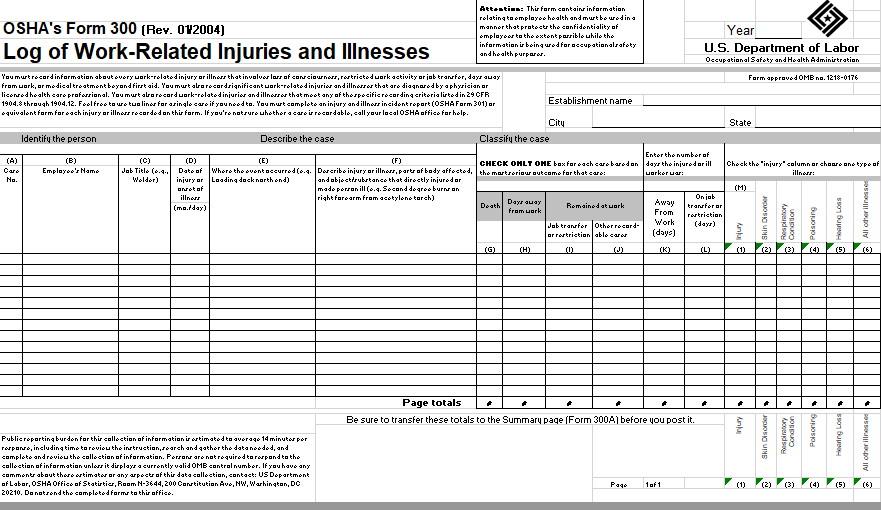
2. Record each injury or job-related illness on OSHA Form 300 (Log of Work-Related Injuries and Illnesses) using the instructions provided.

3. Prepare a supplementary record of occupational injuries and illnesses for recordable cases on OSHA Form 301 (Injury and Illness Incident Report).

4. Every year, prepare an annual summary using OSHA Form 300A (Summary of Work-Related Injuries and Illnesses). Post it no later than February 1, and keep it posted until May 1. A good place to post it is next to the OSHA Workplace
Poster.

5. Retain these records for at least five years. Periodically review these records to look for any patterns or repeat situations. These records can help you to identify high-risk areas that require your immediate attention.

Basic OSHA recordkeeping requirements address only injuries and illnesses, so you might consider expanding your own records to include all incidents, including those where no injury or illness resulted. This information may assist you in pinpointing unsafe conditions and/or procedures. Safety councils, insurance carriers and others can assist you in instituting such a system.

The employer is required to report to OSHA within eight hours of the accident, all work-related fatalities or multiple hospitalizations that involve three or more employees.

Even if your business is exempt from routine recordkeeping requirements, you may be selected by the Federal Bureau of Labor Statistics (BLS) or a related state agency for inclusion in an annual sample survey. You will receive a letter directly from the agency with instructions, if you are selected.


EXPOSURE RECORDS AND OTHERS

In addition to injury/illness records, certain OSHA standards require records on the exposure of employees to toxic substances and hazardous exposures, physical examination reports and employment records.

As you identify hazards, you will be able to determine whether these requirements apply to your workplace. Your records should be used in conjunction with your control procedures and with your self-inspection activity. They should not be considered merely as bookkeeping.


STARTING A SAFETY AND HEALTH MANAGEMENT SYSTEM: Creating a Plan

You can use this handbook to create a basic plan of action for starting a safety and health management system at your business. The action plan described in this section provides the most direct route to getting yourself organized to complete the Four-Point Program outlined in the previous section.

Decide to Start Now

The time to start your safety and health management system is now. You have a better picture of what constitutes a good safety and health program. Now you can address the practical concerns of putting these elements together and coming up with a program to suit your workplace.

Hopefully, you have been taking notes for your action plan as you reviewed the preceding description of the Four-Point Program. You should now be ready to decide what you want to accomplish and to determine what steps are necessary to achieve your goals. Next you need to determine how and when each step will be done and who will do it.

Your plan should consider your company's immediate needs and provide for ongoing, long-lasting worker protection. Once your plan is designed, it is important to follow through and use it in the workplace. You will then have a program to anticipate, identify and eliminate conditions or practices that could result in injuries and illnesses.

If you have difficulty deciding where to begin, a phone call to your state Consultation Program will help get you started. A state consultant will survey your workplace for existing or potential hazards. Then, if you request it, he or she will determine what you need to make your safety and health program effective. The consultant will work with you to develop a plan for making these improvements and to keep your program effective.

Whether you choose to work with a consultant or to develop your program yourself, many publications are available from your state on-site Consultation Program or from OSHA that spell out in greater detail the steps you can take to create an effective safety and health program for your workplace. The rewards for your efforts will be an efficient and productive workplace with a low level of loss and injury.


Designating Responsibility

You must decide who in your company is the most appropriate person to manage your safety and health system. Who can ensure that the program will become an integral part of your business? In many cases it will be you, the owner. Sometimes it will be a plant manager or key supervisor. It could even be an engineer, personnel specialist, or other staff member.

Whoever you choose should be committed to workplace safety and health, have the time to develop and manage the program, and be willing to take on the responsibility and accountability that goes with operating an effective program. The individual will need your full cooperation and support, but the ultimate responsibility for safety and health in your workplace rests on you.


Ask for Help

Federal occupational safety and health law allows a state to develop and operate its own occupational safety and health program in place of the Federal OSHA program. It is possible that the regulatory aspect of the law (setting of mandatory minimum standards and conducting inspections of workplaces) is being operated by your state government as opposed to Federal OSHA.

One of the first things to learn is which branch of government, Federal or state, has current jurisdiction over your business. If you are not sure what agency is responsible for administering workplace safety and health in your state, contact the nearest OSHA Area Office to find out. (See OSHA's website. You will need certain Federal OSHA publications (or comparable state publications) for use in your safety and health activities, such as:
  • OSHA Workplace Poster (Job Safety and Health Protection - OSHA 3165). You must display the Federal or state OSHA poster in your workplace. This poster is also available in Spanish (Job Safety and Health Protection OSHA-3167).
  • OSHA standards that apply to your business. You need to have a copy of all OSHA standards that apply to your type of business available for reference. (See Appendix D.) Standards are the regulations that OSHA uses to inspect for compliance and should be the baseline for your inspections in determining what to do when hazards are identified. Most businesses fall under OSHA's General Industry Standards. If you are involved with construction or maritime operations, you will need the standards that apply to these classifications. (In states with state-run occupational safety and health programs, use the appropriate state standards.)
  • Recordkeeping requirements and the necessary forms.
  • Occupational Safety and Health Act of 1970. You may want a copy of this legislation for reference.
Organize the Workplace

Poor housekeeping can contribute to low morale and sloppy work. Most safety action programs start with an intensive cleanup campaign in all areas of the workplace.

Get rid of unnecessary items; provide proper waste containers; store flammables properly; make sure exits are not blocked; mark aisles and passageways; provide adequate lighting, etc.

Get everyone involved and impress upon employees that you want to make your workplace safer, more healthful and more efficient.


Start Gathering Specific Facts About Your Situation

Before making changes in your safety and health operations, you should gather information about the current conditions and business practices that comprise your safety and health program. This information can help you identify problems and determine what is needed to solve them.

Your workplace assessment should be conducted by the person responsible for your safety and health management system and/or a professional safety and health consultant. The assessment consists of two major activities:

1. A comprehensive safety and health survey of your entire facility will identify any existing or potential safety and health hazards. This initial survey should focus on evaluating workplace conditions with respect to safety and health regulations and generally recognized safe and healthful work practices. It should include checking on the use of any hazardous materials, observing employee work habits and practices, and discussing safety and health problems with employees. See the Self-Inspection Checklists (at pages 18-39), to help you get a good start on creating this initial survey.

2. The second major activity is to assess your existing safety and health program and identify areas that work well and those that need improvement. You should gather as much information as you can that relates to safety and health management in
your workplace. You should include the following in this review:
  • Safety and health activities. Examine ongoing activities as well as those tried previously, company policy statements, rules (both work and safety), guidelines for proper work practices and procedures, and records of training programs.
  • Equipment. List your major equipment, what it is used for and where it is located. Special attention should be given to inspection schedules, maintenance activities, and plant and office layouts.
  • Employee capabilities. Make an alphabetical list of all employees, showing the date hired, their job descriptions, and experience and training.
  • Accident and injury/illness history. Review first aid cases and workers' compensation insurance payments and awards, and review your losses. Compare your insurance rate with others in your group. Give special attention to recurring accidents, types of injuries, etc.
After gathering facts, see if any major problem areas emerge such as interruptions in your normal operations, too many employees taking too much time off due to illness or injury, too many damaged products, etc. General help with this kind of problem identification can often be obtained from compensation carriers, local safety councils, trade associations, state agencies, major suppliers or similarly situated businesses in the same industry.

If you discover a major problem, see what can be done to solve it. Once a problem is identified, you can work on the corrective action or a plan to control the problem. Take immediate action and make a record of what you have done. Even if you find no major problems, don't stop there. Now it is time to develop a comprehensive safety and health program to avoid any major problems in the future.


Establish a Four-Point Safety and Health Program

The success of any workplace safety and health program depends on careful planning. This means that you must take the time to analyze what you want to accomplish and develop an action plan in order to attain your goals. From this standpoint, you can design a step-by-step process to take you from the idea stage to an effective safety and health management system.

The best way to create a safe and healthful workplace is to institute the Four-Point Program discussed at page 8 of this handbook.

Establish your management commitment and involve your employees. No safety and health program will work without this commitment and involvement. The first step is to designate a person to be responsible for your safety and health program.

Involve your employees as widely as possible from the beginning. They are most in contact with the potential and actual safety and health hazards at your worksite and will have constructive input on the development of your program. The ultimate success of your safety and health program will depend on their support.

Make sure your program assigns responsibility and accountability to all employees in your organization. A good safety and health program makes it clear that each and every employee, from you through the supervisory levels to the line worker, carries responsibility for his or her part of the program. Make safety and health duties clear and hold every individual accountable for his or her safety- and health-related duties.

Refer to the recommended actions to take in the Worksite Analysis paragraph at page 9. These will help start your program off on the right track. You will be building the foundation for a successful safety and health program.

Establish and regularly conduct a worksite analysis. A successful safety and health program depends on an accurate identification of all the hazards and potential hazards in your workplace. This is an ongoing process that includes routine self-inspections.

Create systems and procedures to prevent and control hazards identified through your worksite analysis. OSHA standards can be helpful because they address controls in order of effectiveness and preference. The hierarchy of controls is engineering, administrative, work practice and PPE. Whenever feasible, engineering, administrative or work practice controls should be instituted even if they do not eliminate the hazard or reduce exposure. Use of such controls in conjunction with PPE will help reduce the hazard or exposure to the lowest practical level. Where no standard exists, creative problem-solving and consultant resources may help you create effective controls. The basic formula for controlling workplace hazards, in order of preference, includes:
  • Eliminating the hazard from the machine, the method, the material or the facility.
  • Abating the hazard by limiting exposure or controlling it at its source.
  • Training personnel to be aware of the hazard and to follow safe work procedures to avoid it.
  • Prescribing PPE for protecting employees against the hazard and ensuring that they not only use it, but that they know how to use it correctly.
Establish and provide ongoing training for employees, supervisors and managers to ensure that everyone at your worksite can recognize hazards and how to control them.

These points are crucial to a safe and healthful workplace for you and your employees, making it more difficult for accidents to occur and for work-related health problems to develop.


Develop and Implement Your Action Plan

Developing an action plan to build a safety and health program around the four points can serve as a "road map" to take your program to where you want it to be. An action plan tells you what has to be done, the logical order in which to do it, who is
responsible and where you want to be when you finish. It describes problems and solutions, but is not ironclad. An action plan can and should be changed to correspond with changes in the workplace.

A good action plan has two parts:

1. A list of major changes or improvements to make your safety and health program effective. Each item should be prioritized, have a target date for completion and identify who is responsible for implementation.

2. A specific plan to implement each major change or improvement, including what you want to accomplish, the steps required, who will be assigned to do what and a schedule for completion. A worksheet to help you design an overall action plan and describe specific action steps appears in Appendix A.

Once a plan is established, put it into action, beginning with the highest priority item. Ensure that it is realistic, manageable and addresses the steps you have planned for that item. A detailed description of the steps required will help you keep track of your progress. Keep in mind that you can work on more than one item at a time and that priorities may change as other needs are identified or as your company's resources change.

Open communication with your employees is crucial to the success of your efforts. Their cooperation depends on them understanding what the safety and health program is all about, why it is important to them and how it affects their work. The more you do to involve them in the changes you are making, the smoother your transition will be.

Putting your action plan into operation at your workplace will be a major step toward implementing an effective safety and health program.

Remember, a safety and health program is a plan put into practice. Keep your program on track by periodically checking its progress and by calling on a state consultant when you need assistance.

Any good management system requires periodic review. Take a careful look at each component of your safety and health program to determine what is working well and what changes are needed. Once again, a state consultant can assist you in this area. Any necessary improvements can be turned into new safety and health objectives for the coming year. Developing new action plans to implement these improvements will continue progress toward an effective safety and health program, reduce your safety and health risks, and increase efficiency and profit.

Remember that it is important to document your activities. The best way to evaluate the success of your safety and health program is to have documentation of what you have done, which provides guidance on how you can make it work even
better.

Technical assistance may be available to you as a small business owner or manager through your insurance carrier; your fellow business-people; suppliers of your durable equipment and raw materials; the local safety council; and many local, state and Federal agencies, including the state on-site Consultation Programs and closest OSHA Area Office.

Establishing a quality safety and health management system will take time and involve some resources, but you should be pleased with the results. Employees will feel reassured because of your commitment to their safety and health on the job. You may save money through increased productivity and reduced workers' compensation insurance costs. You may gain increased respect in your community. The tangible and intangible rewards for a solid safety and health program far outweigh the cost of an accident, injury or workplace fatality.


SELF-INSPECTION

The most widely accepted way to identify hazards is to conduct safety and health inspections because the only way to be certain of an actual situation is to look at it directly from time to time.

Begin a program of self-inspection in your own workplace. Self-inspection is essential if you are to know where probable hazards exist and whether they are under control.

This section includes checklists designed to assist you in self-inspection fact-finding. The checklists can give you some indication of where to begin taking action to make your business safer and more healthful for all of your employees. These checklists are by no means all-inclusive and not all of the checklists will apply to your business. You might want to start by selecting the areas that are most critical to your business, then expanding your self-inspection checklists over time to fully cover all areas that pertain to your business. Remember that a checklist is a tool to help, not a definitive statement of what is mandatory. Use checklists only for guidance.

Don't spend time with items that have no application to your business. Make sure that each item is seen by you or your designee and leave nothing to memory or chance. Write down what you see or don't see and what you think you should do about it.

Add information from your completed checklists to injury information, employee information, and process and equipment information to build a foundation to help you determine what problems exist. Then, as you use the OSHA standards in your problem-solving process, it will be easier for you to determine the actions needed to solve these problems.

Once the hazards have been identified, institute the control procedures described at page 9 and establish your four-point safety and health program.


Self-Inspection Scope

Your self-inspections should cover safety and health issues in the following areas:
  • Processing, Receiving, Shipping and Storage - equipment, job planning, layout, heights, floor loads, projection of materials, material handling and storage methods, training for material handling equipment.
  • Building and Grounds Conditions - floors, walls, ceilings, exits, stairs, walkways, ramps, platforms, driveways, aisles.
  • Housekeeping Program - waste disposal, tools, objects, materials, leakage and spillage, cleaning methods, schedules, work areas, remote areas, storage areas.
  • Electricity - equipment, switches, breakers, fuses, switch-boxes, junctions, special fixtures, circuits, insulation, extensions, tools, motors, grounding, national electric code compliance.
  • Lighting - type, intensity, controls, conditions, diffusion, location, glare and shadow control.
  • Heating and Ventilation - type, effectiveness, temperature, humidity, controls, natural and artificial ventilation and exhausting.
  • Machinery - points of operation, flywheels, gears, shafts, pulleys, key ways, belts, couplings, sprockets, chains, frames, controls, lighting for tools and equipment, brakes, exhausting, feeding, oiling, adjusting, maintenance, lockout/tagout, grounding, work space, location, purchasing standards.
  • Personnel - training, including hazard identification training; experience; methods of checking machines before use; type of clothing; PPE; use of guards; tool storage; work practices; methods for cleaning, oiling, or adjusting machinery.
  • Hand and Power Tools - purchasing standards, inspection, storage, repair, types, maintenance, grounding, use and handling.
  • Chemicals - storage, handling, transportation, spills, disposals, amounts used, labeling, toxicity or other harmful effects, warning signs, supervision, training, protective clothing and equipment, hazard communication requirements.
  • Fire Prevention - extinguishers, alarms, sprinklers, smoking rules, exits, personnel assigned, separation of flammable materials and dangerous operations, explosion-proof fixtures in hazardous locations, waste disposal and training of personnel.
  • Maintenance - provide regular and preventive maintenance on all equipment used at the worksite, recording all work performed on the machinery and by training personnel on the proper care and servicing of the equipment.
  • PPE - type, size, maintenance, repair, age, storage, assignment of responsibility, purchasing methods, standards observed, training in care and use, rules of use, method of assignment.
  • Transportation - motor vehicle safety, seat belts, vehicle maintenance, safe driver programs.
  • First Aid Program/Supplies - medical care facilities locations, posted emergency phone numbers, accessible first aid kits.
  • Evacuation Plan - establish and practice procedures for an emergency evacuation, e.g., fire, chemical/biological incidents, bomb threat; include escape procedures and routes, critical plant operations, employee accounting following an evacuation, rescue and medical duties and ways to report emergencies.
Self-Inspection Checklists

These checklists are by no means all-inclusive. You should add to them or delete items that do not apply to your business; however, carefully consider each item and then make your decision. You should refer to OSHA standards for specific guidance that may apply to your work situation. (Note: These checklists are typical for general industry but not for construction or maritime industries.)

EMPLOYER POSTING

Is the required OSHA Job Safety and Health Protection Poster displayed in a prominent location where all employees are likely to see it?
Are emergency telephone numbers posted where they can be readily found in case of emergency?
Where employees may be exposed to toxic substances or harmful physical agents, has appropriate information concerning employee access to medical and exposure records and Material Safety Data Sheets (MSDSs) been posted or otherwise made readily available to affected employees?
Are signs concerning exit routes, room capacities, floor loading, biohazards, exposures to x-ray, microwave, or other harmful radiation or substances posted where appropriate?
Is the Summary of Work-Related Injuries and Illnesses (OSHA Form 300A) posted during the months of February, March and April?

RECORDKEEPING

Are occupational injuries or illnesses, except minor injuries requiring only first aid, recorded as required on the OSHA 300 log?
Are employee medical records and records of employee exposure to hazardous substances or harmful physical agents up-to-date and in compliance with current OSHA standards?
Are employee training records kept and accessible for review by employees, as required by OSHA standards?
Have arrangements been made to retain records for the time period required for each specific type of record? (Some records must be maintained for at least 40 years.)
Are operating permits and records up-to-date for items such as elevators, air pressure tanks, liquefied petroleum gas tanks, etc.?

SAFETY AND HEALTH PROGRAM

Do you have an active safety and health program in operation that includes general safety and health program elements as well as the management of hazards specific to your work-site?
Is one person clearly responsible for the safety and health program?
Do you have a safety committee or group made up of management and labor representatives that meets regularly and reports in writing on its activities?

OSHA HANDBOOK FOR SMALL BUSINESSES

Do you have a working procedure to handle in-house employee complaints regarding safety and health?
Are your employees advised of efforts and accomplishments of the safety and health program made to ensure they will have a workplace that is safe and healthful?
Have you considered incentives for employees or workgroups who excel in reducing workplace injury/illnesses?

MEDICAL SERVICES AND FIRST AID

Is there a hospital, clinic, or infirmary for medical care near your workplace or is at least one employee on each shift currently qualified to render first aid?
Have all employees who are expected to respond to medical emergencies as part of their job responsibilities received first aid training; had hepatitis B vaccination made available to them; had appropriate training on procedures to protect them from bloodborne pathogens, including universal precautions; and have available and understand how to use appropriate PPE to protect against exposure to bloodborne diseases?*
*Pursuant to an OSHA memorandum of July 1, 1992, employees who render first aid only as a collateral duty do not have to be offered pre-exposure hepatitis B vaccine only if the employer includes and implements the following requirements in his/her exposure control plan: (1) the employer must record all first aid incidents involving the presence of blood or other potentially infectious materials before the end of the work shift during which the first aid incident occurred; (2) the employer must comply with post-exposure evaluation, prophylaxis and follow-up requirements of the Bloodborne Pathogens standard with respect to "exposure incidents," as defined by the standard; (3) the employer must train designated first aid providers about the reporting procedure; (4) the employer must offer to initiate the hepatitis B vaccination series within 24 hours to all unvaccinated first aid providers who have rendered assistance in any situation involving the presence of blood or other potentially infectious materials.
If employees have had an exposure incident involving bloodborne pathogens, was an immediate post-exposure medical evaluation and follow-up provided?
Are medical personnel readily available for advice and consultation on matters of employees' health?
Are emergency phone numbers posted?
Are fully supplied first aid kits easily accessible to each work area, periodically inspected and replenished as needed?
Have first aid kits and supplies been approved by a physician, indicating that they are adequate for a particular area or operation?
Is there an eye-wash station or sink available for quick drenching or flushing of the eyes and body in areas where corrosive liquids or materials are handled?

FIRE PROTECTION

Is your local fire department familiar with your facility, its location and specific hazards?
If you have a fire alarm system, is it certified as required and tested annually?
If you have interior standpipes and valves, are they inspected regularly?
If you have outside private fire hydrants, are they flushed at least once a year and on a routine preventive maintenance schedule?
Are fire doors and shutters in good operating condition?
Are fire doors and shutters unobstructed and protected against obstructions, including their counterweights?
Are fire door and shutter fusible links in place?
Are automatic sprinkler system water control valves, air and water pressure checked periodically as required?
Is the maintenance of automatic sprinkler systems assigned to responsible persons or to a sprinkler contractor?
Are sprinkler heads protected by metal guards if exposed to potential physical damage?
Is proper clearance maintained below sprinkler heads?
Are portable fire extinguishers provided in adequate number and type and mounted in readily accessible locations?
Are fire extinguishers recharged regularly with this noted on the inspection tag?
Are employees periodically instructed in the use of fire extinguishers and fire protection procedures?

PERSONAL PROTECTIVE EQUIPMENT AND CLOTHING

Has the employer determined whether hazards that require the use of PPE (e.g., head, eye, face, hand, or foot protection) are present or are likely to be present?
If hazards or the likelihood of hazards are found, are employers selecting appropriate and properly fitted PPE suitable for protection from these hazards and ensuring that affected employees use it?
Have both the employer and the employees been trained on PPE procedures, i.e., what PPE is necessary for job tasks, when workers need it, and how to properly wear and adjust it?
Are protective goggles or face shields provided and worn where there is any danger of flying particles or corrosive materials?
Are approved safety glasses required to be worn at all times in areas where there is a risk of eye injuries such as punctures, abrasions, contusions, or burns?
Are employees who wear corrective lenses (glasses or contacts) in workplaces with harmful exposures required to wear only approved safety glasses, protective goggles, or use other medically approved precautionary procedures?
Are protective gloves, aprons, shields, or other means provided and required where employees could be cut or where there is reasonably anticipated exposure to corrosive liquids, chemicals, blood, or other potentially infectious materials? See the OSHA Bloodborne Pathogens standard, 29 CFR 1910.1030(b), for the definition of "other potentially infectious materials."
Are hard hats required, provided and worn  where danger of falling objects exists?
Are hard hats periodically inspected for damage to the shell and suspension system?
Is appropriate foot protection required where there is the risk of foot injuries from hot, corrosive, or poisonous substances, falling objects, crushing, or penetrating actions?
Are approved respirators provided when needed? (See 29 CFR 1910.134 for detailed information on respirators or check OSHA's website).
Is all PPE maintained in a sanitary condition and ready for use?
Are food or beverages consumed only in areas where there is no exposure to toxic material, blood, or other potentially infectious materials?
Is protection against the effects of occupational noise provided when sound levels exceed those of the OSHA Noise standard?
Are adequate work procedures, PPE and other equipment provided and used when cleaning up spilled hazardous materials?
Are appropriate procedures in place to dispose of or decontaminate PPE contaminated with, or reasonably anticipated to be contaminated with, blood or other potentially infectious materials?

GENERAL WORK ENVIRONMENT

Are all worksites clean, sanitary and orderly?
Are work surfaces kept dry and appropriate means taken to assure the surfaces are slip-resistant?
Are all spilled hazardous materials or liquids, including blood and other potentially infectious materials, cleaned up immediately and according to proper procedures?
Is combustible scrap, debris and waste stored safely and removed from the worksite promptly?
Is all regulated waste, as defined in the OSHA Bloodborne Pathogens standard (29 CFR 1910.1030), discarded according to Federal, state and local regulations?
Are accumulations of combustible dust routinely removed from elevated surfaces including the overhead structure of buildings, etc.?
Is combustible dust cleaned up with a vacuum system to prevent suspension of dust particles in the environment?
Is metallic or conductive dust prevented from entering or accumulating on or around electrical enclosures or equipment?
Are covered metal waste cans used for oily or paint-soaked waste?
Are all oil and gas-fired devices equipped with flame failure controls to prevent flow of fuel if pilots or main burners are not working?
Are paint spray booths, dip tanks, etc., cleaned regularly?
Are the minimum number of toilets and washing facilities provided and maintained in a clean and sanitary fashion?
Are all work areas adequately illuminated?
Are pits and floor openings covered or otherwise guarded?
Have all confined spaces been evaluated for compliance with 29 CFR 1910.146? (Permit required confined spaces.)

WALKWAYS

Are aisles and passageways kept clear and marked as appropriate?
Are wet surfaces covered with non-slip materials?
Are holes in the floor, sidewalk, or other walking surface repaired properly, covered, or otherwise made safe?
Is there safe clearance for walking in aisles where motorized or mechanical handling equipment is operating?
Are materials or equipment stored in such a way that sharp projections will not interfere with the walkway?
Are spilled materials cleaned up immediately?
Are changes of direction or elevations readily identifiable?
Are aisles or walkways that pass near moving or operating machinery, welding operations, or similar operations arranged so employees will not be subjected to potential hazards?
Is adequate headroom provided for the entire length of any aisle or walkway?
Are standard guardrails provided wherever aisle or walkway surfaces are elevated more than 30 inches (76.20 centimeters) above any adjacent floor or the ground?
Are bridges provided over conveyors and similar hazards?

FLOOR AND WALL OPENINGS

Are floor openings guarded by a cover, a guardrail, or equivalent on all sides (except at stairways or ladder entrances)?
Are toeboards installed around the edges of permanent floor openings where persons may pass below the opening?
Are skylight screens able to withstand a load of at least 200 pounds (90.7 kilograms)?
Is the glass in windows, doors, glass walls, etc., subject to possible human impact, of sufficient thickness and type for the condition of use?
Are grates or similar type covers over floor openings such as floor drains designed to allow unimpeded foot traffic or rolling equipment?
Are unused portions of service pits and pits not in use either covered or protected by guardrails or equivalent?
Are manhole covers, trench covers and similar covers, and their supports designed to carry a truck rear axle load of at least 20,000 pounds (9,072 kilograms) when located in roadways and subject to vehicle traffic?
Are floor or wall openings in fire-resistant construction provided with doors or covers compatible with the fire rating of the structure and provided with a self-closing feature when appropriate?

STAIRS AND STAIRWAYS

Do standard stair rails or handrails on all stairways have at least four risers?
Are all stairways at least 22 inches (55.88 centimeters) wide?
Do stairs have landing platforms not less than 30 inches (76.20 centimeters) in the direction of travel and extend 22 inches (55.88 centimeters) in width at every 12 feet (3.6576 meters) or less of vertical rise?
Do stairs angle no more than 50 and no less than 30 degrees?
Are stairs of hollow-pan type treads and landings filled to the top edge of the pan with solid material?
Are step risers on stairs uniform from top to bottom?
Are steps slip-resistant?
Are stairway handrails located between 30 inches (76.20 centimeters) and 34 inches (86.36 centimeters) above the leading edge of stair treads?
Do stairway handrails have at least 3 inches (7.62 centimeters) of clearance between the handrails and the wall or surface they are mounted on?
Where doors or gates open directly on a stairway, is a platform provided so the swing of the door does not reduce the width of the platform to less than 21 inches (53.34 centimeters)?
Are stairway handrails capable of withstanding a load of 200 pounds (90.7 kilograms), applied within 2 inches (5.08 centimeters) of the top edge in any downward or outward direction?
Where stairs or stairways exit directly into any area where vehicles may be operated, are adequate barriers and warnings provided to prevent employees from stepping into the path of traffic?
Do stairway landings have a dimension measured in the direction of travel at least equal to the width of the stairway?
Is the vertical distance between stairway landings limited to 12 feet (3.6576 meters) or less?

ELEVATED SURFACES

Are signs posted, when appropriate, showing the elevated surface load capacity?
Are surfaces that are elevated more than 30 inches (76.20 centimeters) provided with standard guardrails?
Are all elevated surfaces beneath which people or machinery could be exposed to falling objects provided with standard 4-inch (10.16centimeter) toeboards?
Is a permanent means of access and egress provided to elevated storage and work surfaces?
Is required headroom provided where necessary?
Is material on elevated surfaces piled, stacked, or racked in a manner to prevent it from tipping, falling, collapsing, rolling, or spreading?
Are dock boards or bridge plates used when transferring materials between docks and trucks or railcars?

EXITING OR EGRESS - EVACUATION

Are all exits marked with an exit sign and illuminated by a reliable light source?
Are the directions to exits, when not immediately apparent, marked with visible signs?
Are doors, passageways or stairways that are neither exits nor access to exits, but could be mistaken for exits, appropriately marked "NOT AN EXIT," "TO BASEMENT," "STOREROOM," etc.?
Are exit signs labeled with the word "EXIT" in lettering at least 5 inches (12.70 centimeters) high and the stroke of the lettering at least l/2inch (1.2700 centimeters) wide?
Are exit doors side-hinged?
Are all exits kept free of obstructions?
Are at least two means of egress provided from elevated platforms, pits, or rooms where the absence of a second exit would increase the risk of injury from hot, poisonous, corrosive, suffocating, flammable, or explosive substances?
Are there sufficient exits to permit prompt escape in case of emergency?
Are special precautions taken to protect employees during construction and repair operations?
Is the number of exits from each floor of a building and the number of exits from the building itself appropriate for the building occupancy load?
Are exit stairways that are required to be separated from other parts of a building enclosed by at least 2-hour fire-resistive construction in buildings more than four stories in height, and not less than 1-hour fire-resistive construction elsewhere?
Where ramps are used as part of required exiting from a building, is the ramp slope limited to 1 foot (0.3048 meter) vertical and 12 feet (3.6576 meters) horizontal?
Where exiting will be through frameless glass doors, glass exit doors, storm doors, etc., are the doors fully tempered and meet the safety requirements for human impact?

EXIT DOORS

Are doors that are required to serve as exits designed and constructed so that the path of exit travel is obvious and direct?
Are windows that could be mistaken for exit doors made inaccessible by means of barriers or railings?
Are exit doors able to be opened from the direction of exit travel without the use of a key or any special knowledge or effort when the building is occupied?
Is a revolving, sliding, or overhead door prohibited from serving as a required exit door?
Where panic hardware is installed on a required exit door, will it allow the door to open by applying a force of 15 pounds (6.80 kilograms) or less in the direction of the exit traffic?
Are doors on cold storage rooms provided with an inside release mechanism that will release the latch and open the door even if the door is padlocked or otherwise locked on the outside?
Where exit doors open directly onto any street, alley, or other area where vehicles may be operated, are adequate barriers and warnings provided to prevent employees from stepping into the path of traffic?
Are doors that swing in both directions and are located between rooms where there is frequent traffic provided with viewing panels in each door?

PORTABLE LADDERS

Are all ladders maintained in good condition, joints between steps and side rails tight, all hardware and fittings securely attached, and moveable parts operating freely without binding or undue play?
Are non-slip safety feet provided on each metal or rung ladder, and are ladder rungs and steps free of grease and oil?
Are employees prohibited from placing a ladder in front of doors opening toward the ladder unless the door is blocked open, locked, or guarded?
Are employees prohibited from placing ladders on boxes, barrels, or other unstable bases to obtain additional height?
Are employees required to face the ladder when ascending or descending?
Are employees prohibited from using ladders that are broken, have missing steps, rungs, or cleats, broken side rails, or other faulty equipment?
Are employees instructed not to use the top step of ordinary stepladders as a step?
When portable rung ladders are used to gain access to elevated platforms, roofs, etc., does the ladder always extend at least 3 feet (0.9144 meters) above the elevated surface?
Are employees required to secure the base of a portable rung or cleat type ladder to prevent slipping, or otherwise lash or hold it in place?
Are portable metal ladders legibly marked with signs reading "CAUTION - Do Not Use Around Electrical Equipment" or equivalent wording?
Are employees prohibited from using ladders as guys, braces, skids, gin poles, or for other than their intended purposes?
Are employees instructed to only adjust extension ladders while standing at a base (not while standing on the ladder or from a position above the ladder)?
Are metal ladders inspected for damage?
Are the rungs of ladders uniformly spaced at 12 inches (30.48 centimeters) center to center?

HAND TOOLS AND EQUIPMENT

Are all tools and equipment (both company and employee-owned) used at the workplace in good condition?
Are hand tools, such as chisels, punches, etc., which develop mushroomed heads during use, reconditioned or replaced as necessary?
Are broken or fractured handles on hammers, axes and similar equipment replaced promptly?
Are worn or bent wrenches replaced?
Are appropriate handles used on files and similar tools?
Are employees aware of hazards caused by faulty or improperly used hand tools?
Are appropriate safety glasses, face shields, etc., used while using hand tools or equipment that might produce flying materials or be subject to breakage?
Are jacks checked periodically to ensure they are in good operating condition?
Are tool handles wedged tightly into the heads of all tools?
Are tool cutting edges kept sharp so the tool will move smoothly without binding or skipping?
Are tools stored in a dry, secure location where they cannot be tampered with?
Is eye and face protection used when driving hardened or tempered studs or nails?

PORTABLE (POWER OPERATED) TOOLS AND EQUIPMENT

Are grinders, saws and similar equipment provided with appropriate safety guards?
Are power tools used with proper shields, guards, or attachments, as recommended by the manufacturer?
Are portable circular saws equipped with guards above and below the base shoe?
Are circular saw guards checked to ensure that they are not wedged up, leaving the lower portion of the blade unguarded?
Are rotating or moving parts of equipment guarded to prevent physical contact?
Are all cord-connected, electrically operated tools and equipment effectively grounded or of the approved double insulated type?
Are effective guards in place over belts, pulleys, chains and sprockets on equipment such as concrete mixers, air compressors, etc.?
Are portable fans provided with full guards or screens having openings 1/2 inch (1.2700 centimeters) or less?
Is hoisting equipment available and used for lifting heavy objects, and are hoist ratings and characteristics appropriate for the task?
Are ground-fault circuit interrupters provided on all temporary electrical 15 and 20 ampere circuits used during periods of construction?
Are pneumatic and hydraulic hoses on power-operated tools checked regularly for deterioration or damage?

ABRASIVE WHEEL EQUIPMENT GRINDERS

Is the work rest used and kept adjusted to within 1/8 inch (0.3175 centimeter) of the wheel?
Is the adjustable tongue on the top side of the grinder used and kept adjusted to within 1/4 inch (0.6350 centimeters) of the wheel?
Do side guards cover the spindle, nut and flange and 75 percent of the wheel diameter?
Are bench and pedestal grinders permanently mounted?
Are goggles or face shields always worn when grinding?
Is the maximum revolutions per minute (rpm) rating of each abrasive wheel compatible with the rpm rating of the grinder motor?
Are fixed or permanently mounted grinders connected to their electrical supply system with metallic conduit or other permanent wiring method?
Does each grinder have an individual on and off control switch?
Is each electrically operated grinder effectively grounded?
Are new abrasive wheels visually inspected and ring tested before they are mounted?
Are dust collectors and powered exhausts provided on grinders used in operations that produce large amounts of dust?
Are splash guards mounted on grinders that use coolant to prevent the coolant from reaching employees?
Is cleanliness maintained around grinders?

POWER-ACTUATED TOOLS

Are employees who operate power-actuated tools trained in their use and required to carry a valid operator's card?