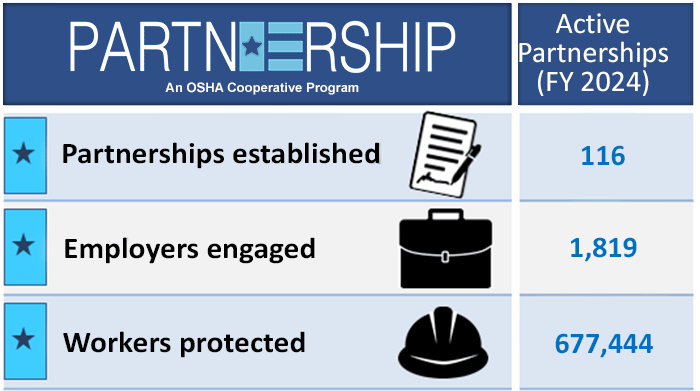
The Occupational Safety and Health Administration (OSHA) agrees to a partnership
with (name of partnering entity) to enhance workplace safety and health through the strategy of
implementing fully written safety and health programs. The overall goal will be to reduce serious
injuries and illnesses (using as a minimum one percent per year) and to reduce the occurrence of the
four major hazards in the categories of falls, electrocutions, struck-by and caught-between (using as
a minimum ten percent per year). Measurements will be obtained from OSHA 300 logs and self inspections.
Employers who are willing to accept this program will receive OSHA assistance and annual on-site
enforcement inspections (in accordance with approved protocols) in lieu of programmed inspections.
Selection criteria for participants:
- Executive Commitment: Participants agree to submit a letter stating executive commitment to
develop and maintain a safety and health program for construction projects (and associated staff
housing, if applicable). The letter should be from the Chief Executive Officer (CEO) or equivalent.
It should make clear such a program is a priority for the CEO and that he (or she) will personally
track programs and hold managers accountable for administration of the program. The letter should be
addressed to the OSHA Regional Administrator and endorsed by each member company. A similar letter
should be addressed to managers and employees and posted for two months in the workplace. Such
letters must also be translated (in writing) in the language of the workers.
- Commitment to Develop a Formal Safety and Health Program. The program will be in writing, will be
shared with all employees, will be given to OSHA within 6 months of an employer becoming a member of
the partnership, and will address the elements described below:
Element 1: Employee Involvement
Management will ensure employee involvement with the safety and health program in each of the
following methods:
- Establishment of a joint employer/employee safety and health team. The team should meet at
least monthly to identify construction hazards, training needs, and other related issues. Valid
ideas and/or recommendations will receive reasonable and timely action. Identified imminent danger
hazards (those immediately likely to cause death or serious injury) which are identified by the
committee will be immediately corrected by management.
- An employee representative shall participate in any scheduled safety inspection/audit---unless
performed by independent consultants/contractors.
- Employees will be informed via posted notice of hazards and corrections of any safety/health
inspections/audits.
- Employee representatives will, as a part of their regular duties, be allowed to accompany a
compliance officer on any OSHA inspection.
- Company safety and health programs, inspections/audits, hazard information, and informational
safety and health posters will be in the language of affected workers---as well as English.
- Employees will have the right to submit safety and health complaints or recommendations to
management. Valid complaints will be corrected within a reasonable time.
- Employees will not be discriminated against as a result of participation in the safety and
health program, submitting complaints, or exercising their rights under the OSH Act.
- This partnership does not preclude employees and/or employees from exercising any right
provided under the OSHA Act (or, for federal employees, 29 CFR 1960), nor does it abrogate any
responsibility to comply with the Act.
Element 2: Periodic Safety and Health Inspections/Audits
- Company agrees to conduct periodic workplace inspections/audits for the purpose of identifying
and correcting safety and health hazards.
- Inspections/audits will be conducted as frequently as deemed necessary by the company, but in
no case less than once every twelve months.
- The company may utilize the services of a consultant or contractor to perform these
inspections/audits in addition to or in lieu of their own inspection/audit.
- An employee representative will participate in the inspection/audit of the workplace and staff
housing, unless such inspection/audit is conducted by a consultant or contractor.
- Company agrees to correct all hazards identified in these inspections/audits within a
reasonable time.
Element 3: Training and Education:
Participating companies agree to:
- Train their workforce (in the language of the workers) in the details of their safety and
health program.
- Train workers on fall protection and prevention of electrocutions, caught-between and struck-by
accidents
- Train select personnel in basic first aid and CPR
- Train personnel in hazard communications.
- Make material safety data sheets (MSDSs) available to any requesting employee.
- Train workers in any other aspects that will enable them to do their jobs safely.
Element 4: Employment of a Safety and Health Professional
Participating companies agree to have a full time safety official whose job will be to manage the
safety and health program, reduce injuries/illnesses, and ensure compliance with OSHA standards.
This official will have the authority to affect safety and health corrections and to shut down
operations that pose an imminent danger risk.
Element 5: Recordkeeping Injury/Illness Analysis
- Company will maintain records of recordable injuries and illnesses as required by OSHA.
- Annual summaries of injuries/illnesses will be posted for the information of workers as
required by OSHA.
- The safety and health official will analyze injury and illness trends to identify work practice
improvements or material modifications necessary to prevent accidents.
- OSHA will collect 300 log data from each company at the time of the annual on site enforcement
visit. This data will be used to track overall reduction of injuries and illnesses in order to
measure the long term effectiveness of the partnership.
- Other information collected or reviewed during the annual enforcement visits.
Element 6: Safety and Health Program Analysis
- The safety and health official will prepare an annual analysis of the company's safety and
health program. This will include a summary of all major hazards found and corrected through
inspection and safety committee efforts, those still uncorrected, injury/illness trends, and
recommendations for safety and health improvements.
- The analysis will be submitted to the CEO or equivalent.
Element 7: Cooperation with OSHA
- Participants agree to allow OSHA to inspect without delay in the event of a catastrophe,
fatality, complaint or referral.
- Participants agree to allow OSHA to conduct annual on site enforcement inspections in
accordance with this partnership agreement. These inspections may result in citations and
penalties being issued to the company.
- Participants agree to cooperate with OSHA during all inspections and to share information on
its safety and health program, program analysis, recordkeeping data, and internal inspection/audit
results.
- Participants agree to allow an employee representative to participate on OSHA inspections and
to allow interviews with workers.
- Participants will post notices of imminent danger, when issued by OSHA, and then will
immediately correct the hazards or voluntarily remove workers from exposure.
OSHA Commitment and Partnership Benefits
- So long as the company is meeting the intent of the partnership, OSHA verification inspections
will be limited in scope to a review and evaluation of the safety and health program, analysis of
injuries, interviews of select employees to verify quality, and then a focused inspection to
verify compliance. Obvious hazards will be cited.
- OSHA will limit the scope of accident and complaint investigations to information relevant to
the accident or complaint (including records) and will not expand the inspection to other areas
unless serious hazards are obvious and will not expand the inspection to other areas, unless there
are obvious hazards.
- OSHA will endeavor to support the company in reasonable requested training.
- OSHA will furnish technical advice, publications and training material to the employer upon
request. Such requests will not cause an OSHA inspection.
- Informal complaints (unsigned)---participant will have an opportunity to resolve such
complaints; however, if corrections are inadequate, an inspection may be made to compel
compliance.
- OSHA will arrange quarterly conference calls amount all active participants in the partnership.
Partnership Limitations
It is stipulated that partnering employers remain subject to OSHA inspections and investigations in
accordance with established Agency procedures.
- OSHA will conduct accident investigations.
- OSHA will conduct investigations of formal (signed) complaints and informal (unsigned)
complaints that do not result in voluntary and adequate corrections by the employer.
Partnership Review: Partnership agreement will be reviewed in the event of a
fatality, catastrophic event, or poor performance identified in an OSHA evaluation. The review will
determine whether the agreement will continue.
Partnership Evaluation: The partnership evaluated by the OSHA Area office on an annual basis, in
accordance with established Agency procedures. OSHA may ask that the following information be
provided by the company during the on-site verification inspection, for review or collection by OSHA
- OSHA 300 Log of Injuries and Illnesses
- exposure assessment data for all hazardous chemicals to which employees may exposed
- number of employee complaints, number of training sessions held, and number of employees and
supervisors/managers trained
- number of and results of safety /health audits and inspections, which may include hazards
identified and corrected.
- documentation of employee involvement, including minutes of safety meeting
- documentation of communication between management and employees (may include computer memos,
feedback on each suggestion, or other appropriate documentation
- consultation visits received
- participation in health or safety seminars
Partnership Management: The individual partnership establishments will be responsible for providing
the required data to the Compliance Assistance Specialist at the OSHA office which coordinates the
agreement. Annual evaluations will be completed and submitted in a timely manner to DCSP. Conference
calls will be held on a quarterly basis and face-to-face meetings will be held annually as resources
permit.
Partnership Termination
This partnership will expire five years from the date of signing.
For non-signatory participants of the strategic partnership, OSHA may terminate the participant's
membership at any time with written notice. Additionally, the participant may withdraw from the
strategic partnership at any time with a written notice to OSHA.
OSHA will terminate the agreement for any sustained willful violation or any sustained
failure-to-abate situations.
OSHA will terminate the agreement for any major identified program discrepancy that is not improved
within a reasonable and agreed upon time frame.
OSHA will terminate the agreement in the event of proven and unresolved discrimination against
employees who exercise their protected safety and health rights under the OSH Act.
Signatures
Kathy Delaney
OSHA Dallas Area Director |
Jeffrey Hicks
President Llano Utilities |
Joseph Scott
Vice President Llano Utilities |
Frank Killingsworth
Vice President KCK Utility Construction |
Edward Richardson
Vice President Starling Richardson |
Dean Wingo
OSHA Fort Worth Area Director |
|