Powered Industrial Trucks
Each year, tens of thousands of injuries related to powered industrial trucks (PIT), or forklifts, occur in US workplaces. Many employees are injured when lift trucks are inadvertently driven off loading docks, lifts fall between docks and an unsecured trailer, they are struck by a lift truck, or when they fall while on elevated pallets and tines. Most incidents also involve property damage, including damage to overhead sprinklers, racking, pipes, walls, and machinery. Unfortunately, most employee injuries and property damage can be attributed to lack of safe operating procedures, lack of safety-rule enforcement, and insufficient or inadequate training.
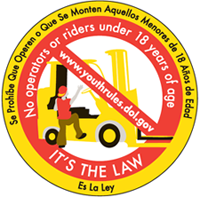
 |
It is a violation of Federal
law for anyone UNDER 18 years of age to operate a forklift or for anyone OVER 18 years of age who is not properly trained and certified to do so.
|
Powered industrial trucks are addressed in specific standards for the general industry, marine terminals, and longshoring.
OSHA Standards
This section highlights OSHA standards, Federal Registers (rules, proposed rules, and notices), directives (instructions for compliance officers),
and standard interpretations (official letters of interpretation of the standards) related to powered industrial trucks. OSHA compliance information that applies
to specific activities is also available, including:
Loading and
Unloading, Working with
Hazardous Materials, and Vehicle
Maintenance. For additional citation information by industry group, see Frequently Cited OSHA Standards.
Note: Twenty-five states, Puerto Rico and the Virgin
Islands have
OSHA-approved State Plans and have adopted their own standards and
enforcement policies. For the most part, these States adopt standards that are
identical to Federal OSHA. However, some States have adopted different standards
applicable to this topic or may have different enforcement policies.
General Industry (29 CFR 1910)
Marine Terminals (29 CFR 1917)
-
1917 Subpart C, Cargo handling gear and equipment
- 1917.43, Powered industrial trucks
- 1917.44,
General rules applicable to vehicles
- 1917.50, Certification of marine terminal material handling devices
(See also mandatory appendix I, of this part)
-
Longshoring Industry.
OSHA Publication 2232, (2001).
Also available as a 480 KB PDF, 291 pages.
Contains all the safety and health standards concerning the marine terminal and longshoring
industries, as contained in 29 CFR 1917 and 29 CFR 1918) as of June 30, 2000.
Longshoring (29 CFR 1918)
-
1918 Subpart G, Cargo handling gear and equipment other than ship's gear
- 1918.65, Mechanically-powered vehicles used aboard vessels
-
Longshoring Industry.
OSHA Publication 2232, (2001).
Also available as a 480 KB PDF, 291 pages.
Contains all the safety and health standards concerning the marine terminal and longshoring
industries, as contained in 29 CFR 1917 and 29 CFR 1918) as of June 30, 2000.
Federal Registers
Directives
-
29 CFR 1910.147 - The Control of Hazardous Energy - Enforcement Policy and
Inspection Procedures. CPL 02-00-147, (2008, February 11).
-
Shipyard Employment "Tool Bag" Directive. CPL 02-00-142, (2006, August 3).
Provides guidance for implementing intervention and inspection programs to
reduce or eliminate workplace hazards related to shipyard employment.
-
Longshoring and Marine Terminals "Tool Shed" Directive. CPL 02-00-139,
(2006, May 23). Provides guidance concerning the application of occupational
safety and health standards in longshoring and marine terminal activities, and
ensures consistent enforcement of OSHA's marine cargo handling industry
standards (29 CFR 1917 and
29 CFR 1918).
- Compliance Assistance for the Powered Industrial Truck Operator Training Standards.
CPL 02-01-028 [CPL 2-1.28A], (2000, November 30).
- Chocking of Tractor Trailer under the Powered Industrial Truck Standard.
CPL 02-01-030 [CPL 2-1.30], (1999, October 19). Establishes policy to
ensure proper enforcement of
29 CFR 1910.178(k)(1) and
29 CFR 1910.178(m)(7).
- Logging Operations, Inspection Procedures and Interpretive Guidance Including Twelve Previously Stayed Provisions. CPL 02-01-022 [CPL 2-1.22], (1996,
September 27). Clarifies the use of overhead guards for
forklifts.
- Electrical Safety-Related Work Practices -- Inspection Procedures and Interpretation Guidelines. STD 01-16-007 [STD 1-16.7], (1991, July 1).
States that employees using industrial
trucks under overhead lines must be trained on the electrical
hazards involved.
- 29 CFR 1910.151(c), Medical Services and First Aid; 29 CFR 1926.50 and .51, Medical Service and First Aid, and ... STD 01-08-002 [STD 1-8.2], (1982, March
8). Provides guidelines regarding eye wash and body flushing
facilities required for immediate emergency use in electric storage battery
charging and maintenance areas.
- 29 CFR 1910.178(k)(1) and (m)(7): Mechanical Means to Secure Trucks or Trailers to a Loading Dock. STD 01-11-007 [STD 1-11.7], (1981, August 5).
Discusses the use of mechanical means to secure trucks or
trailers to a loading dock in situations where they provide
the equivalent protection of wheel chocks.
- Disparity Between 29 CFR 1910.178(c)(2)(vii) and Table N-1, 29 CFR 1910.178(c)(2).
STD 01-11-006 [STD 1-11.6A], (1979, February 19).
- 29 CFR 1910.178(g)(2); Battery Charging Stations for Fork Lifts and Other Industrial Trucks. STD 01-11-004 [STD 1-11.4], (1978, October 30).
Clarifies
29 CFR 1910.178(g)(2) as it applies to
"battery charging" areas where power industrial truck batteries are charged
only.
- 29 CFR 1910.178(m)(6) Powered Industrial Trucks; Truck Operations. STD
01-11-003 [STD 1-11.3], (1978, October 30). Provides guidelines on citing
29 CFR 1910.178(m)(6) when trucks use a door opening device for opening or closing
railroad freight car doors.
-
Search all available
directives
on powered industrial trucks.
Standard Interpretations
- Evaluation of what is considered a safe speed to operate powered industrial trucks (forklifts). (2004, November 4).
- Powered industrial trucks must not be placed into service, or must be removed from service, when any condition exists that adversely affects the safety of the vehicle. (2004, September 13).
- Requirements for the sound level of a warning device (horn) located on a forklift. (2004, August 13).
- Fall protection requirements for elevated platforms of powered industrial trucks; body belts versus harnesses. (2004, June 28).
- Written approval requirements for powered industrial truck modifications and additions that affect capacity or safe operation. (2004, March 30).
- Batteries in powered industrial trucks must be secured horizontally and/or vertically. (2003, March 18).
- Acceptability of using extensible boom forklifts to lift steel joist for spreading by hand. (2003, January 23).
- Powered industrial truck addition/modification approval and marking requirements. (2002, July 3).
- Clarification of PIT requirements covering: fall protection and safety platforms, seatbelts, LP-gas storage, smoking, and eye wash stations. (2002, March 8).
- Host employers may require site-specific forklift training of visiting workers. (1999, October 28).
- Clarification of systems for electronic access to MSDSs. (1999, February 18).
- Reporting over-the-road fatalities;
refusing entry and employee interviews to an OSHA inspector; and OSHA's policy associated with seat belts on forklift trucks. (1997, May 28).
- Cross-view back-up mirrors on delivery trucks. (1997, January 24).
- Clarification regarding the policy for the use of seat belts on powered industrial trucks in general industry. (1996, December 11).
-
Search all available
standard interpretations on powered industrial trucks.
Other Federal Standards
Other federal agencies have standards relevant to powered industrial trucks.
The following is an overview of the major laws enacted, regulations, training requirements, and other resources:
US Department of Labor (DOL)
Note: These are NOT OSHA regulations. However, they do
provide guidance from their originating organizations related to worker
protection.
US Department of Transportation (DOT)
Note: These are NOT OSHA regulations. However, they do
provide guidance from their originating organizations related to worker
protection.
DOT regulations focus on the transportation requirements
for "hazardous materials," which include low-level radioactive waste. These
regulations govern, for example, the types of containers that must be used for
various materials, labeling on containers and vehicles, and papers that must
accompany each shipment.
- 49 CFR 107,
Hazardous materials program procedures
- 49 CFR 171,
General information, regulations, and definitions
-
49 CFR 172,
Hazardous materials table, special provisions, hazardous materials
communications, emergency response information, training requirements and security plans. In 1992 Congress passed amendments to 49 CFR, Subpart H of Part 172.704 and 49 CFR 173.1. Congress directed
OSHA to develop a standard to protect workers involved with loading, unloading,
handling, marking, labeling, preparing, or representing or transporting hazardous materials that are listed in DOT's List of Hazardous
Substances and Reportable Quantities:
-
49 CFR 172.704,
Training Requirements.
Specify differing amounts of training depending on job function and role.
- 49 CFR 172.704(a)(1). General awareness/familiarization training
- 49 CFR 172.704 (a)(3). Safety training
- 49 CFR 172.704 (a)(4). Security awareness training
- 49 CFR 172.704 (a)(5). In-depth security training
- OSHA-required, EPA-required and other training provided by employers may be used to satisfy the training requirements
specified in 49 CFR 172.704(a) to the extent that such training addresses the training components.
- 49 CFR 173,
Shippers — General requirements for shipments and packagings. The training requirements specify differing amounts of classroom
training for workers subject to the standards according to their job functions and roles they may serve.
- 49 CFR
174, Carriage by rail
- 49 CFR
175, Carriage by aircraft
- 49 CFR
176, Carriage by vessel
- 49 CFR
177, Carriage by public highway
- 49 CFR
178, Specifications for packagings
-
PHMSA - Regulations. Pipeline and Hazardous Materials Safety
Administration (PHMSA).
Environmental Protection Agency (EPA)
Note: These are NOT OSHA regulations. However, they do
provide guidance from their originating organizations related to worker
protection.
EPA's mission is to protect human health and to safeguard
the natural environment — air, water, and land — upon which life depends. The
agency also works with industries and all levels of government in a wide variety
of voluntary pollution prevention programs and energy conservation efforts.
- Forklifts, Generators, and Compressors (gasoline/propane).
Covers nonroad spark-ignition engines over 19 KW(25 hp). Includes many
types of equipment, including forklifts and generators.
- Frequently Asked Questions: Environmental Impacts of Newly Regulated Nonroad Engines [24 KB PDF, 5 pages].
EPA420-F-02-033, (2002, September). Answers questions on nonroad engines powered by gasoline, liquid propane gas (LPG), or compressed natural gas rated over 25 horsepower,
including forklifts which are used in commercial and industrial applications,
that are now covered by EPA
emission standards.
-
Air Resources Board (ARB). California Environmental Protection Agency.
Radioactive Material
It is estimated that more than 4 million packages containing radioactive material are transported in
commerce annually within the United States. To date, there have been no known deaths or serious injuries to transport workers,
emergency services personnel, or the general public as a result of the radioactive nature of the material. This safety record
can be attributed to the proper packaging of radioactive material and the effectiveness of the transportation safety standards
and regulations.
- 40 CFR 264,
Standards for owners and operators of hazardous waste treatment, storage, and
disposal facilities. Includes the training requirements of 40 CFR 264.16.
Nuclear Regulatory Commission (NRC)
Note: These are NOT OSHA regulations. However, they do
provide guidance from their originating organizations related to worker
protection.
Radioactive Material
NRC regulations establish licensing requirements for low-level
radioactive waste disposal facilities and standards for packaging and shipping low-level radioactive waste. A commercial
low-level radioactive waste disposal facility must obtain a license from the NRC before it can begin
operations.
10 CFR 61 establishes the standards for
issuing a license to a low-level waste disposal facility. The training requirements for workers are:
- 10 CFR 19,
Notices, instructions and reports to workers: inspection and investigations.
Includes the training requirements found in
10 CFR 19.12.
National Consensus
Voluntary standards help the government fulfill its
mandate to ensure public safety and health and provide sound technical solutions
to today’s critical issues without creating additional cost and operations
burdens. Organizations that
develop national consensus standards include:
Industrial Truck Standards Development Foundation (ITSDF)
Note: These are NOT OSHA regulations. However, they do
provide guidance from their originating organizations related to worker
protection.
B56 Standards. Copies of these standards are available for free download upon request:
- B56.1-2009, Safety Standard for Low and High Lift Trucks. (2010).
Defines the safety requirements relating to the elements of design, operation, and maintenance of low lift and high lift powered
industrial trucks controlled by a riding or walking operator, and intended for use on compacted, improved surfaces.
- B56.6-2005, Safety Standard for Rough Terrain Forklift
Trucks. (2005).
Defines the safety requirements relating to the elements of design, operation, and maintenance of rough terrain forklift trucks. These trucks are
intended for operation on unimproved natural terrain as well as the disturbed terrain of construction sites.
- B56.6-2011, Safety Standard for Rough Terrain Forklift
Trucks (Reaffirmation of ANSI/ITSDF B56.6-2005). (2011).
- B56.10-2006, Safety Standard for Manually Propelled High Lift Industrial Trucks. (2006).
Defines the safety requirements relating to the elements
of design, operation, and maintenance of manually propelled high lift industrial trucks controlled by a walking operator, and intended for use on level, improved surfaces.
- B56.11.4-2005,
Hook-Type Forks and Fork Carriers for Powered Industrial Forklift Trucks. (2005).
Encompasses standards relative to hook-type fork carriers and the attaching elements of fork arms and load
handling attachments for forklift trucks, in relation to manufacturers' rated capacities of trucks up to and
including 11,000 kg (24,000 lb).
- B56.11.6-2005, Evaluation of Visibility From Powered Industrial Trucks. (2005).
Establishes the conditions, procedures, equipment, and acceptability criteria for evaluating visibility from
powered industrial trucks. It applies to internal combustion engine powered and electric high lift, counterbalanced,
sit-down rider industrial trucks up to and including 10,000 kg (22,000 lb) capacity, inspection, testing, and
acceptance, thereby fostering universal use of export pallets in international commerce with minimal restrictions.
- B56.11.7-2005, Liquefied Petroleum Gas (LPG) Fuel
Cylinders (Horizontal or Vertical) Mounting - Liquid Withdrawal. (2005). Establishes dimensions for LPG fuel cylinders used on
powered industrial trucks.
- B56.11.7-2011, Liquid Propane Gas (LPG) Fuel
Cylinders (Horizontal or Vertical) Mounting - Liquid Withdrawal. (2011). For Powered industrial trucks EFFECTIVE 8/22/12.
National Fire Protection Association (NFPA)
Note: These are NOT OSHA regulations. However, they do
provide guidance from their originating organizations related to worker
protection.
- 30, Flammable and Combustible
Liquids Code. (2008). Identifies how to properly use, contain,
and store flammable and combustible liquids.
- 58,
Liquefied Petroleum Gas Code.
(2008). Identifies requirements for all large tank installations, operating and maintenance procedures, and fire safety analyses.
- 505,
Fire Safety Standard for Powered Industrial Trucks Including Type Designations, Areas of Use, Conversions,
Maintenance, and Operations. (2006). Identifies industrial truck types for use in hazardous
(classified) locations, truck conversions, and maintenance and operation requirements for industrial trucks powered
by electric motors or internal combustion engines.
- Fire Protection Guide to Hazardous Materials.
(2010). Contains much of the data contained in NFPA documents derived from
hundreds of reference sources.
- 49, Hazardous Chemicals Data. Identifies 325 chemicals in
Material Safety Data Sheet (MSDS) format.
- 325, Fire Hazard Properties of Flammable Liquids, Gases, and Volatile Solids.
Identifies
over 1,300 chemicals in tabular format listing various data.
- 491, Guide for Hazardous Chemical Reactions. Identifies 3,550 dangerous mixtures documented
from real-life incidents.
- 497,
Classification of Flammable Liquids, Gases, or Vapors and of Hazardous
(Classified) Locations for Electrical Installations in Chemical Process Areas.
(2008). Contains detailed guidelines and diagrams that assist in
Class I hazardous (classified) area classification for the purpose of properly
selecting and installing electrical equipment that will not be an ignition
source in environments where flammable or combustible liquids, gases, or vapors
are processed or handled.
- 704,
Standard for the Identification of the Fire Hazards of Materials for Emergency
Response. (2007). Provides a readily recognized and easily
understood system, the "Diamond Hazard", for identifying specific hazards and their severity. Hazards are identified
using spatial, visual, and numerical methods to describe in simple terms the relative hazards of a material. It
addresses the health, flammability, instability, and related hazards that may be presented as short-term, acute
exposures that are most likely to occur as a result of fire, spill, or similar emergency.
- Data extracted from:
- 77,
Recommended Practice on Static Electricity. (2007). Identifies combustibility parameters and static electric
characteristics.
- 430,
Code for the Storage of Liquid and Solid Oxidizers. (2004). Identifies oxidizer classifications for 90 chemicals.
- 499,
Classification of Combustible Dusts and of Hazardous (Classified) Locations for
Electrical Installations in Chemical Process Areas. (2008). Identifies parameters to determine the degree and extent of
hazardous locations for dusts, including National Electric Code (NEC) groups.
International Organization for Standardization (ISO)
Note: These are NOT OSHA regulations. However, they do
provide guidance from their originating organizations related to worker
protection.
-
Technical Committee (TC) 110, Industrial Trucks
-
TC 110/SC1, General terminology
- 5053:1987, Powered industrial trucks -- Terminology
-
TC 110/SC2, Safety of powered industrial trucks
- 509:1996, Pallet trucks -- Principal dimensions
- 938:1975, Hand-operated stillage trucks -- Principal dimensions
- 1044:1993, Industrial trucks -- Lead-acid traction batteries for electric trucks -- Preferred voltages
- 1074:1991, Counterbalanced fork-lift trucks -- Stability tests
- 1756:1975, Industrial trucks -- Dimensions of stillages -- Connection gauge
- 2328:2007, Fork-lift trucks -- Hook-on type fork arms and fork arm carriages -- Mounting dimensions
- 2330:2002, Fork-lift trucks -- Fork arms -- Technical characteristics and testing
- 2331:1974, Fork lift trucks -- Hook-on type fork arms -- Vocabulary
- 3184:1998, Reach and straddle fork-lift trucks -- Stability tests
- 3287:1999, Powered industrial trucks -- Symbols for operator controls and other displays
- 3691:1980, Powered industrial trucks -- Safety code
- 3739-3:1995, Industrial tyres and rims -- Part 3: Rims
- 5057:1993, Industrial trucks -- Inspection and repair of fork arms in service on fork-lift trucks
- 5766:1990, Pallet stackers and high-lift platform trucks -- Stability tests
- 5767:1992, Industrial trucks operating in special condition of stacking with mast tilted forward -- Additional stability test
- 6055:2004, Industrial trucks -- Overhead guards -- Specification and testing
- 6292:1996, Powered industrial trucks and tractors -- Brake performance and component strength
- 8379:1998, Rough terrain trucks -- Stability tests
- 10525:1997, Counterbalanced trucks handling freight containers of 6 m (20 ft) length and above -- Additional stability tests
- 13562-1:2000, Industrial variable-reach trucks -- Part 1: Stability tests
- 13562-2:2001, Industrial variable-reach trucks -- Part 2: Additional stability tests for trucks handling freight containers of 6 m length and above
- 13563-1:2001, Single side loading fork-lift trucks -- Part 1: Stability tests
- 13563-2:2001, Single side loading fork-lift trucks -- Part 2: Additional stability tests for trucks handling freight containers of 6 m length and above
- 15794:2001, Bi-directional and multi-directional fork-lift trucks -- Stability tests
- 15870:2000, Powered industrial trucks -- Safety signs and hazard pictorials -- General principles
- 15871:2000, Industrial trucks -- Specifications for indicator lights for container handling and grappler arm operations
-
TC 110/SC3, Castors and wheels
-
TC 110/SC4, Rough-terrain trucks
Hazards and Solutions
The National Institute for Occupational Safety and Health
(NIOSH) investigations of forklift-related deaths indicate that many workers and
employers may not be aware of the risks of operating or working near forklifts
and are not following the procedures set forth in OSHA standards, consensus
standards, or equipment manufacturer's guidelines. Generally, reducing the risk
of forklift incidents requires comprehensive worker training, systematic traffic
management, a safe work environment, a safe forklift, and safe work practices.
The following references aid in recognizing and controlling some of the hazards
associated with powered industrial trucks (PIT).
Potential Hazards
Case Studies
Possible Solutions
- Longshoring
and Marine Terminals: Fatal Facts.
OSHA. Consists of guidesheets that address the most frequent sources
of fatalities in the maritime cargo handling industry, including forklift truck operations.
- Protecting Young Workers: Prohibition Against Young Workers Operating Forklifts.
OSHA Safety and Health Information Bulletin (SHIB), (2003, September 30). Informs employers that youth employment regulations (29 CFR 570)
promulgated under the Fair Labor Standards Act prohibit most employees under the age of 18 years from operating forklifts for
non-agricultural operations and reminds employers that all forklift operators must be trained and certified.
- Materials Handling and Storage [559 KB PDF*, 41 pages]. OSHA Publication 2236, (Revised 2002)
- Shipyard Industry [561 KB PDF*, 220 pages]. OSHA Publication 2268, (1998).
- Worker Safety Series - Warehousing.
OSHA Pocket Guide.
Also available as a 277 KB
PDF, 15 pages. Includes a section on forklift hazards and solutions.
- Public Warehousing and Storage.
OSHA Industry Profile.
Also available as a 1 MB PDF,
11 pages.
Includes information related to forklifts in the public warehousing and storage industry.
- Preventing Injuries and Deaths of Workers Who Operate
or Work Near Forklifts. National Institute for Occupational Safety and
Health (NIOSH) Publication No. 2001-109 (Alert), (2001, June). Includes
information on forklift fatality data, current standards, case reports,
recommendations, and instructs
workers in the steps they may take to protect themselves.
- Departmentwide Program Evaluation of the Hazardous
Materials Transportation Programs: Final Report [297 KB PDF, 172 pages]. US Department of
Transportation (DOT), (2000, March),
Additional Information
Training
- Powered Industrial Trucks.
OSHA, (1999). Includes downloadable outreach training materials for the powered industrial truck
operator training standard.
- National Ag Safety Database (NASD)
- Forklift Safety Guide [3 MB
PDF, 42 pages]. Washington State Department of Labor and Industries. Provides
resources and regulations for truck operator safety.
- How to
Use the Hazardous Materials Regulations CFR 49 Parts 100 to 185.
US Department of Transportation (DOT), Pipeline and Hazardous Materials Safety
Administration (PHMSA). Provides a simple overview of the complex set of hazardous materials
regulations and includes a compliance checklist.
- Training Requirements. US Department of Transportation (DOT), Pipeline and
Hazardous Materials Safety Administration (PHMSA). Defines a HAZMAT employee as someone who works for a HAZMAT employer and directly affects HAZMAT transportation safety, including:
An owner-operator of a motor vehicle which transports HAZMAT; a person (including a self-employed person) who:
- Loads, unloads, or handles HAZMAT;
- Tests, reconditions, repairs, modifies, marks, or otherwise represents packagings as qualified for use in the transportation of HAZMAT;
- Prepares HAZMAT for transportation;
- Is responsible for safety of transporting HAZMAT; or
- Operates a vehicle used to transport HAZMAT.
HAZMAT employer means a company with employees involved in:
- Transporting HAZMAT in commerce;
- Causing HAZMAT to be transported or shipped in commerce; or
- Representing, marking, certifying, selling, offering, reconditioning, testing, repairing,
or modifying packagings as qualified for use in the transportation of HAZMAT.
(The term "HAZMAT employer" also includes any department, agency, or instrumentality of the United States, a State, a
political subdivision of a State, or an Indian tribe engaged in offering or transporting HAZMAT in commerce).
Note:
To find additional
material, perform a search using the keywords "forklift
safety" or "forklift training" with any search engine to
find many private companies who provide forklift safety
training services, including videos, written programs,
operation training, and more.
Other Resources
- Industrial Truck Association (ITA)
- National Lumber and Building Material Dealers Association (NLBMDA)
- Risk Management. The safety subcommittee provides several resources in the area
of forklift safety to help dealers train employees and enhance company
practices.
-
Saddle Creek Corporation Provides Forklift and Golf Cart Drivers with Eye
Protection. OSHA Success Story. Discusses Saddle Creek
Corporation's (a warehouse and logistics company) implementation of a formal
eye protection program for its forklift and golf cart operators.
OSHA Cooperative Programs
OSHA cooperative programs support agency outreach and assistance efforts. OSHA's
consultation projects, partners, and allies serve as ambassadors for OSHA, disseminating information and best practices.
OSHA cooperative programs include:
- Alliance Program
- Find a Cooperative Program
-
Voluntary Protection Programs (VPP).
Identifies a select group of facilities that have
designed and implemented outstanding health and safety programs. Star participants meet all VPP requirements. Merit
participants have demonstrated the potential and willingness to achieve Star program status, and are implementing
planned steps to fully meet all Star requirements.
Accessibility Assistance: Contact the OSHA Directorate of Technical Support and Emergency Management at (202) 693-2300 for assistance accessing PDF materials.
*These files are provided for downloading.
|