


Heat
Prevention » Heat Hazard Recognition
There are many factors that have a role in creating an occupational heat stress risk to workers. These factors include:
- Environmental conditions (such as air temperature, humidity, sunlight, and air speed), especially on sequential days.
- Presence of heat sources (e.g., hot tar ovens or furnaces) in the work area.
- Level of physical activity, i.e., the workload leading to body heat production.
- Use of clothing or protective gear that can reduce the body’s ability to lose excess heat.
- Individual/personal risk factors.
Workload considerations are described at length in the OSHA Technical Manual: Heat Stress. Common values given for categories of work are included in the table on Workload.
You should consider the above factors when evaluating heat stress risk to workers.
Heat-related illness prevention starts by determining if a heat hazard is present in the workplace.
Two heat sources contribute to the risk of heat-related illness.
- Environmental heat is produced by warm or hot surroundings.
- Metabolic heat, generated by the body, is related to workload (physical activity).
To determine workers' total heat stress, employers must assess both of the above heat sources.
Employers should compare the total heat stress to published occupational heat guidance. This step allows employers to determine if the work conditions are too hot. Employers should be aware of any heat advisories from the National Weather Service. They should know that workers may experience heat stress at temperatures much lower than public heat advisories.
Remember: Physical labor increases the heat experienced by workers. Sports physiologists recognize that heat-related illness may occur, surprisingly, at low to moderate temperatures, including below 65°F when workload is very heavy (Armstrong 2007).
- Environmental Heat
-
Environmental heat is more than just temperature. Four factors contribute to heat stress in workers:
- Air temperature.
- Humidity. High relative humidity makes it difficult for the body to cool itself through sweating.
- Radiant heat from sunlight or artificial heat sources such as furnaces.
- Air movement. In most situations, wind helps workers cool off.
An environmental heat assessment should account for all of these factors. OSHA recommends the use of wet bulb globe temperature (WBGT) monitor to measure workplace environmental heat.
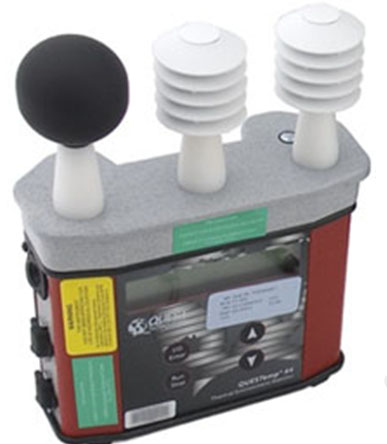
WBGT devices contain three different thermometers:
- A dry bulb thermometer to measure the ambient air temperature.
- A natural wet bulb thermometer to measure the potential for evaporative cooling.
- A black globe thermometer to measure radiant heat.
The WBGT instrument should be placed close to the work location. For example, if the work is in direct sunlight, then the WBGT instrument should be in the sun. Employers should always follow the WBGT manufacturer's instructions about setup, calibration, and use.
WBGT has important advantages over other environmental heat measurements. One major advantage is that WBGT accounts for all four major environmental heat factors — temperature, humidity, radiant heat, and wind. In contrast, standard thermometers only assess one factor (air temperature). Heat Index is another common way to measure heat stress. It is measured in the shade and combines air temperature and relative humidity to represent how hot the conditions feel at rest. The heat index does not account for the effects of wind, sunlight, radiant heat sources, or workload. Air (dry bulb) temperature also ignore relative humidity. All these factors can influence the total heat stress experienced by workers.
Workplace environmental heat should be measured on-site using WBGT meters. Use of heat index is a less desirable substitute. While local weather reports based on meteorological data from observation stations can be useful, the readings from these stations may not reflect the conditions at the specific worksite. Heat conditions at the worksite may be different for multiple reasons, from cloud cover and humidity to local heat sinks. The potential error increases with distance from the weather station.
In addition to possible distance-based errors, weather reports can be inaccurate if the worksite has features that affect heat conditions. These features include:
- Indoor work — A weather report cannot gauge conditions inside a building.
- Direct sunlight — Weather services measure temperature and Heat Index in the shade. Work in the sun may be considerably hotter. Direct sunlight can increase Heat Index by up to 13.5°F (7.5°C).
- Heat sources — Weather reports cannot account for the heat generated by fires, hot tar or other materials, ovens, or other hot equipment, or heat-absorbing surfaces such as roads and roof surfaces.
- Wind blockage — Some worksites may be hotter than surrounding areas because of structures that block air movement. Examples include trenches and bowl-shaped athletic stadiums.
- Reflective material — Water, metal, or other materials can reflect sunlight onto workers.
At worksites with the above features, weather reports are unlikely to provide accurate estimates of environmental heat. Employers should use an on-site measurement such as WBGT.
NIOSH, ACGIH, the U.S. military, and many athletic organizations recommend WBGT for measurement of heat stress in workers and athletes. Some of these guidelines can be found in the Additional Resources.
OSHA has compiled a set of tools that facilitate estimation of WBGT from historical weather data.
Use of Heat Index for Screening
The Heat Index does not measure worksite heat as accurately as WBGT. Employers should not rely on Heat Index alone for the most accurate hazard assessment. Some employers may find the Heat Index helpful as part of more comprehensive workplace hazard assessment. Therefore, do not rely solely on the Heat Index reported by weather forecasts for your safety at work, as it may underestimate your actual risk.
Outdoor workers have died of heat stroke when the day's maximum Heat Index was only 86°F. OSHA has found that less severe heat-related illnesses can happen at even lower Heat Index values. Employers who choose to monitor the Heat Index should be aware of the heat-related illness risk for workers below the national and local weather service heat advisory warnings for the general public.
The NIOSH/OSHA Heat App uses the Heat Index, a screening tool. It does not replace a more accurate WBGT-based hazard assessment which is the core tool used by occupational health professionals (ACGIH 2017, NIOSH 2016).
- Metabolic Heat and Workload (Physical Activity Level)
-
Most heat-related illnesses affect workers who do strenuous physical activity. When workers engage in intense work, their bodies create heat. This "metabolic" heat combines with environmental heat (from temperature, sunlight, humidity, etc.) so workers' core temperature can rise to dangerous levels.
To prevent a hazardous combination of environmental and metabolic heat, employers should be aware of workers' activity level. Workload can be classified as light, moderate, heavy, or very heavy.
- Light: Sitting or standing with minimal arm and leg work.
- Moderate: Continuous modest intensity, such as light pushing/pulling or normal walking.
- Heavy: Intense upper body work such as carrying loads or sawing.
- Very heavy: Intense activity at an almost maximum pace.
Heavy and very heavy work carry the highest risk of heat-related illness.
The following table shows more examples of activities in each workload category.
Level of Workload / Physical Activity * Examples Metabolic Rate in Watts, “typical” recognizing that different ways of doing the same task may lead to dramatically different wattage Rest - Sitting
- Thinking
- 115
Light - Sitting with minimal hand and arm work
- Sewing
- Writing or drawing
- Driving a car
- Occasional or slow walking
- Stooping, crouching, or kneeling
- Standing watch
- 180
Moderate - Pushing and pulling light carts
- Hammering nails
- Picking fruit or vegetables
- Continuous normal walking
- Driving or operating mobile equipment
- Raking
- Mopping or vacuuming floors
- Scraping, painting, or plastering
- Laundry/dry cleaning
- Tapping and drilling
- Machining
- Molding
- Packaging
- Laboratory work
- Cooking
- General carpentry
- Using hand tools
- 300
Heavy - Intense arm and trunk work
- Carrying loads
- Shoveling
- Sawing or heavy carpentry
- Roofing
- Pushing and pulling heavy carts or wheelbarrows
- Fast walking (> 4 mph)
- Landscaping
- Casting
- Manual raising and lowering loads
- Stacking lumber
- Truck and automobile repair
- Waxing and buffing by hand
- Welding
- Heavy item assembly
- Grinding and cutting
- Drilling rock or concrete
- Mixing cement
- Felling trees
- 415
Very heavy - Any activity done at near maximum pace
- Climbing stairs, ladder, or ramp
- Using an axe
- Intense shoveling or digging
- Sledgehammer use
- Stacking concrete
- Brick or stone masonry
- Firefighting
- Rapid marching or physical fitness training
- 520
* Workers who are overweight or obese might produce more metabolic heat than other workers who perform the same tasks. The above table assumes a 70-kg (154-pound) worker.
More detailed information about workload can be found in the Additional Resources. For example, an online compendium of physical activities, the Eastman Kodak Human Factors Handbook (1986), the Threshold Limit Value documentation from the American Conference of Governmental Industrial Hygienists (2017), all demonstrate ways to estimate workload including formulas to estimate metabolic heat categories by specific task elements.
Estimating each worker's workload is important. More protections are necessary for workers who do intense labor (e.g. labor activities that elevate a worker's heart rate and respiration rate through exertion). These workers should be given frequent rest breaks and work should be scheduled in the cooler part of the day. When in doubt about a worker's physical activity level, assume a higher workload or consult a qualified occupational safety and health professional.
- Determination of Whether the Work is Too Hot
-
To figure out if heat stress is too high, employers should consider the job, the environment, and the worker.
- First estimate the workload as shown above.
- Next measure the environmental heat using WBGT or a similar method.
- If the worker is wearing clothes or protective equipment that can impair heat dissipation, then add clothing adjustment factors to the measured WBGT. This process yields an "effective WBGT."
- Determine whether the worker is acclimatized to heat or not. In general, assume that workers are unacclimatized if they have been doing the job for less than 1-2 weeks.
- Use the following tables to determine whether the total heat stress is hazardous.
First consult this table, which is a simplified version of recommendations from NIOSH and ACGIH:
Table 1. Simplified heat exposure recommendations.
Effective WBGT (°C) Unacclimatized workers Acclimatized workers Below 70°F (21°C) Low risk of heat-related illness Low risk of heat-related illness 70 to 77°F(21 to 25°C) Strenuous work possibly unsafe Low risk of heat-related illness Above 77°F (25°C) High risk of heat-related illness with strenuous work Strenuous work possibly unsafe Note: Effective WBGT equals measured WBGT plus any clothing adjustment factors.
- Clothing Adjustment Factors
-
Certain types of clothing, especially protective gear, can trap heat and make workers feel much hotter than the measured temperature suggests. To account for this, we add a 'clothing adjustment factor' to the WBGT measurement to get the 'effective WBGT,' which is a better indicator of how hot the worker actually feels.
Type of Clothing Clothing Adjustment Factor – This amount must be added to the measured WBGT when determining heat stress. Work clothing (baseline) 0 Cloth coveralls 0 Spunbound melt-blown synthetic (SMS) coveralls 0.9°F (0.5°C) Polyolefin coveralls 1.8°F (1°C) Double-layer cloth clothing 5.4°F (3°C) Limited-use vapor-barrier coveralls 19.8°F (11°C) Table adapted from NIOSH guidelines (2016).
If Table 1 indicates that the heat stress is potentially unsafe, a more detailed hazard assessment is warranted. Use Table 2 or OSHA’s Heat Stress Calculator to determine whether the total heat stress is too high.
Table 2. Heat stress recommendations, adapted from NIOSH guidelines (2016).
Workload Limit for Unacclimatized Workers (Action Limit) Limit for Acclimatized Workers (Threshold Limit Value) Effective WBGT Light 28°C (82.4°F) 30°C (86°F) Moderate 25°C (77°F) 28°C (82.4°F) Heavy 23°C (73.4°F) 26°C (78.8°F) Very heavy 21°C (69.8°F) 25°C (77°F)