


Flavorings-Related Lung Disease
Overview
Highlights
- Diacetyl and Substitutes. OSHA Worker Alert, (November 2010).
- Occupational Exposure to Flavoring Substances: Health Effects and Hazard Control. OSHA Safety and Health Information Bulletin (SHIB), (October 14, 2010).
- Sampling and Analytical Methods. OSHA.
- Acetoin Diacetyl. Method 1012, (November 2008).
- 2,3-Pentanedione. Method 1016, (July 2010).
- Hazard Communication Guidance for Diacetyl and 2,3-Pentandione. Section 8.3.7.2 of NIOSH’s Criteria for a Recommended Standard: Occupational Exposure to Diacetyl and 2,3-Pentandione, (2016).
In 2000, NIOSH conducted an investigation of exposures at a microwave popcorn manufacturing plant in Missouri.1, 2 Public health officials contacted NIOSH because a cluster of former employees of the facility had developed a rare lung disease called bronchiolitis obliterans. The majority of employees diagnosed with bronchiolitis obliterans had been exposed to mixtures of butter flavoring chemicals. Evaluations of employees working in the plant revealed high rates of both respiratory symptoms and abnormal lung function.1 The investigation concluded that there was "a risk for occupational lung disease in workers with inhalation exposure to butter flavoring chemicals".2
Investigations of other workplaces have also shown that employees that use or manufacture certain flavorings have developed similar health problems.3 Similar findings were also reported in workers exposed in the manufacture of diacetyl.3 Because many of the cases have been associated with popcorn manufacturing plants, the term "popcorn lung" has often been used to describe the respiratory symptoms and fixed obstructive lung disease seen in these employees. Although much of the research and attention has been focused on butter flavorings, employees who are involved in the use or manufacture of other types of flavorings, such as strawberry, caramel, vanilla, and butterscotch, may also be at risk.3 Research is continuing in other industries, such as the investigations that NIOSH is doing at coffee production plants.3, 6
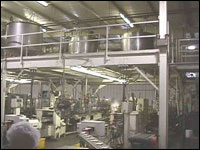
Flavorings can be either natural or manmade. Some are simple and made up of only one ingredient, but others are complex mixtures of several substances. Employees may be exposed to flavorings in the form of vapors, dusts, or mists.4 There are many different types of flavorings and most have not been tested for respiratory toxicity. The Food and Drug Administration (FDA) regulates the safety of food additives for consumption, but it does not require safety testing of other routes relevant to occupational exposure, such as inhalation. Research continues to determine if certain components or combinations of flavorings are associated with pulmonary disease.
Flavorings commonly contain diacetyl or its structurally similar substitute, 2,3-pentanedione. NIOSH established recommended exposure limits (RELs) of 5 ppb for diacetyl and 9.3 ppb for 2,3-pentanedione as 8-hour time weighted averages (TWAs). NIOSH also recommended 15-minute short-term exposure limits (STELs) of 25 ppb for diacetyl and 31 ppb for 2,3-pentanedione. The higher REL for 2,3-pentanedione was based on analytical limitation.3 The American Conference of Governmental Industrial Hygienists set a threshold limit value (TLV)® of 0.010 ppm as an 8-hour time weighted average and a STEL of 0.020 ppm for diacetyl (ACGIH 2012).5 There are currently no specific OSHA standards for occupational exposure to flavorings, diacetyl, or 2,3-pentanedione. However, OSHA standards regulating all workplaces offer protection to workers exposed to these substances.
NIOSH has also expressed concern about other volatile and reactive flavorings that could potentially have toxic effects that are similar to those caused by diacetyl and 2,3-pentandione exposure. NIOSH recommends controlling exposures to those flavorings with assistance from occupational safety and health professionals and by following recommendations in their criteria document for diacetyl and 2,3-pentandione.3
Standards
There are currently no specific OSHA standards for occupational exposure to butter-flavoring, diacetyl, or 2,3-pentanedione. However, OSHA standards regulating all workplaces offer protection to workers exposed to these substances.
Health Effects
Describes the health effects of flavorings-related lung disease, diagnosis and treatment.
Diacetyl and 2,3-Pentandione
Provides exposure information for diacetyl and 2,3-Pentadione.
Hazards and Solutions
Provides resources for recognizing and controlling hazards related to flavorings-related lung disease.
Additional Resources
Provides links and references to additional resources related to flavorings-related lung disease.
1 Kreiss K. et al. "Clinical bronchiolitis obliterans in workers at a microwave-popcorn plant." New England Journal of Medicine 347.5(2002): 330-330.
2 NIOSH, (2006). Gilster-Mary Lee Corporation, Jasper, Missouri National Institute for Occupational Safety and Health (NIOSH) Health Hazard Evaluation Report. HETA 2000-0401-299, (January 2006).
3 NIOSH, (2016). Criteria for a recommended standard: occupational exposure to diacetyl and 2,3-pentanedione. U.S. Department of Health and Human Services (DHHS), National Institute for Occupational Safety and Health (NIOSH) Publication No. 2016-111, (October 2016).
4 NIOSH Alert. Preventing Lung Disease in Workers who Use or Make Flavorings. U.S. Department of Health and Human Services (DHHS), National Institute for Occupational Safety and Health (NIOSH) Publication No. 2004-110, (December 2003).
5 ACGIH. 2012 TLVs® and BEIs®: threshold limit values for chemical substances and physical agents and biological exposure indices. Cincinnati, Ohio: American Conference of Governmental Industrial Hygienists (2012).
6 NIOSH, (2017). Evaluation of exposures and respiratory health at a coffee processing facility. NIOSH Health Hazard Evaluation Report No. 2015-0147-3266. (January 2017).