|
 |
 |
 |
 |
 |
|
|
|
|
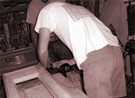
The
operation consists of a two-person team working
around a clamping system to build base cabinets.
Stock material is loaded onto the clamp and
secured into place by gluing and nailing. Both
team members participate in all aspects of the
operation. Each person has two different glue guns
and a nail gun. A faceplate is first positioned
into the clamp and glue is applied. The side
panels are set in and clamped into place. Support
blocks are glued and nailed in place. More glue is
applied and the top and bottom are put into place.
Exposed surfaces are glued and the back panel is
set into place. The back is then nailed into place
and the cabinet is lifted to the conveyer.
Potential
Hazard:
- Use of an extended wrist with finger force
to activate the trigger mechanism during
gluing can cause injury.
Possible Solutions:
- Educate the operator on the importance of
maintaining a neutral wrist while performing
repetitive motions.
- Redesign tools that make it easy for the
operator to maintain a neutral wrist position.
Potential Hazard:
- Ulnar deviation of the wrist with finger
force to activate trigger mechanism of nail
gun can cause injury.
Possible Solutions:
- Provide a step to elevate the employee and
make it easier to maintain a neutral wrist
position.
- Educate the operator on the importance of
maintaining a neutral wrist while performing
repetitive motions.
- Realign the work surface to allow for a
neutral wrist position while performing the
task. Design a nail gun with a power grip to
be used in these situations.
Potential Hazard:
- Workers abduction of their arms to reach
above shoulder height to get stock for
construction of cabinet. Problem also exists
when these bins are filled with feed stock.
Potentially harmful loads are being elevated
from waist height to head height. In addition,
there are excessive finger and thumb pinch
grip force movements, with ulnar deviation of
the wrist while stocking the upper bins.
Twisting of the body while lifting creates a
torquing situation on the back vertebrae.
Possible Solutions:
- Realign storage areas for feed stock so
reaches above shoulder height or bending over
to get material is not necessary.
- Educate employees in proper lifting
techniques.
Potential Hazard:
- Using the hand as a mallet to pound and
force components into position can cause
injury.
Possible Solutions:
- Provide mallets to use when force is needed
to adjust portion of parts.
- Train employees in the proper use of mallets
where force is needed.
Potential Hazard:
- Extended reaches and bending when gluing
causes strain on the lower back and shoulder
area.
Possible Solutions:
- Realign the work surface for easier access
without excessive reaches.
- Have employees do only their half of cabinet
to eliminate excessive reaches.
- Evaluate the feasibility of raising the work
surface for early stages of cabinet
construction and lowering it for final stages.
|
|
 |
|
|
|
The cabinets
come down the conveyer, the surfaces are cleaned,
and a template is used to drill guide holes for
hinge screws. The door that already has the hinge
on it is then attached to the cabinet.
Potential Hazard:
- Extending the wrist while cleaning,
drilling, and holding the template can cause
injury.
Possible Solutions:
- Educate the operator on the importance of
maintaining a neutral wrist while performing
repetitive motions.
Potential Hazard:
- Bending over at the waist to work on cabinet
hardware from the top can cause injury.
Possible Solutions:
- Reposition the worker in front of the
cabinet for tasks done within the cabinet.
Potential Hazard:
- Bending over to pick up drawers for
installation into cabinet can cause injury.
Possible Solutions:
- Have drawers come in on conveyer at waist
height to minimize bending.
- Stack drawers on pallets that could be
placed on a lifting table to prevent bending.
Potential Hazard:
- Using a palm pinch grip to lift a door and
abducting the elbow and holding the door above
shoulder height to support right hand doors
while hinges are screwed into place can cause
injury.
Possible Solutions:
- Use two-man teams to install the doors. Have
one person hold the door in position while the
other secures the hinge in place.
- Design a clamp on the hinge so the door does
not need to be held while the screws are
secured.
- Provide a side bar for screw guns so both
hands can be used during operation.
Potential Hazard:
- Deviating the wrist while securing the top
and bottom hinges of larger cabinets can cause
injury.
Possible Solutions:
- Provide movable platforms to bring employees
up to a level where they can perform the job
in an ergonomically safe manner.
- Educate the operator on the importance of
maintaining a neutral wrist while performing
repetitive motions.
|
|
 |
|
|
|
Potential
Hazard:
- As crew gun creates excessive force on the
wrist and shoulder during operation.
Possible Solutions:
- Suspend the screw gun from an assist sling
to reduce the force required to lift the gun.
Potential Hazard:
- Excessive bending to place hardware into
cabinets can cause injury.
Possible Solutions:
- Remove boxes from under conveyer line to
allow employee better access to work area.
|
|
 |
|
|
|
The
operation builds large wall units. These are built
on a rack that holds the materials at about a
30-degree angle.
Potential Hazard:
- Extending the reach with the arm above
shoulder height and supporting the weight of
the nailing gun can cause injury.
Possible Solutions:
- Reposition equipment to allow easier access
to all sides of the cabinet.
- Provide stools or platforms to allow workers
to elevate themselves and gain better access
to work.
Potential Hazard:
- Deviation of the wrist along with force
which is required for activation of the nail
gun.
Possible Solutions:
- Educate the operator on the importance of
maintaining a neutral wrist while performing
repetitive motions.
- Institute the procedures mentioned above.
|
|
 |
|
|
|
The
operators place a face plate into the clamp and
apply glue to several of the surfaces. The top and
bottom are set in place and nailed. The shelving
area is secured in place with screws and a sheet
of pliable material is wrapped around the back.
This material is nailed into place using a nail
gun.
Potential Hazard:
- Extending the reach with a wrist deviation
while operating the nailing gun can cause
injury.
Possible Solutions:
- Educate the operator on the importance of
maintaining a neutral wrist while performing
repetitive motions.
- Have each member of the team do the nailing
on his or her own side of the cabinet.
Potential Hazard:
- Deviating the wrist with an abducted elbow
while operating the nailing gun and attaching
cabinet backs can cause injury.
Possible Solutions:
- Redesign the nail gun to incorporate a power
grip.
- Suspend the nail gun with a sling to remove
stress from the operator.
- Provide steps so employees can elevate
themselves in relation with work surface.
Potential Hazard:
- Extending the reach with a deviated wrist to
get inside of cabinet to secure a lazy susan
in place can cause injury.
Possible Solutions:
- Reposition the work so employees can gain a
better access.
- Redesign the clamp and/or table to allow
tilting or rotation for easier worker access.
- Educate the operator on the importance of
maintaining a neutral wrist while performing
repetitive motions.
Potential Hazard:
- Inward and outward rotation of the forearm
while gluing can cause injury.
Possible Solution:
- Educate the operator on the importance of
maintaining a neutral wrist while performing
repetitive motions.
|
|
 |
|
|
|
A two-man
crew assembles various pre-drilled pieces into a
cabinet. A baseplate has glue put into all
pre-drilled holes and is placed on a table. Pieces
with exposed dowels are put into pre-drilled holes
and the other pieces are slid into pre-cut slots.
A top panel which is pre-drilled and pre-cut is
then placed on top and the whole unit is forced
together.
Potential Hazard:
- Using the palm of hand as a pounding
instrument can cause injury.
Possible Solutions:
- Use a rubber mallet to seat materials into
their proper position.
- Provide training to personnel about using
tools instead of hands to position items.
Potential Hazard:
- Abducting elbows and working with elbows
above shoulder height can cause injury.
Possible Solutions:
- Provide steps to allow workers to elevate
themselves in reference to the work.
|
|
 |
|
|
|
The operator
takes the finished products from the preassembly
station, seals the cracks, and nails the joints.
The operator also applies support boards for
backing, then loads the cabinet onto a conveyer.
Potential Hazard:
- Extending the reach with a raised and
abducted elbow and flexed wrist while using
finger force in operation of nail gun can
cause injury.
Possible Solutions:
- Reposition work for better worker access by
providing a rotating table.
- Develop a nail gun that utilizes a power
grip.
Potential Hazard:
- Inward and outward rotation of forearm while
gluing can cause injury.
Possible Solutions:
- Educate the operator on the importance of
maintaining a neutral wrist while performing
repetitive motions.
- Reposition work for better worker access by
using a rotating table.
- Provide a glue gun with a power grip.
|
|
 |
|
|
|
The worker
leans over a table with piecework on it and screws
drawer rails into place for the frameless
cabinets.
Potential Hazard:
- Extending the reach and bending to get
materials from supply bin can cause injury.
Possible Solutions:
- Place bins of material under the work bench
or redesign the work area in another way to
minimize reach.
- Put the materials on a turntable swivel so
the work items can be rotated easily to the
worker.
Potential Hazard:
- Using excessive grip force while applying
pressure to the screwdriver can cause injury.
Possible Solutions:
- Provide a collar for the screwdriver handle
so the employee can use the fleshy part of the
hand to push the tool.
|
|
 |
|
|
|
Work is
positioned on a horizontal table. The clip is
placed and is secured with a screw.
Potential Hazard:
- Ulnar deviation of the wrist with finger
force to activate the power screwdriver can
cause injury.
Possible Solutions:
- Use a power-grip screwdriver.
|
|
 |
|
|
|
The worker
bends over, picks up the base plate, and installs
a another piece of stock into prepared grooves. He
then places the piece onto a table and sinks
screws to secure the pieces together. After the
pieces are secured, they are placed on a conveyer
at a low level.
Potential Hazard:
- Excessive bending at the waist to pick up
raw materials and to place the finished
product on the conveyer can cause injury.
Possible Solutions:
- Bring raw materials in at a higher level by
providing a lift table and raising the
conveyer.
- Provide a bench or table for assembly nearer
to the conveyer to eliminate the carry.
|
|
 |
|
|
|
A frame is
put into the clamp and glue is applied to the
joint areas. The top, bottom and two shelves are
put into their appropriate grooves. A backing
board is placed over the shelves and glued into
place. Two side panels are put on and nailed into
place.
Potential Hazard:
- Deviating the wrist while reaching across
work surface to apply glue to work surface can
cause injury.
Possible Solutions:
- Have each worker do only one-half of the
surface.
- Educate the operator on the importance of
maintaining a neutral wrist while performing
repetitive motions.
- Realign the work for better worker access by
providing a tilting or rotating table or other
redesign.
Potential Hazard:
- Deviating the wrist, abducting of the elbow,
and working with the elbow above shoulder
height while applying force to the trigger
mechanism of nailing gun can cause injury.
Possible Solutions:
- Develop a nail gun that utilizes a power
grip.
- Reorient work for better worker access.
- Provide steps or platforms to elevate
workers in relation to work surfaces.
Potential Hazard:
- Raising an abducted elbow and pushing with
the hand used to support and align materials
while nailing can cause injury.
Possible Solution:
- Provide steps of platforms to elevate
workers in relation to work surfaces, tilt
work piece, or redesign the work area in
another way.
|
|
 |
|
|
|
Home | Rough Mill | Production | Assembly
Finishing/Chemicals | Packaging/Shipping | Additional References | User Guide |
| |
|
|
 |
 |
 |
 |
|