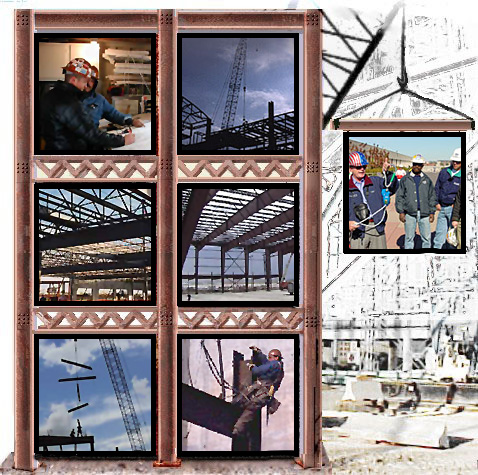
29 CFR 1926.754 Structural Steel Assembly
29 CFR 1926.755 Column Anchorage
29 CFR 1926.756 Beams and columns
29 CFR 1926.757 Open web steel joists
29 CFR 1926.754
Structural steel assembly
Since structural collapse is second only to falls as a cause of fatalities in this industry, stability is essential to the successful erection of any steel structure, including single- story, multi-story, bridges, etc. This section of the standard outlines the work practices that will prevent collapse due to lack of stability. In addition, it addresses slipping/tripping hazards and certain kinds of fall hazards encountered when working on steel structures.
-
Permanent floors must be installed as the erection of structural members progresses, with no more than
eight stories between the erection floor and the upper-most permanent floor [29 CFR 1926.754(b)(1)].
-
Unfinished bolting or welding above the foundation (or the uppermost secured floor) is not permitted to exceed
-
Exceptions are allowed where structural integrity is accounted for in the design.
-
Safety nets or a fully planked or decked floor must be maintained directly under any erection work being performed, within
|
-
To prevent tripping hazards, the following components must not be attached so as to project from the top flanges of beams, joists, or beam attachments until after the metal decking, or other walking/working surface, has been installed:
-
shear connectors (such as headed
steel studs, steel bars, or steel
lugs),
-
reinforcing bars,
-
deformed anchors, and
-
threaded studs [29 CFR 1926.754(c)(1)(i)].
-
Exception: These may be factory installed if all workers, including
connectors and deckers, use fall protection at all times [CPL2-1.34, Q&A
25]
-
When shear connectors are used in construction of composite floors, roofs and bridge decks, they must be laid out and installed after the metal decking has been installed, so the metal decking serves as a working
platform [29 CFR 1926.754(c)(1)].
-
Shear connectors may not be installed from within a controlled decking
zone (CDZ) [29 CFR 1926.760(c)(7)].
-
Workers will not be permitted to walk the top surface of any structural steel member installed after July 18, 2006 that has been coated with paint or similar material, unless all of the following are met:
-
The coating has achieved a minimum average slip resistance of .50 in laboratory tests.
-
The tests were based on the
appropriate ASTM standard test
method and conducted by a
qualified laboratory (Appendix B to
this subpart references appropriate
ASTM standard test methods).
- Documentation of the test
results is available at the site
and to the steel erector [29 CFR 1926.754(c)(3)].
|
-
When deemed necessary by a competent
person, plumbing-up equipment
must be installed during the steel
erection process to ensure the
stability of the structure [29 CFR 1926.754(d)(1)].
-
When plumbing-up equipment is used, it
must be in place and properly
installed before the structure is
loaded with construction material such
as loads of joists, bundles of decking,
or bundles of bridging [29 CFR 1926.754(d)(2)].
-
Plumbing-up equipment may be removed
only with the approval of a
competent person [29 CFR 1926.754(d)(3)].
|
Hoisting, landing, and placing of metal decking bundles
-
Bundle packaging and strapping
may not be used for hoisting unless
specifically designed for that purpose
[29 CFR 1926.754(e)(1)(i)].
-
If loose items such as dunnage,
flashing, or other materials are placed
on top of metal decking bundles
intended to be hoisted, they must be
secured to the bundles [29 CFR 1926.754(e)(1)(ii)].
-
When bundles of metal decking are
landed on joists, all bridging must
be installed and anchored, and all
joist-bearing ends attached [29 CFR 1926.754(e)(1)(iii)].
(See Open web steel joists for exceptions.)
-
Metal decking bundles must be landed
on framing members so that enough
support is provided to allow the
bundles to be unbanded without
dislodging the bundles from the supports [29 CFR 1926.754(e)(1)(iv)].
-
At the end of the shift or when
environmental or jobsite conditions
require, metal decking must be
secured against displacement [29 CFR 1926.754(e)(1)(v)].
Roof and floor holes and openings
- Metal decking at roof and floor holes and openings must be installed as follows:

- Framed metal deck openings must have structural members turned down to allow continuous deck
installation, except where prevented by structural design constraints or constructibility [29 CFR 1926.754(e)(2)(i)].
- Openings such as roof and floor holes must be decked over.
- Where large size, configuration, or other structural constraints do not allow openings to be decked over (e.g. elevator shafts, stair wells, etc.), employees must be protected in accordance with the fall protection provisions of this standard [29 CFR 1926.754(e)(2)(ii)].
-
When metal decking holes and openings
are cut, they must
Covering roof and floor openings
-
Covers for roof and floor
openings shall be capable of
supporting, without failure, twice the
weight of the employees, equipment, and
materials that may be imposed on them
at any one time [29 CFR 1926.754(e)(3)(i)].
-
All covers must be:
-
Secured when installed to
prevent accidental displacement by
the wind, equipment or employees
[29 CFR 1926.754(e)(3)(ii)], and
-
Painted with high-visibility paint, or
-
Marked with the word "HOLE"
or "COVER" to provide warning of
the hazard [29 CFR 1926.754(e)(3)(iii)].
-
Installed smoke dome or skylight
fixtures are not considered covers,
unless they meet the appropriate
strength requirements [29 CFR 1926.754(e)(3)(iv)].
-
Where planks or metal decking around
columns do not fit tightly, wire
mesh, exterior plywood, or equivalent
material must be installed, and must be
of sufficient strength to:
Installation of metal decking
Derrick Floors
-
To support the intended floor
loading, a derrick floor must be
fully decked and/or planked, and the
steel member connections completed [29 CFR 1926.754(e)(6)(i)].
-
Temporary loads placed on a
derrick floor must be distributed over
the underlying support members so as to
prevent local overloading of the deck
material [29 CFR 1926.754(e)(6)(ii)].
|
29 CFR 1926.755 Column anchorage
This section addresses the hazards associated
with column stability and, specifically, the
proper use of anchor rods (anchor bolts) to
ensure column stability. Inadequate anchor
rod/bolt installation has been identified as a
primary contributing factor to structural
collapses.
-
All columns must be anchored by a minimum of 4 anchor rods (anchor bolts). [29 CFR 1926.755(a)(1)]
-
Each column anchor rod (anchor bolt) assembly, including the column-to-base plate weld and the column foundation, must be designed to [29 CFR 1926.755(a)(2)]:
-
resist a minimum eccentric gravity load of 300 pounds located 18 inches from the extreme outer face of the column in each direction at the top of the column shaft.
-
Columns must be set on [29 CFR 1926.755(a)(3)]:
-
level finished floors,
-
pre-grouted leveling plates,
-
leveling nuts, or
-
shim packs
that adequately transfer the construction loads.
-
All columns must be evaluated by a
competent person to determine
whether guying or bracing is
needed; if guying or bracing is needed,
it must be installed. [29 CFR 1926.755(a)(4)]
|
-
Approval by the project structural
engineer of record is required
before anchor rods (anchor bolts) can be [29 CFR 1926.755(b)(1)]:
-
repaired,
-
replaced, or
-
field-modified.
-
Before the erection of a column, the
controlling contractor must provide
written notification to the
steel erector if there has been
any:
|
29 CFR 1926.756 Beams and columns
Inappropriate or inadequate connections of beams
and columns is hazardous and can lead to
collapses and worker fatalities. This section
sets forth performance and specification
requirements for connecting beams and columns, in
order to minimize the hazard of structural
collapse during the early stages of the steel
erection process.
-
During the final placing of solid web
structural members, the load must not
be released from the hoisting
line until [29 CFR 1926.756(a)(1)]:
-
the members are secured with at
least two bolts per connection,
of the same size and strength as
shown in the erection drawings;
-
these bolts are drawn up
wrench-tight; or
-
the equivalent, as specified by the
project structural engineer of
record, except as specified in
29 CFR 1926.756(b) of this section.
-
A competent person must
determine if more than two bolts are
necessary to ensure the stability of
cantilevered members if
additional bolts are needed, they must
be installed. [29 CFR 1926.756(a)(2)]
|
-
Solid web structural members used as diagonal bracing must be
secured by [29 CFR 1926.756(b)]:
-
at least one bolt per
connection drawn up
wrench-tight; or
-
the equivalent, as specified by the
project structural engineer of
record.
|
-
When two structural members on opposite
sides of a column web, or a beam web
over a column, are connected sharing
common connection holes:
-
at least one bolt with its
wrench-tight nut must remain
connected to the first
member; unless
-
a shop-attached, or
field-attached seat or
equivalent connection
device is supplied with the member in order to:
-
secure the first member,
and
-
prevent the column from being
displaced [29 CFR 1926.756(c)(1)]. (See Appendix H to this subpart for examples of equivalent connection devices.)
-
If a seat or equivalent device is used:
-
the seat (or device) must be
designed to support the load
during the double connection
process; and
-
before the nuts on the shared bolts
are removed to make the double
connection, it must be
adequately bolted or welded
to both:
|
-
Each column splice must be:
-
designed to resist a minimum
eccentric gravity load of 300
pounds, and
-
located 18 inches from the
extreme outer face of the column in
each direction, and
-
located at the top of the column shaft [29 CFR 1926.756(d)].
|
-
Perimeter columns must not be
erected unless:
-
They extend a minimum of 48
inches above the finished
floor, to permit installation of
perimeter safety cables prior to
erection of the next story [29 CFR 1926.756(e)(1)], and
-
They have two sets of
holes, or other devices that:
-
are 42-45 inches above the
finished floor, and also at
the midpoint between the
finished floor and the top
cable, and
-
permit installation of
perimeter safety cables
as required by 29 CFR 1926.760(a)(2) [29 CFR 1926.756(e)(2)]
-
Exception: Where
constructability does not allow, the
above requirements can be waived. (See
Appendix F to this Subpart.)
|
29 CFR 1926.757 Open web steel joists
Some of the most serious risks facing the
ironworker are encountered during the erection of
open web steel joists, particularly landing loads
on unbridged joists and improperly placing loads
on joists. Based on a recent analysis of OSHA
data, more than half of ironworker fatalities due
to collapse are related to the erection of steel
joists.
- Where steel joists are used and columns are not
framed in at least two directions with solid web structural steel members, the
columns must be made laterally stable during erection by field-bolting the
steel joist at the column. (See exception below.) [29 CFR 1926.757(a)(1)]
- When installing the stabilizing joist:
|

View
Accident Report |
-
a vertical stabilizer plate
for steel joists must be provided on each column, which must:
-
be at least 6 inches by 6
inches,
-
extend at least 3 inches
below the bottom chord of
the joist, and
-
have a 13/16-inch hole
to provide an attachment point
for guying or plumbing cables [29 CFR 1926.757(a)(1)(i)];
-
the bottom chords must be
stabilized to prevent
rotation during erection [29 CFR 1926.757(a)(1)(ii)]; and
-
hoisting cables must not be
released until:
-
the seat at each end of the
steel joist is field-bolted,
and
-
each end of the bottom chord is
restrained by the column
stabilizer plate. [29 CFR 1926.757(a)(1)(iii)]
- Exception: Where
constructability does not allow a steel
joist to be installed at the column:
- an alternate means of
stabilizing joists must be
installed on both sides near the
column and it must [29 CFR 1926.757(a)(2)(i)]:
-
hoisting cables must not be
released until the seat at each end
of the steel joist is field-bolted
and the joist is stabilized. [29 CFR 1926.757(a)(2)(ii)]
-
Where steel joists at or near columns span 60 feet or
less:
- the joist must be designed with
sufficient strength to allow
one employee to release the
hoisting cable without the need for
erection bridging [29 CFR 1926.757(a)(3)].
- Alternatively, procedures described in the Compliance Directive may be used
instead until July 18, 2003 [CPL 2-1.34, Q&A 32].
- Where steel joists at or near columns span more than 60
feet:
- the joists need to be set in
tandem with all bridging
installed [29 CFR 1926.757(a)(4)], or
- an alternative method of
erection may be used, which [29 CFR 1926.757(a)(4)]:
- provides equivalent
stability to the steel
joist,
- is designed by a qualified
person, and
- is included in the
site-specific erection
plan.
- A steel joist or steel joist girder
must not be placed on any support
structure that is not
stabilized. [29 CFR 1926.757(a)(5)]
- When steel joists are landed on a
structure, they must be secured to
prevent unintentional
displacement prior to installation.
[29 CFR 1926.757(a)(6)]
- Any modification that affects
the strength of a steel joist or steel
joist girder must be made with the
approval of the project structural
engineer of record.[29 CFR 1926.757(a)(7)]
- When connecting individual steel joists
to steel structures in bays 40 feet
or longer (see exception below):
-
Steel joists and steel joist girders
must not be used as anchorage points
for a fall-arrest system unless
written approval to do so is obtained
from a qualified person. [29 CFR 1926.757(a)(9)]
-
A bridging terminus point must
be established before bridging is installed. [29 CFR 1926.757(a)(10)]
|
-
Each end of "K" series steel joists must be finally attached to the support structure with a minimum of:
-
two 1/8-inch fillet welds 1 inch long,
-
two 1/2-inch bolts, or
-
an equivalent connection. [29 CFR 1926.757(b)(1)]
-
Each end of "LH" and "DLH" series steel joists and steel joist girders must be finally attached to the support structure with a minimum of:
-
two 1/4-inch fillet welds 2 inches long,
-
two 3/4-inch bolts, or
-
an equivalent connection. [29 CFR 1926.757(b)(2)]
-
Except for panelized joists, each steel joist must be attached to the support structure, with at least one end on both sides of the seat:
-
immediately upon placement in the
final erection position, and
-
before additional joists are
placed. [29 CFR 1926.757(b)(3)]
-
Panels that have been pre-assembled from steel joists must be attached with bridging to the structure at each corner before the hoisting cables are released. [29 CFR 1926.757(b)(4)]
|
-
For steel joists in Tables A and B that require bridging,
-
attach both sides of the seat of one end of each steel joist to the support structure before hoisting cables are
released. [29 CFR 1926.757(c)(1)]
-
For joists over 60 feet [29 CFR 1926.757(c)(2)]
,
-
Only one employee is allowed on steel joists that do not require erection bridging under Tables A and B, until all bridging is installed and anchored. [29 CFR 1926.757(c)(3)]
-
Employees are not allowed on steel joists where the span of the steel joist is equal to or greater than
the span shown in Tables A and B except in accordance with Erection Bridging provisions. [29 CFR 1926.757(c)(4)]
-
When permanent bridging terminus points cannot be used during erection, additional temporary bridging terminus points are required to provide stability. [29 CFR 1926.757(c)(5)]
|
-
Where the span of the steel joist is equal to or greater than the span shown in Tables A and B, the
following applies:
-
A row of bolted diagonal erection bridging must be installed near the mid-span of the
steel joist [29 CFR 1926.757(d)(1)(i)];
-
Hoisting cables must not be released until this bolted diagonal erection bridging is
installed and anchored [29 CFR 1926.757(d)(1)(ii)]; and
-
No more than one employee is allowed on these spans until all other bridging is installed and
anchored [29 CFR 1926.757(d)(1)(iii)].
-
Where the span of the steel joist is 60 feet through 100 feet, the following applies:
-
All rows of bridging must be
bolted diagonal bridging [29 CFR 1926.757(d)(2)(i)];
-
Two rows of bolted diagonal erection bridging must be installed near the third points of the steel joist (e.g. 1/3
joist-length) from each end [29 CFR 1926.757(d)(2)(ii)];
-
Hoisting cables must not be released until this bolted diagonal erection bridging is installed and
anchored [29 CFR 1926.757(d)(2)(iii)]; and
-
No more than two employees are allowed on these spans until all other bridging is installed and
anchored [29 CFR 1926.757(d)(2)(iv)].
-
Where the span of the steel joist is 100 feet through 144 feet, the following applies:
-
For steel members spanning over 144 feet, the erection methods used
must be in accordance with 29 CFR 1926.756. [29 CFR 1926.757(d)(4)]
-
Where any steel joist that requires bridging is a bottom
chord bearing joist [29 CFR 1926.757(d)(5)],
-
a row of bolted diagonal bridging must be provided near the supports; and
-
this bridging must be installed and anchored before the hoisting cables are released.
-
When bolted diagonal erection bridging is required, the following applies:
-
the bridging must be indicated on the erection drawing [29 CFR 1926.757(d)(6)(i)];
-
the erection drawing must be the exclusive indicator of the proper placement of this
bridging [29 CFR 1926.757(d)(6)(ii)];
-
shop-installed bridging clips, or functional equivalents, must be used where the bridging bolts to the steel joists
[29 CFR 1926.757(d)(6)(iii)].
-
When two pieces of bridging are attached to the steel joist by a common bolt, the nut that secures the first piece of bridging must not be removed from the bolt in order to attach the second [29 CFR 1926.757(d)(6)(iv)]; and
-
bridging attachments must not protrude above the top chord
of the steel joist [29 CFR 1926.757(d)(6)(v)].
|
-
During the construction period, the employer placing a load on steel joists must ensure that the load is distributed so as not to exceed the carrying capacity of any steel joist. [29 CFR 1926.757(e)(1)]
-
Except as noted below, no
construction loads are allowed on the steel joists until all bridging is installed and anchored and all joist-bearing ends are attached. [29 CFR 1926.757(e)(2)]
-
The weight of a bundle of joist bridging must not exceed a total of 1,000 pounds, and [29 CFR 1926.757(e)(3)]:
-
a bundle of joist bridging must be placed on a minimum of three steel joists that are secured at one end, and
-
the edge of the bridging bundle must be within 1 foot of the secured end.
-
No bundle of decking may be placed on steel joists until [29 CFR 1926.757(e)(4)]:
-
all bridging has been installed and anchored, and
-
all joist bearing ends are attached, unless all of the following conditions are met:
- the employer has first determined that the structure or portion of the structure is capable of supporting the
load. This determination must be made:
- The edge of any construction load must be placed within 1 foot of the
bearing surface of the joist end [29 CFR 1926.757(e)(5)].
|
|