Department of Labor Seal photos representing the workforce - digital imagery© copyright 2001 photodisc, inc.
Department of Labor Seal www.osha.gov   [skip navigational links] Search    Advanced Search | A-Z Index
eTools Home : Shipyard Employment Scope | Glossary | Additional Resources | Viewing / Printing Instructions | Credits
Shipyard Employment eTool: Shipbuilding
General Requirements Shipbuilding Ship Repair Shipbreaking Barge Cleaning

Surface Prep » Mechanical Removers
 
Surface prep includes mechanical paint removal operations such as abrasive blasting, flame removal, use of power tools (e.g., needleguns, scalers, sanding) and the use of high-pressure equipment. These operations may expose workers to: Some of these operations may also be considered Hot Work.

Note: Confined space entry is one of the leading hazards associated with barge cleaning. Review the Shipbuilding: Confined/Enclosed Spaces and Other Dangerous Atmospheres chapter for information on how to protect workers from this hazard.
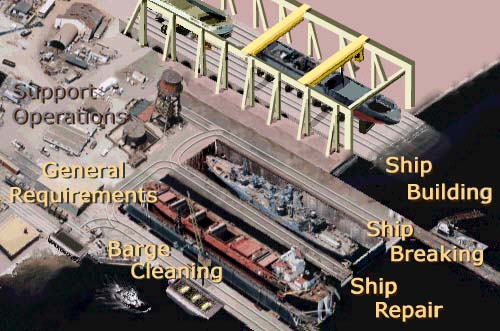
Click on an area for more specific information.
Respiratory Slips/Trips Access/Egress Falls High-Pressure Fire Respiratory Electrical Impact
| Fire | Respiratory | Access/Egress |
| Slips/TripsFalls | High-Pressure |
| Electrical | Impact |

 
Fire and Explosion Hazards
Potential Hazards:

Mechanical paint removal operations include the following hazards:
  • Working in or around spaces that are not "gas free." 
  • Flammable and combustible residues (e.g., combustible dust, oil residue).
Requirements and Example Solutions:
  • Equipment that can generate static electricity (e.g., ventilation systems, abrasive blasting) must be grounded/bonded. [1915.13(b)(11)]
  • Hot work must not be performed in the space and/or adjacent spaces when flammable or combustible cleaning solvents are being used. [1915 Subpart P]
  • Flame or heat must not be used to remove soft or greasy coatings. [1915.34(b)(2)]

Additional Resources:
 
Drums and containers of flammable cleaning solvents
Figure 1: Drums and containers of flammable cleaning solvents.
 
Worker spray painting in enclosed space increases fire hazard
Figure 2: Worker spray painting in enclosed space increases fire hazard.

Warning sign clearly informs workers of fire and explosion hazards of smoking and hotwork in a spray area
Figure 3: Warning sign clearly informs workers of fire and explosion hazards of smoking and hotwork in a spray area.


Shipyard Competent Person testing flammability and other hazards in spray area
Figure 4: Shipyard Competent Person testing flammability and other hazards in spray area.
Back to Top Back to Top  


Respiratory Hazards
Potential Hazards:

Mechanical paint removal operations produce dust, which may present significant health hazards when used in confined or enclosed spaces. Hazards include:
  • Dry ice (C02) when used as blast media.
  • Heavy metal dust including lead, arsenic, cadmium, chrome and beryllium.
  • Silica dust.
  • Toxic fumes produced by flame removal of paint.
Requirements and Example Solutions:
  • Ensure adequate ventilation to maintain concentrations below the PEL. [1915.34(a)(4)]
  • Airline respirators may be necessary if ventilation is not adequate.
  • Abrasive blasters working in enclosed and confined spaces must be protected by hoods and airline respirators. [1915.34(c)(3)]
  • When not working in enclosed and confined spaces, abrasive blasters must be protected with appropriate respirators. [1915.34(c)(3)(ii)]
  • Other employees near the area of operation require appropriate respiratory protection. [1915.34(c)(3)(ii)]
  • Respiratory protection for heavy metal and silica dusts require as a minimum a high efficiency filter (HEPA). See Respiratory Protection eTool.
  • Workers must be protected by an airline respirator when doing flame removal of paint. [1915.34(b)(1)
  • Respirators must be NIOSH approved and used in accordance with 1915.154. [1910.134]
Additional Resources:
Workers protected from toxic cleaning solvents
Figure 5: Workers protected from toxic cleaning solvents.

Ventilation provided for painting in confined space
Figure 6: Ventilation provided for painting in confined space.

Airline respirator for use when ventilation does not provide adequate safety
Figure 7: Airline respirator for use when ventilation does not provide adequate safety.
Back to Top Back to Top


Limited Access
Potential Hazards:
When working in confined or enclosed spaces workers may become trapped and unable to exit due to:
  • Improperly located equipment.
  • Ventilation ducts and hoses running through the opening.
Requirements and Example Solutions:
  • When employees work in confined spaces with limited access, access must not be blocked or impeded by ventilation ducts, hoses or other equipment. [1915.76(b)(2)]
  • More than one means of access shall be provided where practical. [1915.76(b)(1)]
  • Additional openings should be provided for ducts, hoses, and other equipment.
 
Ventilation hoses blocking exit from opening
Figure 8: Improper practice: Ventilation hoses blocking exit from opening.

Special ventilation hose (flat) to avoid blocking exit
Figure 9: Special ventilation hose (flat) to avoid blocking exit.

Two access holes for equipment or access
Figure 10: Two access holes for equipment or access.
Back to Top Back to Top  


Slips and Trips
Potential Hazards:

Workers performing mechanical paint removal are exposed to slick conditions and tripping hazards. Vision may also be obstructed by high levels of airborne dust.
  • Slipping and falling on oily decks.
  • Slipping on slick, wet or grit covered surfaces.
  • Tripping over equipment, hoses, and vessel structures.
  • Pressure changes causing surges in blast hoses.
Requirements and Example Solutions:
Wet and oily surfaces create slipping hazard
Figure 11: Wet and oily surfaces create slipping hazard.
 
Tripping hazards due to poor housekeeping
Figure 12: Improper practice: Tripping hazards due to poor housekeeping.


Lead racks used to remove tripping hazards (welding leads, hoses, etc.) from the deck
Figure 13: Lead racks used to remove tripping hazards (welding leads, hoses, etc.) from the deck.
Back to Top Back to Top  


Fall Hazards
Potential Hazards:

Fall hazards are a leading cause of shipyard fatalities. Shipyard employees are often required to work in dangerous environments that may include fall hazards. Accidents involving elevation equipment such as ladders and scaffolds are often serious, even fatal.

Abrasive and Water Blasting
  • Surges from drops in pressure in the hose line may be able to throw the worker from the work surface.
  • Blasting can create static electricity. This may shock the worker and result in a fall. 
Deck Openings and Edges
  • Falls from deck openings.
  • Falls into open holes.
Scaffolds
  • Falls from ladders.
  • Falls from scaffolds.
Requirements and Example Solutions:

Abrasive and Water Blasting
  • Blasters shall be protected by proper fall protection. [1915.34(c)(3)(v)]
  • Blasters who's vision is obstructed by the hood, shall not work from ladders. [1915.77(c)]
  • Blaster should wear appropriate boots and gloves to insulate from static electricity.
  • Blasting equipment should be grounded and bonded.
Guarding of Deck Openings and Edges
  • Openings and deck edges must be guarded. [1915.73]
  • Flush manholes and other small openings must be guarded after opening. [1915.73(b)]
  • During the installation of guards on large openings and deck edges, fall protection (e.g., harness with lanyard) must be used. [1915.73(d)]
  • When floor plates or gratings (e.g., bilges, engine rooms, pump rooms, machinery spaces) are removed, the openings must be guarded or planked. [1915.73(f)]
Fall Protection for Scaffold Work
  • Guardrails or other appropriate fall protection shall be used when working on scaffolds five feet above surfaces. [1915.71(j)]
  • Fall protection must be used during the installation of guards on scaffolds. [1915.73(d)]
Improper use of step ladder
Figure 14: Improper practice: Improper use of step ladder.

Several unguarded deck openings
Figure 15: Improper practice: Several unguarded deck openings.

Properly guarded deck edges
Figure 16: Properly guarded deck edges.

Worker on scaffold protected by guardrails
Figure 17: Worker on scaffold protected by guardrails.
Maritime Labor/Industry Recommendations
  • Maritime Labor/Industry recommends that personal fall protection including lanyards and harnesses be used and secured during installation of guardrails.
Back to Top Back to Top


Work Environment Temperature Related Hazards
Potential Hazards:

Environmental hazards include temperature, humidity, and air movement within the work area. A combination of PPE use, heat producing equipment, work activity, and environmental conditions can cause temperature related illnesses.

Heat related illnesses include:
  • Heat Stress
  • Heat Stroke
  • Heat Cramps
  • Dehydration
Cold related illnesses include:
  • Hypothermia
  • Frost Bite
Additional Resources:
Full body suit can increase potential heat related illnesses for worker
Figure 18: Full body suit can increase potential heat related illnesses for worker.

Air supplied to hood also reduces heat related problems
Figure 19: Air supplied to hood also reduces heat related problems.
Maritime Labor/Industry Recommendations
Example Solutions:

The following are recommended for heat related illnesses:
  • Drink plenty of fluids.
  • Take frequent breaks.
  • Use a cooling vest.
  • Take breaks in shaded or cooled areas.
  • Use ventilation.
  • Reduce the inner temperature of work spaces by using water sprinklers on outside metal surfaces.
  • Conduct awareness training.
It is recommended that the following be implemented to prevent cold related illnesses:
  • Wear appropriate insulated PPE.
  • Use warming areas for breaks.
  • Conduct awareness training.
Back to Top Back to Top
Workers can be trained to recognize and avoid temperature related hazards
Figure 20: Workers can be trained to recognize and avoid temperature related hazards.


High-Pressure Hazards
Potential Hazards:

The use of high pressure equipment may expose the operators and bystanders to the following hazards:
  • Contact with high-pressure steam, water, or air streams from cleaning equipment.
  • Contact by uncontrolled high-pressure hoses.
  • Contact with steam, water, or air leaks in the high-pressure equipment.
Injuries associated with these hazards include:
  • Loss of body parts (e.g., fingers, hands, etc.)
  • Lacerations
  • Burns
  • Loss of sight
Requirements and Example Solutions:
  • Steam guns must be insulated to prevent heat burns to the operator. [1915.33(e)]
  • Appropriate PPE shall be used. [1915.34(c)(3) and 1915.152
  • Access to the area should be controlled.
  • Use dead man control. [1915.34(c)(1)(iv)]
  • Nozzle and hose couplings shall be secured with metal couplings. [1915.34(c)(1)(ii) and (c)(1)(iii)]
  • Hoses and connections should be inspected prior to use.
Back to Top Back to Top


Electrical Hazards
Potential Hazards:

Employees who work with electrical equipment in wet or damp locations have an increased risk of getting shocked or electrocuted due to:
  • Faulty electrical connections in power tools.
  • Open lighting parts.
  • Broken insulation on power cords.
  • Blasting may cause shocks from static electricity.
Requirements and Example Solutions:
  • Portable electrical tools must be grounded or double insulated. [1915.132(a)]
  • Temporary lighting must be grounded. [1915.92(c)]
  • Power and lighting cables must be inspected by a person competent to evaluate electrical hazards. (Note: This is not the Shipyard Competent Person). [1915.36(a)(5)]
Portable electrical tools must be double insulated or properly grounded
Figure 21: Portable electrical tools must be double insulated or properly grounded.
 
Worker inspecting broken insulation on power cable
Figure 22: Worker inspecting broken insulation on 
power cable.
Maritime Labor/Industry Recommendations
  • All electrical tools or equipment should undergo a visual inspection prior to use.
  • All portable electric hand tools and temporary lighting systems should utilize Ground Fault Circuit Interrupters (GFCI).
  • Electrical tools and equipment should correspond with the requirements of the job.
  • Electrical equipment and tools should be used with proper circuit protection for the voltage and amperage used.
  • Only qualified electricians should attempt repair of electrical tools and equipment in use.
  • A Ground Assurance Program should be in place for all electrical tools and equipment used including:
    • Records of tools inspected and repaired.
    • Records of electrical boxes inspected and repaired.
    • Records of electrical extension cords inspected and repaired.
    • Recall of records of the above.
  • The requirements of the Ground Assurance Program should be performed on a regular basis.
Back to Top Back to Top
Visual inspection takes defective welding tong out of service
Figure 23: Visual inspection takes defective welding 
tong out of service.


Excessive Noise
Potential Hazards:

Mechanical paint removal produces excessive amounts of noise, which may cause hearing loss. Some of the loudest operations include:
  • Abrasive Blasting
  • Needle Gunning
  • Scaling
  • Grinding
Requirements and Example Solutions: Additional Resources: Back to Top Back to Top


Impact Hazards
Potential Hazards:

Mechanical paint removal operations may expose workers to impact from:
  • Blasting agents (e.g., sand)
  • Sparks
  • Mental particles
  • Grinding debris
  • Paint debris
Injuries may include:
  • Particles becoming imbedded in the skin
  • Eye damage
  • Skin burns
  • Skin trauma
Requirements and Example Solutions:
  • Proper use of PPE.
  • Portable rotating tools must be adequately guarded to protect both the operator and nearby workers from flying objects. [1915.34(a)(2)]
Back to Top Back to Top
 

eTools Home : Shipyard Employment Scope | Glossary | Additional Resources | Viewing / Printing Instructions | Credits

Back to Top Back to Top www.osha.gov www.dol.gov

Contact Us | Freedom of Information Act | Customer Survey
Privacy and Security Statement | Disclaimers
Occupational Safety & Health Administration
200 Constitution Avenue, NW
Washington, DC 20210