


Scaffolding eTool
This eTool* includes illustrated safety checklists for specific types of scaffolds. It identifies hazards, as well as the controls that will keep those hazards from becoming tragedies.
Common Hazards Associated with All Scaffolds
- Falls from elevation, due to lack of fall protection.
- Collapse of the scaffold, caused by instability or overloading.
- Being struck by falling tools, work materials, or debris.
- Electrocution, due to the proximity of the scaffold to overhead power lines.
Overview
What Is a Scaffold?
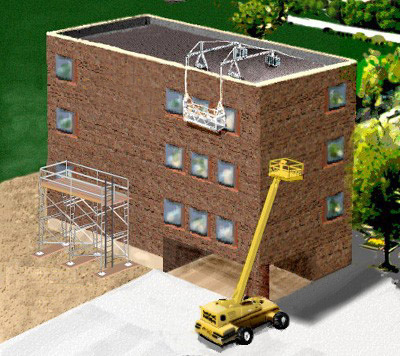
A scaffold is an elevated, temporary work platform. There are two basic types of scaffolds:
- Supported scaffolds, which consist of one or more platforms supported by rigid, load- bearing members, such as poles, legs, frames, outriggers, etc.
- Suspended scaffolds, which are one or more platforms suspended by ropes or other non-rigid, overhead support.
- Other types of equipment, principally scissor lifts and aerial lifts, can be regarded as other types of supported scaffolds.
Who Works with Scaffolds?
Workers who use scaffolds can be divided into three groups:
Common Hazards
- Access
- Collapse
- Electrical
- Falls
- Instability
- Struck-by
Erectors and dismantlers are workers whose principal activity involves assembling and disassembling scaffolding before other work can begin, and after that work, or a portion of it, has been completed.
Training and Competent Person Requirements
OSHA requires employers to provide training by a competent person to each employee who is involved in erecting and/or disassembling a scaffold. A competent person is defined as one who:
- Is capable of identifying existing and predictable hazards.
- Has authorization to take prompt corrective measures to eliminate such hazards.
Requirements for Designing and Constructing Scaffolds
Scaffolds must be designed by a qualified person and be constructed and loaded in accordance with that design. OSHA defines a qualified person as one who:
- Possesses a recognized degree, certificate, or professional standing, or
- By extensive knowledge, training, and experience has successfully demonstrated the ability to solve or resolve problems relating to the subject matter, the work, or the project
A qualified person must do adequate preplanning to assure the safe erection and use of the scaffold. Preplanning includes:
- Determining the type of scaffold necessary for the job.
- Determining the maximum load for the scaffold.
- Assuring a good foundation.
- Avoiding electrical hazards.
Other References
- 29 CFR 1926.454, Training requirements. OSHA Standard.
- 29 CFR 1926.451(a)(6), General requirements. OSHA Standard.
Common Hazards
- Access
- Collapse
- Electrical
- Falls
- Struck-by
Scaffold users are workers whose work requires them to be supported by scaffolding to access the area of a structure where that work is performed.
Training and Competent Person Requirements
Employers are required by OSHA standards to have a qualified person provide training to each employee who performs work while on a scaffold. The training must enable employees to recognize the hazards associated with the type of scaffold being used and to understand the procedures to control or minimize those hazards.
OSHA defines a qualified person as one who:
- Possesses a recognized degree, certificate, or professional standing, or,
- By extensive knowledge, training, and experience has successfully demonstrated the ability to solve or resolve problems relating to the subject matter, the work, or the project
Other References
- 29 CFR 1926.454(a), Training requirements, OSHA Standard.
- 29 CFR 1926.451(f), General requirements: "Use", OSHA Standard.
Scaffold designers are workers who are qualified to design scaffolds.
- Designers for certain scaffolds also must be registered professional engineers.
- Non-mobile scaffolds must not be moved horizontally with workers on them, unless a registered professional engineer designed the scaffold specifically for the move. [29 CFR 1926.451(f)(5)]. Note: To move mobile scaffolds, see 29 CFR 1926.452(w).
- Pole scaffolds over 60 feet in height must be designed by a registered professional engineer, and shall constructed and loaded according to that design. [29 CFR 1926.452(a)(10)].
- Tube and Coupler scaffolds over 125 feet in height must be designed by a registered professional engineer, and must be constructed and loaded according to that design. [29 CFR 1926.452(b)(10)].
- Fabricated frame scaffolds (tubular welded frame scaffolds, welded end frame scaffolds, walk through frame scaffolds) over 125 feet in height must be designed by a registered professional engineer, and constructed and loaded according to that design. [29 CFR 1926.452(c)(6)].
- Outrigger scaffolds: Scaffolds and scaffold components must be designed by a registered professional engineer, and constructed and loaded per that design. [29 CFR 1926.452(i)(8)].
See OSHA's Workers' Rights page for more information on rights and protections.
*eTools are stand-alone, interactive, highly illustrated web-based training tools on occupational safety and health topics. As indicated in the disclaimer, eTools do not create new OSHA requirements.