|
 |
 |
 |
     |
 |
What
is an Incident Command System? ICS
is a standardized on-scene incident management concept
designed specifically to allow responders to adopt an
integrated organizational structure equal to the complexity
and demands of any single incident or multiple incidents
without being hindered by jurisdictional boundaries.
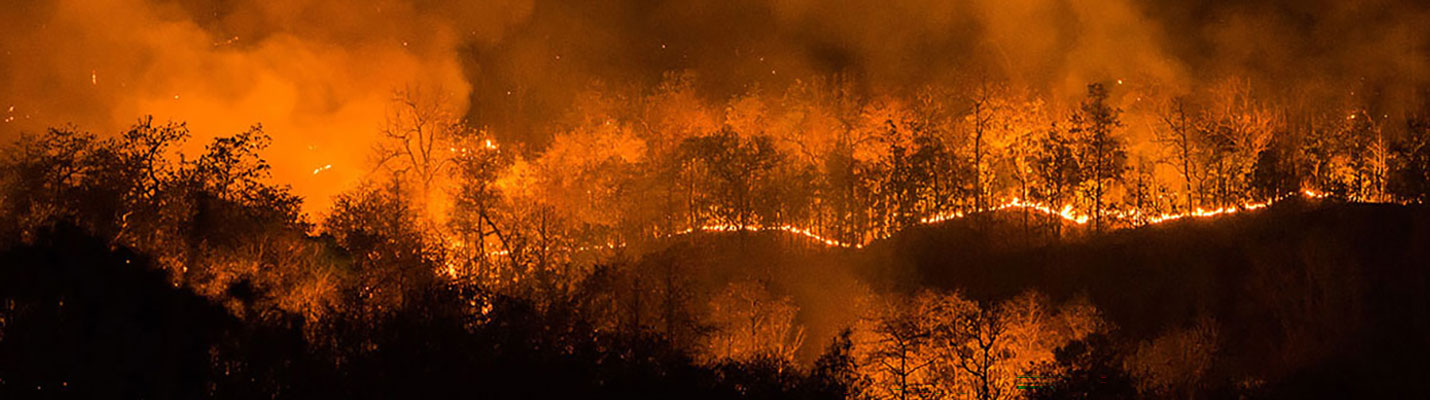
In the early 1970s, ICS was developed to manage rapidly
moving wildfires and to address the following problems:
- Too many people reporting to one supervisor;
- Different emergency response organizational structures;
- Lack of reliable incident information;
- Inadequate and incompatible communications;
- Lack of structure for coordinated planning among
agencies;
- Unclear lines of authority;
- Terminology differences among agencies; and Unclear
or unspecified incident objectives.
|
|
 |
In
1980, federal officials transitioned ICS into a national
program called the National Interagency Incident Management
System (NIIMS), which became the basis of a response management
system for all federal agencies with wildfire management
responsibilities. Since then, many federal agencies have
endorsed the use of ICS, and several have mandated its
use.
An ICS enables integrated communication and planning by
establishing a manageable span of control. An ICS divides
an emergency response into five manageable functions essential
for emergency response operations: Command, Operations,
Planning, Logistics, and Finance and Administration. Figure
1 shows a typical ICS structure.
The following is a list of the duties generally associated
with each ICS function: |
| Incident
Commander/Unified Command |
The
Incident Commander (IC) or the
Unified Command (UC) is responsible
for all aspects of the response, including developing
incident objectives and managing all incident operations.
The IC is faced with many responsibilities when he/she
arrives on scene. Unless specifically assigned to another
member of the Command or General Staffs, these responsibilities
remain with the IC. Some of the more complex responsibilities
include:
- Establish immediate priorities especially
the safety of responders, other emergency workers,
bystanders, and people involved in the incident.
- Stabilize the incident by ensuring life safety
and managing resources efficiently and cost
effectively.
- Determine incident objectives and strategy
to achieve the objectives.
- Establish and monitor incident organization.
- Approve the implementation of the written
or oral Incident Action Plan.
- Ensure adequate health and safety measures
are in place.
|
 |
| |
 |
|
| Command
Staff |
| The
Command Staff is responsible for public affairs,
health and safety, and liaison activities within
the incident command structure. The IC/UC remains
responsible for these activities or may assign individuals
to carry out these responsibilities and report directly
to the IC/UC. |
 |
- The Information
Officer’s role is to develop and release
information about the incident to the news media,
incident personnel, and other appropriate agencies
and organizations.
- The Liaison
Officer’s role is to serve as the point
of contact for assisting and coordinating activities
between the IC/UC and various agencies and groups.
This may include Congressional personnel, local
government officials, and criminal investigating
organizations and investigators arriving on
the scene.
The
Safety
Officer’s role is to develop and recommend
measures to the IC/UC for assuring personnel
health and safety and to assess and/or anticipate
hazardous and unsafe situations. The Safety
Officer also develops the Site Safety Plan,
reviews the Incident Action Plan for safety
implications, and provides timely, complete,
specific, and accurate assessment of hazards
and required controls.
|
|
| General
Staff |
The
General Staff includes Operations,
Planning, Logistics, and Finance/Administrative responsibilities.
These responsibilities remain with the IC until they are
assigned to another individual. When the Operations, Planning,
Logistics or Finance/Administrative responsibilities are
established as separate functions under the IC, they are
managed by a section chief and can be supported by other
functional units.
- The Operations
Staff is responsible for all operations directly
applicable to the primary mission of the response.
- The Planning
Staff is responsible for collecting, evaluating,
and disseminating the tactical information related
to the incident, and for preparing and documenting
Incident Action Plans (IAP's).
- The Logistics
Staff is responsible for providing facilities,
services, and materials for the incident response.
- The Finance
and Administrative Staff is responsible
for all financial, administrative, and cost
analysis aspects of the incident.
|
 |
 |
The following is a list of
Command Staff and General Staff responsibilities that
either the IC or UC of any response should perform or
assign to appropriate members of the Command or General
Staffs:
- Provide response direction;
- Coordinate effective communication;
- Coordinate resources;
- Establish incident priorities;
- Develop mutually agreed-upon incident objectives
and approve response strategies;
- Assign objectives to the response structure;
- Review and approve IAP's;
- Ensure integration of response organizations into
the ICS/UC;
- Establish protocols;
- Ensure worker and public health and safety; and
- Inform the media.
 |
The modular
organization of the ICS allows responders to scale
their efforts and apply the parts of the ICS structure
that best meet the demands of the incident. In other
words, there are no hard and fast rules for when
or how to expand the ICS organization. Many incidents
will never require the activation of Planning, Logistics,
or Finance/Administration Sections, while others
will require some or all of them to be established.
A major advantage of the ICS organization is the
ability to fill only those parts of the organization
that are required. For some incidents, and in some
applications, only a few of the organization’s functional
elements may be required. However, if there is a
need to expand the organization, additional positions
exist within the ICS framework to meet virtually
any need. |
For example, in responses involving responders from
a single jurisdiction, the ICS establishes an organization
for comprehensive response management. However,
when an incident involves more than one agency or
jurisdiction, responders can expand the ICS framework
to address a multi-jurisdictional incident. |
The roles of the ICS participants
will also vary depending on the incident and may even
vary during the same incident. Staffing considerations
are based on the needs of the incident. The number of
personnel and the organization structure are dependent
on the size and complexity of the incident. There is no
absolute standard to follow. However, large-scale incidents
will usually require that each component, or section,
is set up separately with different staff members managing
each section. A basic operating guideline is that the
Incident Commander is responsible for all activities until
command authority is transferred to another person.
Another key aspect of an ICS that warrants mention is
the development of an IAP. A planning cycle is typically
established by the Incident Commander and Planning Section
Chief, and an IAP is then developed by the Planning Section
for the next operational period (usually 12- or 24-hours
in length) and submitted to the Incident Commander for
approval. Creation of a planning cycle and development
of an IAP for a particular operational period help focus
available resources on the highest priorities/incident
objectives. The planning cycle, if properly practiced,
brings together everyone's input and identifies critical
shortfalls that need to be addressed to carry out the
Incident Commander's objectives for that period.
|
|
|
| | | |
| | |
Quick links: | | | | | | | | |
 |
 |
 |
|