Evaluating and Controlling Exposure
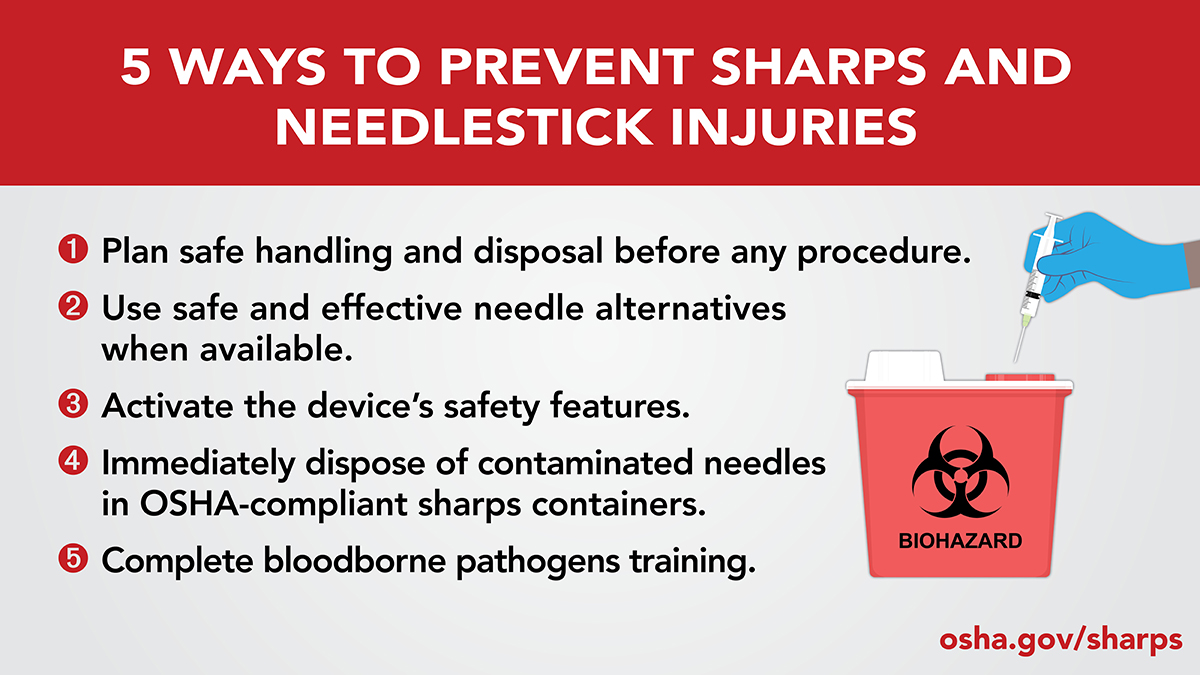
Studies show that nurses sustain the most needlestick injuries and that as many as one-third of all sharps injuries occur during disposal. The Centers for Disease Control and Prevention (CDC) estimates that 62 to 88 percent of sharps injuries can be prevented simply by using safer medical devices. The following references provide information regarding possible solutions for bloodborne pathogens and needlestick hazards.
Please Note: Articles/references that are dated before April 18, 2001 may not reflect the changes of the new Bloodborne Pathogens Standard but still provide relevant, general information.
Control Programs
Engineering controls are defined in OSHA's Bloodborne Pathogens standard as controls that isolate or remove the bloodborne pathogens hazard from the workplace [29 CFR 1910.1030(b)]. The standard states "Engineering and work practice controls shall be used to eliminate or minimize employee exposure" [29 CFR 1910.1030(d)(2)(i)]. This means that if an effective and clinically appropriate safety-engineered sharp exists, an employer must evaluate and implement it.
- STOP STICKS Campaign - Safer Sharps Devices. National Institute for Occupational Safety and Health (NIOSH), (2011).
- Bloodborne Pathogens - Personal Protective Equipment (PPE) Reduces Exposure to Bloodborne Pathogens [365 KB PDF*, 2 pages]. OSHA Fact Sheet, (2011, January).
- Bloodborne Pathogens - Hepatitis B Vaccination Protection [363 KB PDF*, 2 pages]. OSHA Fact Sheet, (2011, January).
- Preventing Exposures to Bloodborne Pathogens among Paramedics. US Department of Health and Human Services (DHHS), National Institute for Occupational Safety and Health (NIOSH) Publication No. 2010-113, (2010, April).
- Information for Employers Complying with OSHA's Bloodborne Pathogens Standard. US Department of Health and Human Services (DHHS), National Institute for Occupational Safety and Health (NIOSH) Publication No. 2009-111, (2009, March).
- Workbook for Designing, Implementing, and Evaluating a Sharps Injury Prevention Program [2 MB PDF, 168 pages]. Centers for Disease Control and Prevention (CDC), (2008).
- Model Plans and Programs for the OSHA Bloodborne Pathogens and Hazard Communications Standards. OSHA Publication 3186-06N, (2003). Also available as a 520 KB PDF, 29 pages. Includes a model exposure control plan that meets the requirements of the OSHA Bloodborne Pathogens Standard and can be tailored to meet the specific requirements for an establishment.
- Occupational HIV Transmission and Prevention among Health Care Workers. Centers for Disease Control and Prevention (CDC), (2002, February). Offers recommendations to prevent transmission of HIV to healthcare personnel in the workplace.
- A Best Practices Approach for Reducing Bloodborne Pathogens Exposure [3 MB PDF, 100 pages]. Cal/OSHA Consultation Service, Department of Industrial Relations, (2001).
- Checklist for Sharps Injury Prevention [21 KB PDF, 2 pages]. The University of Virginia, International Health Care Worker Safety Center. Provides a checklist intended to help facilities comply with the sharps safety requirements of OSHA's Bloodborne Pathogens Standard.
- Safety in Surgery. The University of Virginia International Healthcare Worker Safety Center, (2008). Resources to reduce exposure risk and improve healthcare workers safety in surgical settings.
Safer Needle Devices

Figure 1. Rate of injury associated with the use of curved suture needles during gynecologic surgical procedures and percentage of suture needles used that were blunt, by quarter—three hospitals, New York City hospitals, April 1993–June 1994
- FDA, NIOSH and OSHA Joint Safety Communication: Blunt-Tip Surgical Suture Needles Reduce Needlestick Injuries and the Risk of Subsequent Bloodborne Pathogen Transmission to Surgical Personnel. (2012, May 30).
- Use of Blunt-Tip Suture Needles to Decrease Percutaneous Injuries to Surgical Personnel: Safety and Health Information Bulletin. OSHA and the National Institute for Occupational Safety and Health (NIOSH) Publication No. 2008-101, (2007, October). Supersedes NIOSH Publication 2007–132.
- Safety Device List. The University of Virginia Health System, International Healthcare Worker Safety Center, (2003). Provides a list of devices designed to prevent percutaneous injury and exposure to bloodborne pathogens in the health care setting.
- Evaluation of Blunt Suture Needles in Preventing Percutaneous Injuries Among Health-Care Workers During Gynecologic Surgical Procedures; New York City, March 1993-June 1994. Centers for Disease Control and Prevention (CDC), Morbidity and Mortality Weekly Report (MMWR) 46(02);25-29, (1997, January 17). Identifies the effectiveness of blunt needles in reducing percutaneous injuries (PIs) and suggests that they should be considered for more widespread use in surgical procedures.
- Evaluation of Safety Devices for Preventing Percutaneous Injuries Among Health-Care Workers During Phlebotomy Procedures -- Minneapolis-St. Paul, New York City, and San Francisco, 1993-1995. Centers for Disease Control and Prevention (CDC), Morbidity and Mortality Weekly Report (MMWR) 46(02);21-25, (1997, January 17). Indicates that the use of phlebotomy safety devices significantly reduces phlebotomy-related percutaneous injury (PI) rates.
- Sharps Disposal Containers with Needle Removal Features. OSHA Hazard Information Bulletin (HIB), (1993, March 12). Alerts field personnel to the risk of possible safety and health hazards that may arise with the use of some sharps disposal containers that incorporate an "unwinder" mechanism to accomplish needle removal.
- Needlestick and Other Risks from Hypodermic Needles on Secondary I.V. Administration Sets - Piggyback and Intermittent I.V. Food and Drug Administration (FDA) Safety Alert, (1992, April 16). Urges the use of needleless systems or recessed needle systems to reduce the risk of needlestick injuries.
- Safer Medical Device Implementation in Health Care Facilities - Sharing Lessons Learned. National Institute for Occupational Safety and Health (NIOSH). NIOSH developed this forum to assist health care facilities that are working through the process of implementing safer needle devices in their workplaces.
Decontamination
- Selected EPA-registered Disinfectants. Environmental Protection Agency (EPA), (2009, January 9). Includes lists of EPA registered anti-microbial products to assist in choosing the appropriate decontaminant.
Post-exposure Evaluation
According to the NIOSH Alert Preventing Needlestick Injuries in Health Care Settings, it is estimated that 600,000 to 800,000 needlestick injuries (NSIs) and other percutaneous injuries (PIs) occur annually among health care workers. PIs are caused by sharp objects such as hypodermic needles, scalpels, suture needles, wires, trochanters, surgical pins, and saws. Additional exposure incidents include splashes and other contact with mucous membranes or non-intact skin. Post-exposure management is an integral part of a complete program for preventing infection following exposure incidents.
The following references provide useful information about the management of occupational exposure incidents to blood or other potentially infectious materials.
- Bloodborne Pathogens - Bloodborne Pathogen Exposure Incidents [364 KB PDF*, 2 pages]. OSHA Fact Sheet, (2011, January).
- A Comprehensive Immunization Strategy to Eliminate Transmission of Hepatitis B Virus Infection in the United States. Centers for Disease Control and Prevention (CDC), Morbidity and Mortality Weekly Report (MMWR) 55(RR16);1-25, (2006, December 8).
- Updated U.S. Public Health Service Guidelines for the Management of Occupational Exposures to HIV and Recommendations for Postexposure Prophylaxis. Centers for Disease Control and Prevention (CDC), Morbidity and Mortality Weekly Report (MMWR) 54(RR09);1-17, (2005, September 30). Updates US Public Health Service recommendations for the management of health-care personnel (HCP) who have occupational exposure to blood and other body fluids that might contain human immunodeficiency virus (HIV).
- Updated U.S. Public Health Service Guidelines for the Management of Occupational Exposures to HBV, HCV, and HIV and Recommendations for Postexposure Prophylaxis. Centers for Disease Control and Prevention (CDC), Morbidity and Mortality Weekly Report (MMWR) 50(RR11);1-42, (2001, June 29). Updates and consolidates recommendations for the management of health-care personnel (HCP).
- Immunization of Health-Care Workers: Recommendations of the Advisory Committee on Immunization Practices (ACIP) and the Hospital Infection Control Practices Advisory Committee (HICPAC). Centers for Disease Control and Prevention (CDC), Morbidity and Mortality Weekly Report (MMWR) 46(RR-18);1-42, (1997, December 26). Summarizes recommendations of the ACIP concerning the use of certain immunizing agents in health-care workers (HCWs), and assists workers and administrators, in optimizing infection prevention and control programs.
- Rapid HIV Testing. Centers for Disease Control and Prevention (CDC). These pages include descriptions of the rapid HIV tests approved by the FDA, how the tests can be implemented in different settings and research on the effectiveness and possible uses of the tests.
- EPINet. The University of Virginia, International Healthcare Worker Safety Center. The Exposure Prevention Information Network (EPINet) system provides standardized methods for recording and tracking percutaneous injuries and blood and body fluid contacts. EPINet consists of a Needlestick and Sharp Injury Report, a Blood and Body Fluid Exposure Report, and software for entering, accessing, and analyzing the data from the forms.
- National HIV/AIDS Clinicians' Consultation Center. The University of California - San Francisco. Offers a post-exposure prophylaxis hotline called PEPline. PEPline offers health care providers around-the-clock advice about managing occupational exposures to HIV and Hepatitis B and C.
Accessibility Assistance: Contact the OSHA Directorate of Technical Support and Emergency Management at (202) 693-2300 for assistance accessing PDF materials.
*These files are provided for downloading.

Newsletter
RSS Feeds
Print This Page
Text Size