| <<< Back to
Bloodborne Pathogens and Needlestick Prevention - OSHA Standards |
Printing Instructions
|
Frequently Asked Questions:
OSHA's Occupational Exposure
to Bloodborne Pathogens
Standard (29 CFR 1910.1030) and Smallpox Vaccination Programs
|
NOTE: These FAQs were drafted in cooperation with the
Centers for Disease Control and Prevention (CDC) and are intended to address questions about how the
provisions of OSHA's Bloodborne Pathogens Standard (29 CFR 1910.1030) apply to
healthcare workers who administer smallpox vaccinations during the current vaccination
program. For additional information on
smallpox vaccinations, visit
Centers for Disease Control and Prevention (CDC).
What is the Bloodborne Pathogen Standard?
OSHA's Bloodborne Pathogens Standard (29 CFR 1910.1030) as amended pursuant
to the 2000 Needlestick Safety and Prevention Act, is a regulation that
prescribes safeguards to protect workers against health hazards related to bloodborne pathogens. It
has provisions dealing with exposure control plans, engineering and work practice
controls, hepatitis B vaccination, hazard communication and training, and
recordkeeping. The standard imposes requirements on employers of workers who may be exposed to
blood or other potentially infectious materials such as certain tissues and bodily
fluids.
Are workers who administer the smallpox vaccine covered by the Bloodborne Pathogens Standard?
Federal OSHA authority extends to all private sector employers, as well as to
federal entities employing civilians. State and local government employers are only
subject to the Occupational Safety and Health Act if they are in one of the 26 states
and territories that have opted to develop and operate their own
OSHA-approved State Plans. In the remaining states, these governmental employers are not
required to comply with OSHA standards.
The Bloodborne Pathogens Standard is fully consistent with relevant CDC
guidelines, and many state and local government healthcare employers comply with those
guidelines. CDC recommends that all smallpox vaccination clinics comply with the
Standard's provisions.
What are employers involved in smallpox immunization efforts required to do
to comply with the standard?
Because these employers should already be complying with the standard, only a
few additional precautions will be necessary, including updating their exposure
control plans so that they address smallpox vaccination, and providing their employees with vaccination procedure-specific training.
As of January, 2003, CDC has determined that no commercially available
safety-engineered bifurcated needle is an appropriate replacement for the bifurcated
needle that is included in the pre-packaged kit that is being distributed for
administering smallpox vaccine in this national program. If, in the future, improved safety devices
become commercially available, the standard requires employers, as part of any
exposure control plan modification, to evaluate whether any of those devices, including sharps
with engineered sharps injury protections (SESIPs), may be appropriate for the
work practices of their employees.
The exposure control plan
The Bloodborne Pathogens Standard requires employers to review and update
their exposure control plans at least annually or whenever necessary to reflect new
or modified tasks or procedures affecting employee exposure. Facilities involved in the
smallpox immunization plan will need to ensure that their plans include provisions
relevant to the administration of smallpox vaccine.
Existing plans should already include the following elements:
- Exposure determinations defining which job classifications have
occupational exposure. In this instance it is individuals who perform vaccination and/or
handle sharps disposal containers, as well as individuals who perform follow-up care
for people who have been vaccinated.
- Engineering and work practice controls, e.g., appropriate medical devices,
sharps disposal containers, hand hygiene.
- Personal protective equipment.
- Housekeeping, including decontamination procedures and removal of
regulated waste.
- Information and training, including training associated with the
performance of new tasks or procedures (see below).
- Hepatitis B vaccination.
- Post-exposure evaluation and follow-up.
- Recordkeeping (including sharps injury log).
Aspects of the exposure control plan that may need special attention relevant
to the smallpox vaccination program include:
- Training on the safe use and disposal of bifurcated
needles (see below).
-
Procedures for safe performance of vaccination including:
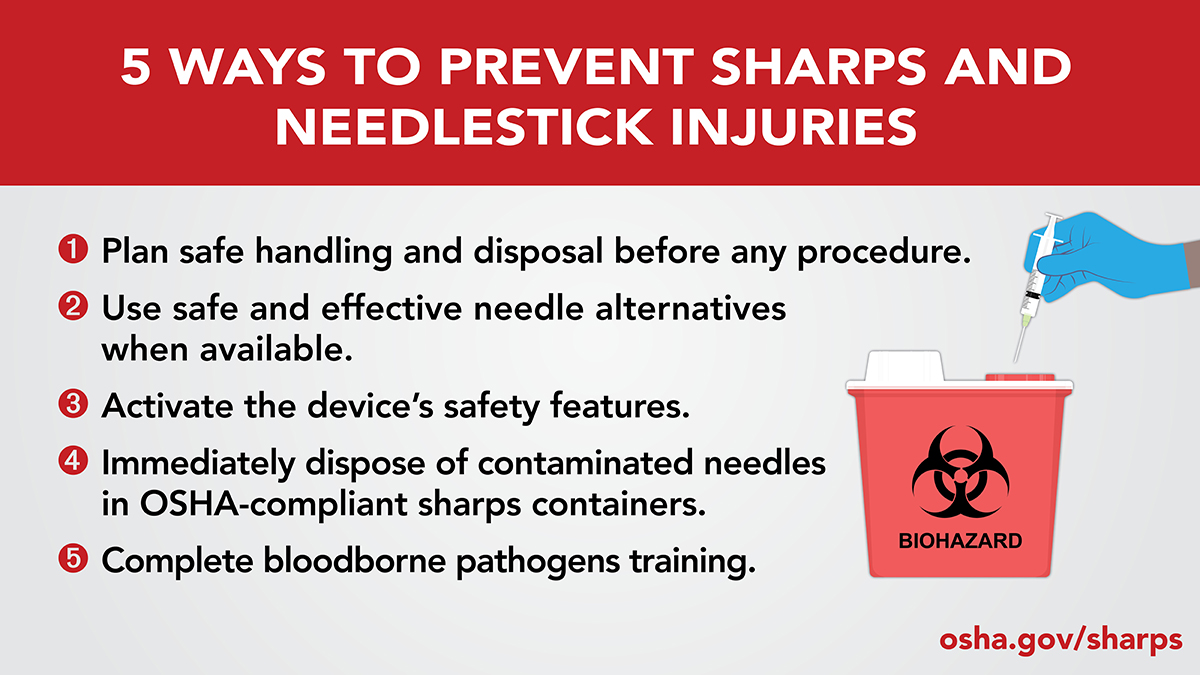
- Ensure that vaccination supplies, including sharps containers, are
conveniently located at the point of vaccination.
- Prior to performing vaccination, explain the procedure to the vaccinee, including the risk of sharps injury to the vaccinator, and the need to avoid inadvertent movement during the procedure.
- Maintain visual contact with the bifurcated needle until vaccination is completed and the needle disposed.
- Immediately dispose of the bifurcated needle in the point-of-use sharps container. (If bifurcated needles must be reprocessed, safety measure to prevent injury after use and during reprocessing should be followed.)
- If a bifurcated needle drops, pick it up carefully in such a way as to
minimize the possibility of accidental needlestick, preferably through the use of
forceps or other methods that reduce the chance of accidental needlestick. In no
event should an employee touch the sharp end of the needle.
- Dispose of vaccine vials and blood-contaminated gauze in the appropriate waste containers in accordance with applicable state, county, municipal regulations.
- Procedures for reporting and follow-up management of blood exposures at
vaccination clinics. If the creation of vaccination clinics will alter the
employer's existing procedure for exposure reporting and medical evaluation
and treatment, then this aspect of the exposure control plan will need to be
amended.
If these steps are followed diligently, the opportunity for blood exposure
and sharps injury should be minimal.
Safer medical devices
As a primary method of employee protection, the Standard requires employers
to eliminate or minimize employee exposure to blood and other potentially
infectious materials, to consider using appropriate commercially available and effective
safer medical devices such as SESIPs to meet this obligation, and to document that consideration whenever they update their exposure control plans. Only one
medical device incorporating the bifurcated needle design is part of the prepackaged
kit for the licensed Dryvax smallpox vaccine. As of January 2003, CDC has determined that
no other commercially available bifurcated needles are appropriate for
administering the smallpox vaccine being distributed in this prepackaged kit. If, in the
future, improved safety devices become commercially available, employers will be responsible
for evaluating whether any of those devices are appropriate for use at their
workplaces.
Training
The Bloodborne Pathogens Standard also requires employers to provide training
to each worker in any new tasks or procedures that affect the employee's occupational
exposure. Administration of the smallpox vaccine would be such a new task or procedure
for most workers. The materials provided by the vaccine manufacturer and the training
provided by CDC provides the foundation for meeting this requirement.
Other provisions
Other OSHA requirements are applicable to workers administering the smallpox
vaccine, including additional provisions of the Bloodborne Pathogens Standard, the Hazard Communication Standard, and recordkeeping, record retention, and
record access rules. For example, workers administering vaccine must be offered hepatitis B vaccination and appropriate follow-up, and an employer's obligations if an
employee sustains a needlestick injury during vaccine administration would be the same
as they would for any other needlestick injury. However, health care employers
are already required to comply with those requirements so no new obligations would be
imposed because of the smallpox vaccination program.
For additional information about how OSHA's Occupational Exposure to Bloodborne
Pathogens Standard (29 CFR 1910.1030) applies to healthcare workers who
administer smallpox vaccinations, please contact your local OSHA office, or the Office
of Health Enforcement at (202) 693-2190.
|
| |
|