Safety and Health Topics

Bloodborne Pathogens and Needlestick Prevention

Introduction


Needlestick injuries and other sharps-related injuries which expose workers to bloodborne pathogens continues to be an important public health concern. Workers in many different occupations are at risk of exposure to bloodborne pathogens, including Hepatitis B, Hepatitis C, and HIV/AIDS. First aid team members, housekeeping personnel in some settings, nurses and other healthcare providers are examples of workers who may be at risk of exposure.

Bloodborne Pathogens is addressed in standards specifically for the general industry.

OSHA Standards

This section highlights the OSHA standard requirements, preambles to final rules (background to final rules), directives (instructions for compliance officers), and standard interpretations (official letters of interpretation of the standards) related to bloodborne pathogens and needlestick prevention.
Note: Twenty-five states, Puerto Rico and the Virgin Islands have OSHA-approved State Plans and have adopted their own standards and enforcement policies. For the most part, these States adopt standards that are identical to Federal OSHA. However, some States have adopted different standards applicable to this topic or may have different enforcement policies.
  • 1910.1030, Bloodborne pathogens.
    • Revisions to 1910.1030 as a result of the Needlestick Safety and Prevention Act:
      • Paragraph 1910.1030(d)(2)(i) requires the use of engineering and work practice controls to eliminate or minimize employee exposure to bloodborne pathogens.
      • Employers must keep a Sharps Injury Log for the recording of percutaneous injuries from contaminated sharps [1910.1030(h)(5)(i)].
      • The Exposure Control Plan (1910.1030(c)(1)(i)) shall:
        • Reflect changes in technology that eliminate or reduce exposure to bloodborne pathogens [1910.1030(c)(1)(iv)(A)].
        • Document annually consideration and implementation of appropriate commercially available and effective safer medical devices designed to eliminate or minimize occupational exposure [1910.1030(c)(1)(iv)(B)].
        • Solicit input from non-managerial employees responsible for direct patient care, who are potentially exposed to injuries from contaminated sharps, in the identification, evaluation, and selection of effective engineering and work practice controls and shall document the solicitation in the Exposure Control Plan [1910.1030(c)(1)(v)].
    • Appendix A, Hepatitis B vaccine declination (Mandatory).
The following information provides discussion on the revised standard. Needlestick Legislation
Preambles to Final Rules Directives Standard Interpretations

Hazard Recognition

OSHA estimates that 5.6 million workers in the health care industry and related occupations are at risk of occupational exposure to bloodborne pathogens, including human immunodeficiency virus (HIV), hepatitis B virus (HBV), hepatitis C virus (HCV), and others. All occupational exposure to blood or other potentially infectious materials (OPIM) place workers at risk for infection with bloodborne pathogens. OSHA defines blood to mean human blood, human blood components, and products made from human blood. Other potentially infectious materials (OPIM) means: (1) The following human body fluids: semen, vaginal secretions, cerebrospinal fluid, synovial fluid, pleural fluid, pericardial fluid, peritoneal fluid, amniotic fluid, saliva in dental procedures, any body fluid that is visibly contaminated with blood, and all body fluids in situations where it is difficult or impossible to differentiate between body fluids; (2) Any unfixed tissue or organ (other than intact skin) from a human (living or dead); and (3) HIV-containing cell or tissue cultures, organ cultures, and HIV- or HBV-containing culture medium or other solutions; and blood, organs, or other tissues from experimental animals infected with HIV or HBV. The following references aid in recognizing workplace hazards associated with bloodborne pathogens.

Bloodborne Pathogens Needlestick

Possible Solutions

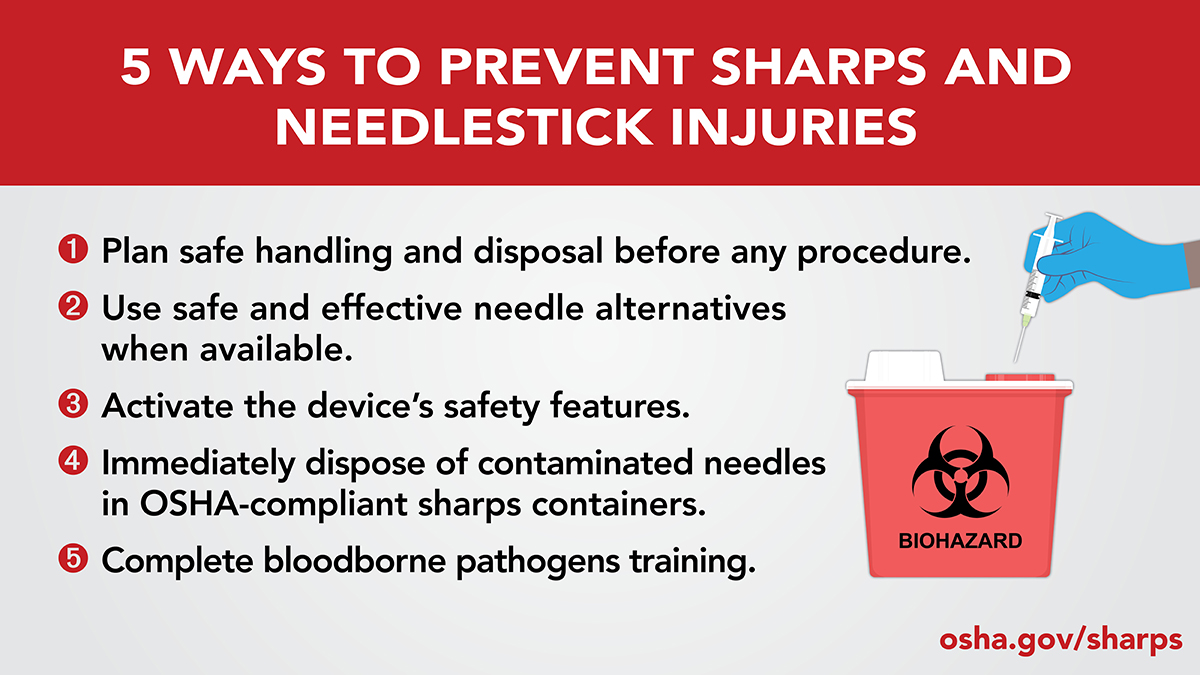
Studies show that nurses sustain the most needlestick injuries and that as many as one-third of all sharps injuries occur during disposal. The Centers for Disease Control and Prevention (CDC) estimates that 62 to 88 percent of sharps injuries can be prevented simply by using safer medical devices. The following references provide information regarding possible solutions for bloodborne pathogens and needlestick hazards. 

Please Note: Articles/references that are dated before April 18, 2001 may not reflect the changes of the new Bloodborne Pathogens Standard but still provide relevant, general information.

Control Programs Safer Needle Devices Decontamination
  • Selected EPA-registered Disinfectants. Environmental Protection Agency (EPA), (2008, June 30). Includes lists of EPA registered anti-microbial products to assist in choosing the appropriate decontaminant.

Post-exposure Evaluation

According to the NIOSH Alert Preventing Needlestick Injuries in Health Care Settings, it is estimated that 600,000 to 800,000 needlestick injuries (NSIs) and other percutaneous injuries (PIs) occur annually among health care workers. PIs are caused by sharp objects such as hypodermic needles, scalpels, suture needles, wires, trochanters, surgical pins, and saws. Additional exposure incidents include splashes and other contact with mucous membranes or non-intact skin. Post-exposure management is an integral part of a complete program for preventing infection following exposure incidents. 

The following references provide useful information about the management of occupational exposure incidents to blood or other potentially infectious materials.

Additional Information

Related Safety and Health Topics Pages Training
  • Training Resources. OSHA. Contains training and reference materials related to bloodborne pathogens.
  • OSHA's Revised Bloodborne Pathogens Standard. OSHA, (2001), 34 slides. Covers safe needle devices and provides new definitions from the revised standard.
  • Bloodborne Pathogens [1 MB ZIP*]. OSHA, (2001, December 17). Assists trainers conducting OSHA 10-hour general industry outreach training for workers. Since workers are the target audience, the material emphasizes hazard identification, avoidance, and control — not standards.
  • Public Health Training Network Catalog. Centers for Disease Control and Prevention (CDC), Public Health Training Network (PHTN). Browse for distance learning courses and resources.
OSHA Resources

Publications Additional Resources Other Resources
Accessibility Assistance: Contact the OSHA Directorate of Technical Support and Emergency Management at (202) 693-2300 for assistance accessing PDF materials.

*These files are provided for downloading.


Page last reviewed: 01/22/2009
Page current as of: 05/24/2010