<< Back to Small Business Forums
Small Business Forum Questions: H1N1 Influenza Preparedness
- Respirators:
- Are workers who wear N95 Respirators required to receive fit tests and
medical evaluations as they normally would during the flu season or during a
pandemic?
Answer: If an employer requires a worker to wear a respirator to do his/her job,
then the worker must be fit tested and medically evaluated prior to its use and
periodically thereafter in accord with OSHA’s Respiratory Protection Standard.
Respirators must be used in the context of a comprehensive respiratory
protection program, (see OSHA standard 29 CFR 1910.134 or
OSHA's home page) which
includes:
- Selection
- Medical evaluation
- Fit testing
- Proper use
- Maintenance and care
- Training
- Written program
- Program evaluation
- Are employers required to have a respiratory protection program?
Answer: If an employer requires a worker to wear a respirator to do his/her job,
then the employer must have a comprehensive, written respiratory protection
program that meets the requirements of 29 CFR 1910.134(c). Please see the list
in question 1.
- Are healthcare workers who perform high-risk procedures required to use
respiratory protection during the tasks that expose them to greater risk of
being infected?
Answer: The Centers for Disease Control and Prevention (CDC) recommends and OSHA
requires the use of a fit-tested N95 disposable respirator or better for
healthcare personnel whose job duties require them to be in close contact
(within 6 feet or entering into a small enclosed airspace (e.g., average patient
room) with confirmed or suspected 2009 H1N1 flu patients and for personnel
performing high-risk aerosol-generating procedures on such patients.
Please see OSHA’s compliance directive regarding enforcement procedures for high
to very high occupational exposure risk to 2009 H1N1 influenza:
CPL-02-02-075 - Enforcement Procedures for High to Very High Occupational
Exposure Risk to 2009 H1N1 Influenza [PDF* - 242 KB].
OSHA requires employers to provide a fit-tested N95 disposable respirator or
better to protect workers performing these types of tasks (i.e., high and very
high exposure risk tasks). OSHA also expects that healthcare employers will
implement a combination of workplace controls and work practices beyond just the
use of respirators.
For additional information, see OSHA’s Fact Sheet,
Healthcare Workplaces
Classified as Very High or High Exposure Risk for Pandemic Influenza and booklet
Pandemic Influenza Preparedness and Response Guidance for Healthcare Workers and
Healthcare Employers.
- Will hospitals be cited if they tried to get respirators and they were not
available (since most are manufactured outside of the U.S.)?
Answer: Where respirators are not commercially available, an employer will be
considered to be in compliance if the employer can show that a good faith effort
has been made to acquire respirators. The employer will also need to implement a
hierarchy of controls such as feasible engineering controls, administrative
controls, and the use, as appropriate, of other personal protective equipment,
such as gloves and facemasks to protect workers while providing close-contact
care. Engineering and administrative controls include: (1.) Taking steps to
eliminate the hazard when feasible (e.g., postponing elective procedures for
persons with suspected or confirmed influenza); (2.) Using engineering controls
to eliminate or reduce exposure (e.g., use airborne infection isolation rooms [AIIR]
for very high exposure risk procedures); (3.) Using administrative controls
(e.g., provide and promote vaccination at no cost to workers); (4.) Using work
practices (e.g., promote hand hygiene and cough etiquette); and (5.) Providing
and ensuring the use of personal protective equipment, including respiratory
protection, and provide proper training to affected workers).
- Response to worker complaints:
- How will OSHA address worker complaints regarding H1N1 Influenza exposure?
Answer: OSHA will follow the standard procedures for handling complaints and
referrals. See OSHA Field
Operations Manual (FOM) (OSHA Instruction CPL 02-00-150). Complaint and Referral Processing where it states when
it is determined that a complaint meets the criteria for a formal complaint, or
a referral is generated from one of the sources identified in the FOM as a
Referral agency, an onsite inspection shall be initiated. Where the inspection
criteria for formal complaints and referrals are not met, non-formal complaint
procedures shall be followed.
If an on-site inspection is initiated, OSHA Inspectors will ensure that
healthcare employers implement a hierarchy of controls (e.g., source controls,
engineering and administrative controls and personal protective equipment),
encourage vaccination, and other work practices recommended by the Centers for
Disease Control and Prevention (CDC). Where respirators are required to be used,
the OSHA Respiratory Protection standard must be followed. See 29 CFR 1910.134.
- How will OSHA classify complaints (re: determination of "serious hazard" or a
letter response)?
Answer: OSHA will follow the standard procedure for handling complaints and
referrals. The procedure is set forth in OSHA’s Field Operations Manual (FOM),
Chapter 9, Complaint and Referral Processing and OSHA’s compliance directive
regarding enforcement procedures for high to very high occupational exposure
risk to 2009 H1N1 influenza:
CPL-02-02-075 - Enforcement Procedures for High to Very High Occupational
Exposure Risk to 2009 H1N1 Influenza [PDF* - 242 KB].
Please see the answer to B-1 above.
- Requirements for a Written Plan:
- CDC emphasizes the importance of employers having a written plan for H1N1.
Will there be any requirements imposed for a written plan?
Answer: Like CDC, OSHA recommends that employers develop a disaster plan that
includes pandemic preparedness (see OSHA’s guidance document Guidance on
Preparing Workplaces for an Influenza Pandemic [PDF*
- 615 KB]. OSHA requires employers to
conduct a hazard assessment and determine if personal protective equipment (PPE)
is necessary. This requirement is identified in 29 CFR 1910.132(d) and must be
verified through a written certification as noted in (d)(2). And, where
respirators are required, OSHA requires employers to have a written program that
covers all of the elements identified in the Respiratory Protection Standard, 29
CFR 1910.134, paragraph (c).
- Communications/Response to H1NI:
- Once a pandemic begins, should employers mandate alternative work schedules
or arrangements or promote social distancing?
Answer: At present, the U.S. Department of Health and Human Services (HHS)/Centers
for Disease Control and Prevention (CDC) and OSHA are not recommending that
employers mandate the use of alternative work schedules or social distancing for
2009 H1N1 flu. However, both HHS/CDC and OSHA recommend that employers plan how
they would use social distancing and scheduling flexibilities in the workplace
so that both could be implemented quickly if the severity of the 2009 H1N1 flu
increases. The decision about when and to what extent these types of precautions
should be used generally will be based on the characteristics of the virus
circulating at the time. OSHA’s experience with 2009 H1N1 flu has indicated that
many employers were not prepared and did not have plans in place to address an
influenza pandemic. Because of this, it is important that employers plan now for
the worst case – a severe pandemic with high mortality and high absenteeism –
and then scale the implementation of the plan during a pandemic according to the
specific situation.
- When communicating with workers, are there restrictions on the type of
information that may be shared?
Answer: The Department of Labor (DOL) developed responses to common workplace
questions and posted the information on
Flu.gov. The following response is
from the Q&As on that website:
"Keep in mind that you may not be familiar with all of your individual
employees’ personal circumstances and that on occasion, sharing private contact
information or other personal information among employees may be objectionable
for any number of legitimate reasons. In certain instances, under federal equal
employment opportunity law, employers may be liable for workplace harassment.
We strongly encourage you to limit the information collected to only that which
is necessary, and limit the individuals with whom the information is shared,
unless you have the consent of your employees.
The
Americans with Disabilities Act (ADA) allows employers to share employees’
otherwise confidential medical information in limited circumstances. One of
these exceptions allows an employer to disclose an employee’s medical
information to her supervisor(s) and/or manager(s) where necessary to meet an
employee’s work restrictions.
In the event of an influenza pandemic, an employer may alert a supervisor of an
employee’s pandemic illness so that the supervisor can implement necessary work
restrictions for public health and safety reasons. (See the U.S. Equal
Employment Opportunity Commission’s publication,
The ADA: A Primer for Small
Business, pp. 10-11, for additional information.)
For additional information on privacy issues related to pandemic influenza, see
Flu FAQ Results for: sick employee, privacy."
- May employers mandate that workers stay home if they are known or suspected
to have been exposed to H1N1?
Answer: The Department of Labor (DOL) developed responses to common workplace
questions and posted the information on
Flu.gov. The following response is
from the Q&As on that website:
"It is important to prepare a plan of action specific to your workplace, given
that a pandemic influenza outbreak could affect many employees. This plan or
policy could permit you to send employees home, but the plan and the employment
decisions must comply with the laws prohibiting discrimination in the workplace
on the basis of race, sex, age (40 and over), color, religion, national origin,
disability, or veteran status. It would also be prudent to notify employees (and
if applicable, their bargaining unit representatives) about decisions made under
this plan or policy at the earliest feasible time.
Your company policies on sick leave, and any applicable employment contracts or
collective bargaining agreements would determine whether you should provide paid
leave to employees who are not at work. If the leave qualifies as
Family and
Medical Leave Act protected leave, the statute allows the employee to elect or
the employer to require the substitution of paid sick and paid vacation/personal
leave in some circumstances. (See the U.S. Department of Labor, Employment
Standards Administration’s
Wage and Hour Division for additional information or
call 1-866-487-9243 if you have any questions.)
Remember when making these decisions to exclude employees from the workplace,
you cannot discriminate on the basis of race, sex, age (40 and over), color,
religion, national origin, disability, union membership or veteran status.
However, you may exclude an employee with a disability from the workplace if
you:
- obtain objective evidence that the employee poses a direct threat (i.e.,
significant risk of substantial harm); and
- determine that there is no available reasonable accommodation (that would not
pose an undue hardship) to eliminate the direct threat.
(See the U.S. Equal Employment Opportunity Commission’s
Enforcement Guidance:
Disability-Related Inquiries and Medical Examinations of Employees under the
Americans with Disabilities Act for additional information.)"
- Are there any job protections for working parents who may have to stay home
if schools close?
Answer: The Department of Labor (DOL) developed responses to common workplace
questions and posted the information on
Flu.gov. The following response is
from the Q&As on that website:
"Covered employers must abide by the
Family and Medical Leave Act (FMLA) as well
as any applicable
state FMLA laws. An employee who is sick, or whose family
members are sick, may be entitled to leave under the FMLA. The FMLA entitles
eligible employees of covered employers to take up to 12 weeks of unpaid,
job-protected leave in a designated 12-month leave year for specified family and
medical reasons which may include the flu where complications arise that create
a "serious health condition" as defined by the FMLA.
There is currently no federal law covering employees who take off from work to
care for healthy children, and employers are not required by federal law to
provide leave to employees caring for dependents that have been dismissed from
school or child care. However, given the potential for significant illness under
some pandemic influenza scenarios, employers should review their leave policies
to consider providing increased flexibility to their employees and their
families. Remember that federal law mandates that any flexible leave policies
must be administered in a manner that does not discriminate against employees
because of race, color, sex, national origin, religion, age (40 and over),
disability, or veteran status."
- Vaccines:
- What are the quality control requirements in the production of vaccines to
ensure that they are safe for patients?
Answer: The Food and Drug Administration (FDA) establishes and enforces quality
assurance procedures for all pharmaceutical manufacturing processes, including
the manufacture of vaccines. In addition, new vaccine development requirements
specify that the manufacturer demonstrate that the vaccine is able to produce
the required immune response (demonstrated by antibody testing) and that its
administration is without severe side effects. FDA’s quality control efforts are
complemented by multiple Centers for Disease Control and Prevention (CDC)
programs to ensure that the vaccines are safe. The CDC's Immunization Safety
Office (ISO) continuously monitors the benefits and risks of U.S. vaccines. The
CDC, with the FDA, administers the Vaccine Adverse Event Reporting System (VAERS).
The CDC collaborates with eight managed care organizations to collect
vaccination data on more than 5.5 million people annually through the Vaccine
Safety Datalink (VSD) Project and works with scientists from 71 countries to
develop standardized case definitions and guidelines for vaccine adverse events
(through the Brighton Collaboration). The CDC also collaborates with six
academic centers to investigate pathophysiologic mechanisms and biologic risks
of vaccine adverse events through the Clinical Immunity Safety Assessment (CISA)
program. Please refer to the CDC website addressing questions of
H1N1 vaccine
safety and to the CDC
Immunization Safety Office website for more detailed information on vaccine
safety programs.
- What is OSHA’s position on employers requiring vaccinations as a precondition
for employment?
Answer: OSHA does not require employers to require vaccination as a precondition
for employment.
- Infection Control Practices:
1. During a pandemic, should an employer require its workers to adopt infection
control practices?
Answer: OSHA encourages employers to establish and implement policies that
promote infection control based on public health best practices. OSHA’s guidance
for a severe influenza pandemic and its guidance for 2009 H1N1 flu includes
basic hygiene precautions that all employers should use to reduce flu
transmission in the workplace, including hand washing, cough etiquette,
encouraging sick workers to stay home, keeping commonly touched surfaces clean,
and vaccine promotion.
- Recordkeeping:
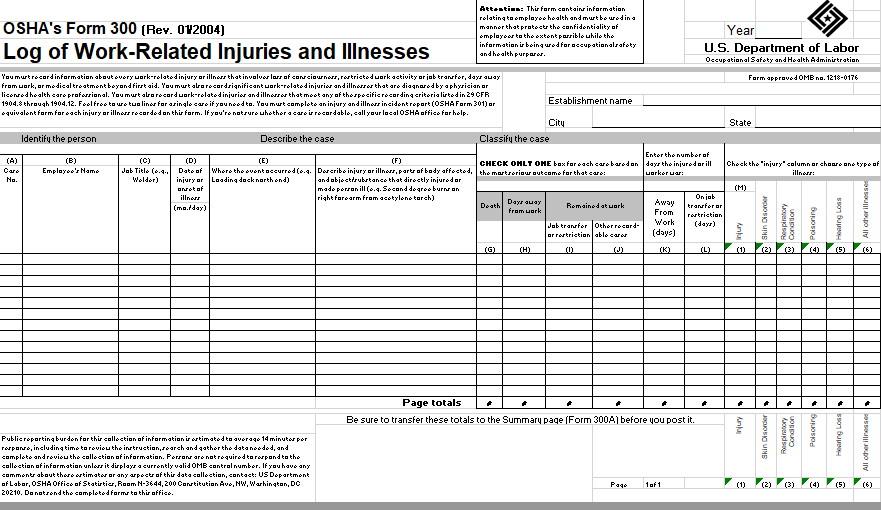
- What instances regarding H1N1 should be recorded on the OSHA 300 log by
employers?
Answer: Employers are responsible for recording cases of 2009 H1N1 illness if
all of the following requirements are met: (1) the case is a confirmed case of
2009 H1N1 illness as defined by the Centers for Disease Control and Prevention
(CDC); (2) the case is work relatedas defined by 1904.5; and (3) the case
involves one or more of the recording criteria set forth in 1904.7 (e.g.,
medical treatment, days away from work). The work-related exception for the
common cold or flu does not apply to these cases. See 29 CFR 1904.5.
- Employees Without Sick Leave
- What is the Federal government doing to aid workers who do not have sick
leave? What are the states doing?
Answer: The U.S. Department of Labor (DOL) and other federal agencies are
currently reviewing federal statutes and regulations that may affect employers
and employees during the unique circumstance where the U.S. experiences a severe
influenza pandemic. Decisions have not yet been made as to whether any changes
are needed. Answers to questions such as this one are based on current laws and
regulations.
DOL developed responses to common workplace questions and posted the information
on
Flu.gov. The following response is from the Q&As on that website:
An employee who is sick or whose family members are sick may be entitled to
leave under the
Family and Medical Leave Act (FMLA) under certain circumstances.
The FMLA entitles eligible employees of covered employers to take up to 12 weeks
of unpaid, job-protected leave in a designated 12-month leave year for specified
family and medical reasons which may include the flu where complications arise
that create a "serious health condition" as defined by the FMLA. Employees on
FMLA leave are entitled to the continuation of group health insurance coverage
under the same conditions as coverage would have been provided if the employee
had been continuously employed during the leave period.
Workers who are ill with pandemic influenza or have a family member with
influenza are urged to stay home to minimize the spread of the pandemic.
Employers are encouraged to support these and other community mitigation
strategies and should consider flexible leave policies for their employees. (See
Community Planning - Flu.gov.)
Accessibility Assistance:
Contact the OSHA Directorate of Cooperative and State Programs at 202-693-2200
for assistance accessing PDF materials.
*These files are provided for downloading.
|