Department of Labor Seal photos representing the workforce - digital imagery© copyright 2001 photodisc, inc.
Department of Labor Seal www.osha.gov   [skip navigational links] Search    Advanced Search | A-Z Index
Powered Industrial Trucks   Powered Industrial Trucks
  Other Federal Standards

Other federal agencies have standards relevant to powered industrial trucks. The following is an overview of the major laws enacted, regulations, training requirements, and other resources:
US Department of Labor (DOL)

Note: These are NOT OSHA regulations. However, they do provide guidance from their originating organizations related to worker protection, and may be referenced by OSHA inspectors for informational purposes.
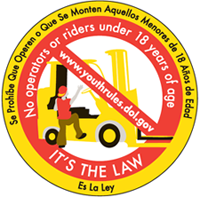
  • 29 CFR 570 Subpart E, Occupations Particularly Hazardous for the Employment of Minors Between 16 and 18 Years of Age or Detrimental to Their Health or Well-Being. Employment Standards Administration (ESA) Child Labor Laws. The operation of a forklift by anyone under 18 years of age is in violation of this law.
    • 29 CFR 570.58, Occupations involved in the operation of power-driven hoisting apparatus (Order 7). Paragraph (a)(1), specifically prohibits employees under 18 years of age from operating forklifts in non-agricultural employment.
  • Youth Employment Provisions for Nonagricultural Occupations Under the Fair Labor Standards Act. US Department of Labor (DOL) Employment Standards Administration (ESA), Wage and Hour Division (WHD), Child Labor Bulletin 101, (2005, February), 346 KB PDF, 23 pages. Serves as a guide to the provisions of the FLSA (also known as the "Wage-Hour Law"), which applies to minors employed in non-agricultural occupations.
  • Fact Sheet #43: Child Labor Provisions of the Fair Labor Standards Act (FLSA) For Nonagricultural Occupations. Provides general information about the Federal youth employment provisions applicable to non-agricultural occupations.
US Department of Transportation (DOT)

Note: These are NOT OSHA regulations. However, they do provide guidance from their originating organizations related to worker protection, and may be referenced by OSHA inspectors for informational purposes.

DOT regulations focus on the transportation requirements for "hazardous materials," which include low-level radioactive waste. These regulations govern, for example, the types of containers that must be used for various materials, labeling on containers and vehicles, and papers that must accompany each shipment.
  • 49 CFR 107, Hazardous materials program procedures
  • 49 CFR 171, General information, regulations, and definitions
  • 49 CFR 172, Hazardous materials table, special provisions, hazardous materials communications, emergency response information, and training requirements. In 1992 Congress passed amendments to 49 CFR, Subpart H of Part 172.704 and 49 CFR 173.1. Congress directed OSHA to develop a standard to protect workers involved with loading, unloading, handling, marking, labeling, preparing, or representing or transporting hazardous materials that are listed in DOT's List of Hazardous Substances and Reportable Quantities:
    • 49 CFR 172.704. Specify differing amounts of training depending on job function and role.
      • 49 CFR 172.704(a)(1). Includes shipping papers, the DOT Hazardous Materials Table, packaging and ship materials, and the safe loading and unloading of hazardous materials.
      • 49 CFR 172.704 (a)(3). Includes identifying hazardous materials, self-protection and employer-provided protection methods, emergency response procedures, and transportation mode-specific training.
      • 49 CFR 172.704 (a)(4). Includes the new requirement for security awareness training and how to recognize and respond to possible security threats within 90 days of employment.
      • 49 CFR 172.704 (a)(5). Contains the new requirements for in-depth security awareness training, including a company security plan, company security objectives, employee responsibilities, actions to take in the event of a security breach, and the organizational security structure.
      • OSHA-required, EPA-required and other training provided by employers may be used to satisfy the training requirements specified in 49 CFR 172.704(a) to the extent that such training addresses the training components.
  • 49 CFR 173, Shippers — General requirements for shipments and packagings. The training requirements specify differing amounts of classroom training for workers subject to the standards according to their job functions and roles they may serve.
  • 49 CFR 174, Carriage by rail
  • 49 CFR 175, Carriage by aircraft
  • 49 CFR 176, Carriage by vessel
  • 49 CFR 177, Carriage by public highway
  • 49 CFR 178, Specifications for packagings
  • Letters of Clarification on Hazardous Materials Regulations (49 CFR Parts 100 - 185). Docket Management System (DMS).
Environmental Protection Agency (EPA)

Note: These are NOT OSHA regulations. However, they do provide guidance from their originating organizations related to worker protection, and may be referenced by OSHA inspectors for informational purposes.

The EPA's mission is to protect human health and to safeguard the natural environment — air, water, and land — upon which life depends. The agency also works with industries and all levels of government in a wide variety of voluntary pollution prevention programs and energy conservation efforts.
  • Forklifts, Generators, and Compressors (gasoline/propane). Covers nonroad spark-ignition engines over 19 KW(25 hp). Includes many types of equipment, including forklifts and generators.
  • Frequently Asked Questions: Environmental Impacts of Newly Regulated Nonroad Engines. EPA420-F-02-033, (2002, September), 24 KB PDF, 5 pages. Nonroad engines powered by gasoline, liquid propane gas (LPG), or compressed natural gas rated over 25 horsepower, including forklifts which are used in commercial and industrial applications, are now covered by EPA emission standards.
  • California Air Resources Board (ARB)
    • ARB Modifies Zero Emission Vehicle Regulation. News Release, (2003, April 24). The ARB voted to make modifications and upgrades to the state's zero emission vehicle (ZEV) program. A ZEV essentially produces no emissions as it operates.
    • ARB has mandated that manufacturers deliver certified compliant clean air engines into California commerce under the following schedule:
      • 25% of all LPG or gasoline engine powered forklifts sold in 2001 must comply.
      • 50% of all LPG or gasoline engine powered forklifts sold in 2002 must comply.
      • 75% of all LPG or gasoline engine powered forklifts sold in 2003 must comply.
      • 100% of all LPG or gasoline engine powered forklifts sold in 2004 must comply.
Radioactive Material

It is estimated that more than 4 million packages containing radioactive material are transported in commerce annually within the United States. To date, there have been no known deaths or serious injuries to transport workers, emergency services personnel, or the general public as a result of the radioactive nature of the material. This safety record can be attributed to the proper packaging of radioactive material and the effectiveness of the transportation safety standards and regulations.
  • 40 CFR 264, Standards for owners and operators of hazardous waste, treatment, storage, and disposal facilities. Includes the training requirements of 40 CFR 264.16.
Nuclear Regulatory Commission (NRC)

Note: These are NOT OSHA regulations. However, they do provide guidance from their originating organizations related to worker protection, and may be referenced by OSHA inspectors for informational purposes.

Radioactive Material

NRC regulations establish licensing requirements for low-level radioactive waste disposal facilities and standards for packaging and shipping low-level radioactive waste. A commercial low-level radioactive waste disposal facility must obtain a license from the NRC before it can begin operations. 10 CFR 61 establishes the standards for issuing a license to a low-level waste disposal facility. The training requirements for workers are:
  • 10 CFR 19, Notices, instructions and reports to workers: Inspection and investigations. Includes the training requirements found in 10 CFR 19.12.
 Safety and
 Health Topics
 
  Powered Industrial Trucks
  OSHA Standards
  Other Federal Standards
  National Consensus Standards
  Hazards and Solutions
  Additional
Information
  Credits
 
Content Reviewed 07/12/2005


Back to Top Back to Top www.osha.gov www.dol.gov

Contact Us | Freedom of Information Act | Customer Survey
Privacy and Security Statement | Disclaimers
Occupational Safety & Health Administration
200 Constitution Avenue, NW
Washington, DC 20210