


Occupational Noise Exposure
Overview

The Center for Disease Control (CDC) estimates that 22 million workers are exposed to potentially damaging noise at work each year. Whether you work at a sports venue, entertainment establishment, on a tarmac, or operate a jackhammer—hearing loss is preventable.
Know Your Workplace Noise Levels!
Noise levels are measured in decibels, and exposure over 85 decibels can damage your hearing. If you need to raise your voice to speak to someone 3 feet away, noise levels might be over 85 decibels (dBA). There are several types of instruments available to measure the noise levels in a workspace. These include sound level meters, noise dosimeters, octave band analyzers, and apps for phones.
Noise is likely a problem in your workplace if you:
- Hear ringing or humming in your ears when you leave work.
- Have to shout to be heard by a coworker an arm's length away.
- Experience temporary hearing loss when leaving work.
The National Institute for Occupational Safety and Health (NIOSH) Sound Level Meter App is one tool available to the public to download on mobile iOS devices for screening sound levels in the workplace.
Standards
OSHA requires employers at general industry, maritime, and longshoring worksites to implement a hearing conservation program when employee noise exposures equal or exceed 85 decibels (dBA) as an 8-hour time-weighted average (TWA). Hearing conservation programs strive to prevent initial occupational hearing loss, preserve and protect remaining hearing, and equip workers with the knowledge and hearing protection devices necessary to safeguard themselves. In addition, engineering or administrative controls (which may include elimination and substitution of noise sources) are required when noise exposure is above 90 dBA as an 8-hour TWA (see 1910.95, Table G-16).
Health Effects
Exposure to loud noise can damage and kill hearing receptor cells in our inner ear. The result is permanent hearing loss that cannot be corrected through surgery or with medicine. Noise-induced hearing loss limits your ability to hear high frequency sounds and understand speech, seriously impairing communication. Hearing aids may help, but they do not restore your hearing to normal.
Exposure & Controls
Hearing loss can be prevented through methods that control exposure to excessive noise. Some of these methods include using quieter machines, isolating the noise source, limiting worker exposure, or using effective hearing protective devices.
Hearing Conservation Program
Under OSHA's Noise Standard, the main elements of an effective hearing conservation program include exposure monitoring, audiometric testing, hearing protection, and training.
Noise in Construction
Noise and hearing conservation are addressed in specific standards for Construction. In this industry, OSHA requires implementation of administrative or engineering controls, as well as a continuing, effective hearing conservation program, whenever exposures exceed 90 dBA as an 8-hour TWA. This section provides information related to noise in construction including OSHA's noise construction standards, national consensus standards and recommendations from other professional organizations, health effects, and general resources.
Additional Resources
Additional information about occupational hearing loss and addressing noise challenges in the workplace.
What do I need to know about the anatomy and physiology of the ear?
The ear is the organ that makes hearing possible. It can be divided into three sections:
- The external outer ear
- The air-filled middle ear
- The fluid-filled inner ear
Outer Ear
The parts of the outer ear include:

- Pinna
- The pinna is the visible portion that is generally referred to as "the ear."
- Its function is to localize sound sources and direct sound into the ear.
- The dimensions and folds of the pinna cause certain sound frequencies to be amplified and other frequencies to be weakened.
- Each individual's pinna puts a distinctive imprint on the acoustic wave traveling into the auditory canal.
- External Auditory Meatus (ear canal)
- The ear canal extends from the pinna to the eardrum and is about 26 millimeters (mm) long and 7 mm in diameter. Size and shape vary among individuals. This is an important factor to consider when fitting hearing protectors.
- The ear canal protects the eardrum and acts as a resonator, providing about 10 decibels (dB) of gain to the eardrum at around 3,300 Hertz (Hz).
- The net effect of the head, pinna, and ear canal is that sounds in the 2,000 to 4,000 Hz region are amplified by 10 to 15 dB.
- Sensitivity to sounds is greatest in this frequency region and noises in this range are the most hazardous to hearing.
- Tympanic Membrane (eardrum)
- The eardrum separates the outer ear from the middle ear, creating a barrier that protects the middle and inner areas from foreign objects. It is somewhat cone-shaped in appearance and is about 17.5 mm in diameter.
- The eardrum vibrates in response to sound pressure waves. The actual distance that the membrane moves is incredibly small (as little as one-billionth of a centimeter).
Middle Ear
The purpose of the middle ear is to conduct sound from the outer ear to the inner ear. There are three main features of the middle ear:

- Ossicles (bones). The malleus (hammer), incus (anvil), and stapes (stirrup) make up the ossicles.
- The primary function of the middle ear is to transform the vibrating motion of the eardrum into motion of the stapes. The middle ear enhances the transfer of this acoustical energy in two ways:
- The area of the eardrum is about 17 times larger than the oval window (see inner ear). The effective pressure (force per unit area) is increased by this amount.
- The ossicles produce a lever action that further amplifies the pressure. As a result, most of the energy entering normal ears through the eardrum is transmitted into motion of the stapes and stimulation of the inner ear system.
- Without the transformer action of the middle ear, only about 1/1000 of the acoustic energy in the air would be transmitted to the inner-ear fluids (a loss of about 30 dB).
- The malleus and the incus vibrate together, transmitting the sound waves from the eardrum to the footplate of the stapes (this pushes the oval window in and out).
- The primary function of the middle ear is to transform the vibrating motion of the eardrum into motion of the stapes. The middle ear enhances the transfer of this acoustical energy in two ways:
- Muscles. These include the tensor tympani and the stapedius.
- Attached to the malleus and stapes, the stapedius and tensor tympani muscles help keep the ossicles in their correct position and protect the internal ear from excessive sound levels.
- When the ear is exposed to sound levels above 80 dB, the muscles contract, decreasing energy transferred to the oval window.
- This protective reflex, known as the "aural reflex," does not actually react fast enough to protect against impulse sounds; the muscles do not stay contracted long enough to protect hearing from long-term steady exposure.
- Eustachian Tube
- The eustachian tube connects the front wall of the middle ear with the nasal air passages.
- The eustachian tube also operates like a valve, which opens during swallowing.
- This equalizes the pressure on either side of the eardrum, which is necessary for optimal hearing. Without this function, a difference between the static pressure in the middle ear and the outside pressure may develop, causing the eardrum to displace inward or outward. This reduces the efficiency of the middle ear and less acoustic energy will be transmitted to the inner ear.
Inner Ear
The purpose of the inner ear is to convert mechanical sound waves to neural impulses that the brain can recognize. The sensory receptors responsible for neural impulse initiation in the auditory nerve are contained in the cochlea of the inner ear.

- The cochlea resembles a snail shell and spirals for about 2 3/4 turns around a bony column.
- Within the cochlea are three canals. They are called:
- The Scala Vesibuli
- The Scala Tympani (a bony shelf, called the spiral lamina, along with the basilar membrane and the spiral ligament, separate the upper scala vestibuli from the lower scala tympani)
- The Scala Media (cochlear duct)
- The scala media is a triangular-shaped duct that contains the organ of hearing, called the "organ of Corti."
- The basilar membrane, narrowest and stiffest near the oval window and widest at the tip of the cochlea, helps form the floor of the cochlear duct.
- The cochlear duct is separated from the scala vestibuli by Reissner's membrane.
Hair Cells and Cilia
- The surface of the basilar membrane contains phalangeal ("finger-like") cells that support the critical hair cells of the organ of Corti.
- The hair cells are arranged with an inner row of about 3,500 hair cells and three to five rows of approximately 12,000 outer hair cells.
- The cilia of the hair cells extend along the entire length of the cochlear duct and are embedded in the undersurface of the tectorial membrane.
- In general, the hair cells at the base of the cochlea respond to high-frequency sounds, while those at the apex respond to low-frequency sounds. When hair cells are damaged, they can no longer respond to sound appropriately and permanent hearing loss occurs.

Activity in the Cochlea
- The movement of the stapedial footplate in and out of the oval window moves the fluid in the scala vestibuli.
- This fluid pulse travels up the scala vestibuli but causes a downward shift of the cochlear duct, along with distortion of Reissner's membrane and a displacement of the organ of Corti.
- The activity is then transferred through the basilar membrane to the scala tympani.
- At the end of the cochlea, the round window acts as a relief point and bulges outward when the oval window is pushed inward.
- The vibration of the basilar membrane causes a pull, or shearing force, of the hair cells against the tectorial membrane.
- This bending of the hair cells activates the neural endings, transforming sound into an electrochemical response.
- This response travels through the vestibulocochlear nerve and the brain interprets the signal as sound.
How loud is too loud?
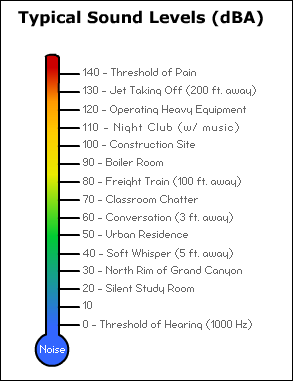
A wide variety of noise sources may exist in the workplace. The NIOSH Sound Level Meter App is a tool to measure sound levels in the workplace and provide noise exposure parameters to help reduce occupational noise-induced hearing loss.
A more detailed explanation of common terms, good program elements, and implementation steps can be found in NIOSH Document: Preventing Occupational Hearing Loss - A Practical Guide, Publication No. 96-110, (October 1996).
Noise is measured in units of sound pressure levels called decibels, named after Alexander Graham Bell, using A-weighted sound levels (dBA). The A-weighted sound levels closely match the perception of loudness by the human ear. Decibels are measured on a logarithmic scale which means that a small change in the number of decibels results in a huge change in the amount of noise and the potential damage to a person's hearing.
OSHA sets legal limits on noise exposure in the workplace. These limits are based on a worker's time weighted average over an 8 hour day. With noise, OSHA's permissible exposure limit (PEL) is 90 dBA for all workers for an 8 hour day. The OSHA standard uses a 5 dBA exchange rate. This means that when the noise level is increased by 5 dBA, the amount of time a person can be exposed to a certain noise level to receive the same dose is cut in half.
The National Institute for Occupational Safety and Health (NIOSH) has recommended that all worker exposures to noise should be controlled below a level equivalent to 85 dBA for eight hours to minimize occupational noise induced hearing loss. NIOSH has found that significant noise-induced hearing loss occurs at the exposure levels equivalent to the OSHA PEL based on updated information obtained from literature reviews. NIOSH also recommends a 3 dBA exchange rate so that every increase by 3 dBA doubles the amount of the noise and halves the recommended amount of exposure time.
Here's an example: OSHA allows 8 hours of exposure to 90 dBA but only 2 hours of exposure to 100 dBA sound levels. NIOSH would recommend limiting the 8 hour exposure to less than 85 dBA. At 100 dBA, NIOSH recommends less than 15 minutes of exposure per day.
In 1981, OSHA implemented new requirements to protect all workers in general industry (e.g. the manufacturing and the service sectors) for employers to implement a Hearing Conservation Program where workers are exposed to a time weighted average noise level of 85 dBA or higher over an 8 hour work shift. Hearing Conservation Programs require employers to measure noise levels, provide free annual hearing exams and free hearing protection, provide training, and conduct evaluations of the adequacy of the hearing protectors in use unless changes to tools, equipment and schedules are made so that they are less noisy and worker exposure to noise is less than the 85 dBA.
What can be done to reduce the hazard from noise?


Noise controls are the first line of defense against excessive noise exposure. The use of these controls should aim to reduce the hazardous exposure to the point where the risk to hearing is eliminated or minimized. With the reduction of even a few decibels, the hazard to hearing is reduced, communication is improved, and noise-related annoyance is reduced. There are several ways to control and reduce worker exposure to noise in a workplace.
Engineering controls that reduce sound exposure levels are available and technologically feasible for most noise sources. Engineering controls involve modifying or replacing equipment, or making related physical changes at the noise source or along the transmission path to reduce the noise level at the worker's ear. In some instances the application of a relatively simple engineering noise control solution reduces the noise hazard to the extent that further requirements of the OSHA Noise standard (e.g., audiometric testing (hearing tests), hearing conservation program, provision of hearing protectors, etc…) are not necessary. Examples of inexpensive, effective engineering controls include some of the following:
- Choose low-noise tools and machinery (e.g., Buy Quiet Roadmap (NASA)).
- Maintain and lubricate machinery and equipment (e.g., oil bearings).
- Place a barrier between the noise source and employee (e.g., sound walls or curtains).
- Enclose or isolate the noise source.
Administrative controls are changes in the workplace that reduce or eliminate the worker exposure to noise. Examples include:

- Operating noisy machines during shifts when fewer people are exposed.
- Limiting the amount of time a person spends at a noise source.
- Providing quiet areas where workers can gain relief from hazardous noise sources (e.g., construct a sound proof room where workers' hearing can recover – depending upon their individual noise level and duration of exposure, and time spent in the quiet area).
- Restricting worker presence to a suitable distance away from noisy equipment.
Controlling noise exposure through distance is often an effective, yet simple and inexpensive administrative control. This control may be applicable when workers are present but are not actually working with a noise source or equipment. Increasing the distance between the noise source and the worker, reduces their exposure. In open space, for every doubling of the distance between the source of noise and the worker, the noise is decreased by 6 dBA.

Hearing protection devices (HPDs), such as earmuffs and plugs, are considered an acceptable but less desirable option to control exposures to noise and are generally used during the time necessary to implement engineering or administrative controls, when such controls are not feasible, or when worker's hearing tests indicate significant hearing damage.
An effective hearing conservation program must be implemented by employers in general industry whenever worker noise exposure is equal to or greater than 85 dBA for an 8 hour exposure or in the construction industry when exposures exceed 90 dBA for an 8 hour exposure. This program strives to prevent initial occupational hearing loss, preserve and protect remaining hearing, and equip workers with the knowledge and hearing protection devices necessary to protect them. Key elements of an effective hearing conservation program include:
- Workplace noise sampling including personal noise monitoring which identifies which employees are at risk from hazardous levels of noise.
- Informing workers at risk from hazardous levels of noise exposure of the results of their noise monitoring.
- Providing affected workers or their authorized representatives with an opportunity to observe any noise measurements conducted.
- Maintaining a worker audiometric testing program (hearing tests) which is a professional evaluation of the health effects of noise upon individual worker's hearing.
- Implementing comprehensive hearing protection follow-up procedures for workers who show a loss of hearing (standard threshold shift) after completing baseline (first) and yearly audiometric testing.
- Proper selection of hearing protection based upon individual fit and manufacturer's quality testing indicating the likely protection that they will provide to a properly trained wearer.
- Evaluate the hearing protectors attenuation and effectiveness for the specific workplace noise.
- Training and information that ensures the workers are aware of the hazard from excessive noise exposures and how to properly use the protective equipment that has been provided.
- Data management of and worker access to records regarding monitoring and noise sampling.