| Machine Hazards > Tool Projection |
Many pieces
of woodworking equipment—such as routers, shapers, and molders—employ rotating
cutter heads with multiple knives. Cutter heads that are not properly adjusted, or that are poorly
mounted or have broken knives, can become unbalanced. Balance is critical for keeping knives
secured to a rapidly moving cutter head.
|
|
|
-
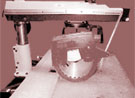
The centrifugal forces on an unbalanced cutter head can
fling the knives from the tool and severely or fatally injure the operator or other nearby
personnel.
-
Using the wrong tool on a cutter head or using a tool at a higher speed than it was designed to operate at also
can cause tool breakage and projection.
|
|
 |
|
|
|
Engineering Controls
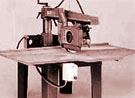
- Machine Guarding - Guards are now standard equipment on most woodworking machines. If you
purchase a machine that does not come equipped with a guard, install
one. Contact the manufacturer of the machine to see if appropriate
guard(s) are available for the equipment. If not, use this guide to help you determine
the appropriate guard to install. Because woodworking equipment is dangerous, guards
should always be designed and installed by technically competent and qualified
persons. In addition, it is always a good idea to have the equipment
manufacturer review proposed guard designs to ensure that the guard will
adequately protect employees and allow safe operation of the equipment.
- There are many ways to guard machines. The type of operation, size or shape of stock, work
being performed on the material, method of handling, and production requirements are some of the
factors that help determine the appropriate safe-guarding method for an
individual machine. All moving machine parts that may cause injury must
be safeguarded. This includes the point of operation, the power transmission apparatus, and
rotary or reciprocating parts. Table 1 describes three types of machine guards commonly used on woodworking
machinery: fixed, adjustable, and self-adjusting.
- To be effective, a guard should prevent
employees from contacting the dangerous parts of the machines, and it should be secure. This is not
always possible, as in the case of the radial arm saw. Regardless, workers should not be able to
easily bypass, remove, or otherwise tamper with the guard. In protecting the worker, however, the guard
must not create additional hazards, nor prevent the worker from performing the job.
- Make sure that guards are in working order and that they are appropriate and practical for the
machinery. Guards must have adequate strength to resist blows and strains and should be constructed
to protect operators from flying splinters and machine parts such as broken saw teeth, cutting
heads, and tools.
- The Rough Mill and Production
sections provide more detailed information on methods of machine
guarding (including construction of guards), and guard types for specific woodworking machines.
- Additional methods for safeguarding machines include guarding by location or distance, feeding methods,
and appropriate placement of controls. However, none of these methods should replace machine
guards. It is always important to provide a guard or barrier that prevents access to the danger area. Table 2 describes these
other safeguarding methods.
Work Practice Controls
- Use appropriate equipment for the job.
Workers can be seriously injured if they do not
use the correct equipment for a job. Use machines
only for work within the rated capacity
specified by the machine manufacturer. Use the
correct tools on a given machine. For example,
when using a circular saw, use the correct blade
for the required cutting action. Similarly, you
must only mount blades, cutter heads, or collars
on machine arbors that have been accurately
sized and shaped to fit these parts.
-
Frequently inspect equipment and guards.
Ensure that: (1) the operator and machine are
equipped with the safety accessories suitable for
the hazards of the job, (2) the machine and
safety equipment are in proper working condition,
and (3) the machine operator is properly
trained. Document the inspections and keep the
records. Documentation should identify the
machine, inspection date, problems noted, and
corrective action taken. Noting problems helps
to ensure that corrective action will be taken,
that operators on all shifts will be made aware of
any potential danger, and that any pattern of
repeat problems on a particular machine can be
detected and resolved as early as possible.
-
Use equipment only when guards are in place
and in working order. A worker should not be
allowed to operate a piece of woodworking
equipment if the guard or any other safety device, return device, spreader, anti-kickback
fingers apparatus, guard on in-running rolls, or
gauge or rip fence is not functioning properly.
When guards cannot be used (during rabbeting
or dadoing, for instance), you must provide combs, featherboards, or suitable jigs for
holding the stock.
-
Provide regular preventive maintenance.
Regularly clean and maintain woodworking
equipment and guards. Ensure that blades are in
good condition. Knives and cutting heads must
be kept sharp, properly adjusted, and secured.
Sharpening blades prevents kickback. You must
also remove any cracked or damaged blades
from service. Keep circular saw blades round
and balanced. You must remove dull, badly set,
improperly filed or improperly tensioned saws
from service, and immediately clean saws to
which gum has adhered.
-
Use appropriate personal protective equipment.
|
|
 |
|
|