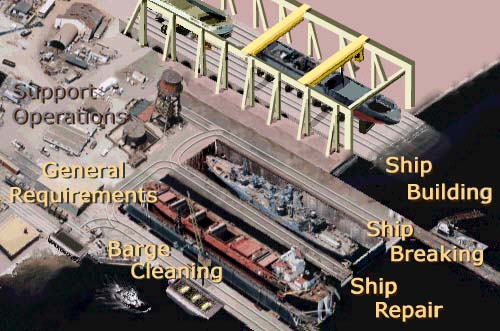
Click on an area for more specific information.

Figure 1: Flammable and combustible
liquids. |
Flammable and combustible liquids, including paint, solvents, and
preservative removers, are used in all aspects of shipbuilding. The use,
storage, and containment of these
materials pose hazards to employees.
This section primarily focuses on the storage and containment
of flammable and combustible liquids. For more detailed information
regarding these materials, see the following:
The storage and containment of flammable and combustible liquids
can expose workers to the following hazards:
Note: Confined space entry is one of the leading
hazards associated with barge cleaning. Review the
Shipbuilding: Confined/Enclosed Spaces and Other Dangerous Atmospheres
chapter for information on how to protect workers from this hazard.
|
Fire and Explosion Hazards |
Potential Hazards:
Fire and explosions may be caused by:
- Spills of flammable and combustible liquids.
- Uncontrolled ignition sources in storage, mixing and
transfer areas.
- Inadequate ventilation in storage, mixing and transfer
areas.
- Painting. See Painting [1915.35].
Requirements and Example Solutions:
- Hot work must not be performed in the space and/or adjacent
spaces when flammable or combustible liquids are being
stored, mixed or transferred. [1915.36(a)(1)
and 1915
Subpart P]
- Rags soaked with solvents must be placed in covered metal
containers. [1915.36(a)(3)
and 1915.91(e)]
- Paints, thinners, and solvents must be kept in
fire-resistant covered containers when not in use. [1915.91(e)]
- Smoking and open flames must be prohibited in the area. [1915.36(a)(1)]
- Arcing and sparking equipment and tools must not be used.
[1915.36(a)(1)]
- Equipment that may generate static electricity (e.g.
ventilation systems) shall be grounded/bonded. [1915.13(b)(11)]
- Explosion-proof lights must be used. [1915.36(a)(4)
and 1915.13(b)(9)]
- Adequate ventilation must be maintained in storage,
mixing and transfer areas. [1915.13(b)(3)
and 1915.36(a)(2)]
- Frequent tests must be required during mixing and spill
clean-up to determine if air concentrations are below 10% of
the LEL. [1915.15(f)
and 1915.36(a)(2)]
- The
Shipyard Competent Person (SCP) must test the exhaust location to
ensure that exhausted vapors do not accumulate to hazardous
levels. [1915.13(b)(7),
(b)(8),
(b)(11),
and (b)(12)]
- Suitable fire fighting equipment must be immediately
available. [1915.36(a)(6)]
- Spills of solvents must be cleaned up immediately. [1915.13(b)(5)]
- 30 gallon drums and containers of flammable or toxic
liquids must be placed in an area where they will not be
subject to physical damage. [1915.173(d)]
- 55 gallon drums containing flammable or toxic liquids
shall be surrounded by dikes or pans. [1915.173(e)]
- Power and lighting cables must be inspected by a person
competent to evaluate electrical hazards (not the
Shipyard Competent Person) and ensure there are no
connections within 50 feet of the storage, mixing, and
transfer of flammable and combustible liquids. [1915.36(a)(5)]
|

Figure 2: Drums and containers of flammable cleaning solvents.

Figure 3: Worker spray painting in enclosed space increases fire hazard.

Figure 4: Warning sign clearly informs workers of fire and explosion hazards of smoking and hotwork in a spray area,

Figure 5: Shipyard Competent Person testing flammability and other hazards in spray area. |
|
|
Maritime Labor/Industry Recommendations
|
- Signs should be displayed around flammable liquid storage and mixing areas
indicating the presence of flammable and combustible
liquids, as well as signs for no smoking or open
flames.
Back to Top
|
|
Respiratory Hazards |
Potential Hazards:
Toxic vapors and mists produced by flammable and combustible
liquids may present significant health hazards when transferred,
mixed, or stored. These materials produce vapors that are
often heavier than air, and can become highly-concentrate in confined and
enclosed spaces, causing displacement of oxygen and increasing
health risks.
Requirements and Example Solutions:
- A hazard assessment must be made to determine the
proper selection of respirators. [1915.152(b)]
- Many epoxy, anti-fouling, and coal tar pitch paints
may cause respiratory damage, skin sensitization and
possible life-threatening allergic reactions. Use of
these materials required special precautions:
- Air-line respirators
- Gloves
- Respirators must be used in accordance with 1915.154.
[1910.134]
Additional Resources:
|

Figure 6: Workers protected from toxic cleaning solvents.

Figure 7: Ventilation provided for painting in confined space.

Figure 8: Airline respirator for use when ventilation does not provide adequate safety. |
Back to Top
|
| Contact with Flammable and Combustible Liquids |
Potential Hazards:
Employees working with flammable and combustible liquids are
at risk of harm if skin or eye contact occurs.
- Organ damage through skin or eye absorption.
- Skin or eye burns and irritation.
- Ingestion of contaminated food.
Requirements and Example Solutions:
- A hazard assessment must be made to determine the proper
selection of PPE. [1915.152(b)]
- The face, eyes, head, hands and all other exposed body parts of employees handling highly volatile paints
shall be protected. [1915.35(b)(9)]
Also see PPE: Painting module.
- Spills or other releases of flammable, combustible, toxic,
corrosive and irritant materials must be cleaned up as work
progresses. [1915.13(b)(5)]
- When clothing becomes saturated with flammable and
combustible liquids, clothing should be changed
immediately.
- Washing facilities must be available in case employees are
exposed to these materials. [1915.97(b)]
- Workers must be trained in the hazards and precautions of
the materials they work with in accordance with the Hazard
Communication Standard. [1915.1200]
Additional Information:
|

Figure 9: Improper practice: Worker exposed to health hazards from skin absorption and eye contact.

Figure 10: Worker protected from toxic paint fumes with proper PPE.

Figure 11: Worker protected by
PPE from toxic paint fumes
and spills while mixing paint. |
|
|
Maritime Labor/Industry Recommendations |
- Fixed or portable eye wash stations/safety showers should meet ANSI
Z358.1-1998: Emergency Eye Wash and Shower Equipment.
|

Figure 12: Eye wash station. |
Back to Top |
|
|