Chemical paint strippers and removers used for surface preparation include
corrosive acids, (e.g., hydrochloric and phosphoric), alkalis (e.g., sodium hydroxide/lye),
chlorinated hydrocarbons (e.g., trichloroethane) and carcinogens (e.g., methylene
chloride). These chemicals may present severe eye, skin and respiratory exposure hazards.
Paint strippers and removers potentially expose workers to:
Note: Confined space entry is one of the leading
hazards associated with barge cleaning. Review the
Shipbuilding: Confined/Enclosed Spaces and Other Dangerous Atmospheres
chapter for information on how to protect workers from this hazard.
|
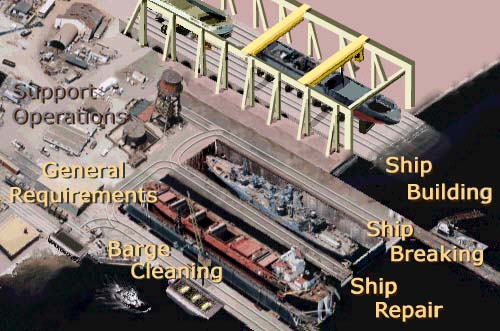
Click on an area for more specific information.

Figure 1: Chemical Removers. |
|
Fire and Explosion |
Potential Hazards:
Fire and explosions may be caused by:
- Flammable and combustible cleaning
solvents such as Methyl Ethyl
Ketone (MEK), mineral
spirits, and diesel fuel/oil.
- Liquids with high flash points
(greater than 100 F) may present a fire or explosion hazard when
applied as a fine mist.
- Airborne particulate or dust.
- Hydrogen gas generated during cleaning processes.
- Painting. See
Painting [1915.35].
Requirements and Example Solutions:
|

Figure 2: Drums and containers of flammable cleaning solvents.

Figure 3: Shipyard Competent Person testing flammability and other hazards in spray area. |
Back to Top
|
|
Respiratory Hazards |
Potential Hazards:
Toxic vapors or corrosive mists produced by chemical paint and preservative removers
may present significant health hazards including
oxygen-deficient atmospheres. When used in confined or enclosed spaces these agents
produce vapors that are often heavier than air. This can cause
displacement of air, reducing oxygen levels, which may be fatal.
Note: Paint strippers often contain methylene chloride, which has additional requirements.
Requirements and Example Solutions:
- Ensure adequate ventilation to maintain concentrations below the PEL.
[1915.32(a)(2)]
- The
Shipyard Competent Person (SCP) may require continual monitoring to
determine air concentrations are within the PELs and below IDLH
levels. If they are not, additional engineering controls (e.g.,
ventilation), administrative controls or PPE (e.g. respirators) must
be used. [1915.32(a)(3)]
- Airline respirators may be necessary if ventilation is not adequate.
- Respirators must comply with 1915.154.
[1910.134]
Additional Resources:
|

Figure 4: Workers protected from toxic cleaning solvents.

Figure 5: Ventilation provided for painting in confined space.

Figure 6: Airline respirator for use when ventilation does not provide adequate safety. |
Back to Top |
|
|
Contact Hazards |
Potential Hazards:
Toxic and corrosive paint strippers and removers can harm employees
eyes and/or skin.
- Organ damage through skin or eye absorption.
- Skin or eye burns and irritation.
- Ingestion of contaminated food.
Requirements and Example Solutions:
- Appropriate PPE must be used.
- Solvents spills must be cleaned up immediately. [1915.13(b)(5)]
- Washing facilities must be available. [1915.97(b)]
- Workers must be trained in accordance with the Hazard Communication
Standard. [1915.1200]
Additional Information
|

Figure 7: Improper practice: Worker exposed to health hazards from skin absorption and eye contact.

Figure 8: Worker protected from toxic paint fumes with proper PPE.

Figure 9: Worker using washing facilities. |
|
|
Maritime Labor/Industry Recommendations
|
- Fixed or portable eye wash stations/safety showers should meet ANSI
Z358.1-1998: Emergency Eye Wash and Shower Equipment.
|
Back to Top |
|
|
|
Limited Access
|
Potential Hazards:
When working in confined or enclosed spaces workers may become trapped and
unable to exit due to:
- Improperly located equipment.
- Ventilation ducts and hoses running through the opening.
Requirements and Example Solutions:
- When employees work in confined spaces with limited access, the
access must not be blocked or impeded by ventilation ducts, hoses or
other equipment. [1915.76(b)(2)]
- More than one means of access must be provided where practical. [1915.76(b)(1)]
- Additional openings should be provided for ducts, hoses, and other equipment.
|

Figure 10: Improper practice: Ventilation hoses blocking exit from opening.

Figure 11: Special ventilation hose (flat) to
avoid blocking exit.

Figure 12: Two access holes for equipment or access. |
Back to Top |
|
|
Slips and Trips
|
Potential Hazards:
Workers performing surface preparation are exposed to slick conditions and tripping hazards.
- Slipping and falling on oily decks.
- Tripping over equipment, hoses, and vessel structures.
Requirements and Example Solutions:
|

Figure 13: Improper practice:
Wet and oily surfaces create slipping hazard.

Figure 14: Tripping hazards due to poor housekeeping.

Figure 15: Lead racks used to remove tripping hazards (welding leads, hoses, etc.) from the deck. |
Back to Top |
|
|
Fall Hazards
|
Potential Hazards:
Fall hazards are a leading cause of shipyard fatalities.
Shipyard employees are often required to work in dangerous environments that may include fall hazards. Accidents involving elevation equipment such as ladders and scaffolds are often serious, even fatal.
- Falls from ladders.
- Falls from scaffolds.
- Falls from open deck edges.
- Falls into open holes.
Requirements and Example Solutions:
Guarding of Deck Openings and Edges
- Deck openings and edges must be guarded. [1915.73]
- Flush manholes and other small openings must be guarded after opening. [1915.73(b)]
- During the installation of guards on large openings and deck
edges, fall protection (e.g., harness with lanyard) must be used. [1915.73(d)]
- When floor plates or gratings (e.g., bilges, engine rooms,
pump rooms, machinery spaces) are removed, the
openings must be guarded or planked. [1915.73(f)]
Fall Protection for Scaffold Work
- Guardrails or other appropriate fall protection shall be
used when working on scaffolds five feet above surfaces. [1915.71(j)]
- Fall protection must be used during the installation of guards on scaffolds. [1915.73(d)]
|

Figure 16: Improper practice: Improper use of step ladder.

Figure 17: Improper practice: Several unguarded deck openings.

Figure 18: Properly guarded deck edges.

Figure 19: Worker on scaffold protected by guardrails. |
|
|
Maritime Labor/Industry Recommendations |
- Maritime Labor/Industry recommends that personal fall protection including
lanyards and harnesses be used and secured during installation
of guardrails.
Back to Top
|
|
High-Pressure Hazards |
Potential Hazards:
The use of high pressure equipment may expose the operator as well as bystanders to the following hazards:
-
Contact with high-pressure steam, water, or air streams from cleaning
equipment.
-
Contact by uncontrolled high-pressure hoses.
-
Contact with steam, water, or air leaks from high-pressure equipment.
Injuries associated with these hazards include:
-
Loss of body parts (e.g., fingers, hands, etc.)
-
Lacerations
-
Burns
-
Loss of sight
Requirements and Example Solutions:
- Steam guns must be insulated to prevent heat burns to the
operator. [1915.33(e)]
- Appropriate PPE must be used. [1915.152]
- Access to the area should be controlled.
- Hoses and connections should be inspected prior to use.
Back to Top
|
|