Department of Labor Seal photos representing the workforce - digital imagery© copyright 2001 photodisc, inc.
Department of Labor Seal www.osha.gov   [skip navigational links] Search    Advanced Search | A-Z Index
eTools Home : Shipyard Employment Scope | Glossary | Additional Resources | Viewing / Printing Instructions | Credits
Shipyard Employment eTool: Shipbuilding
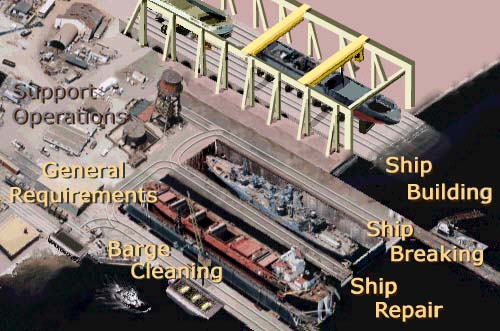
General Requirements Shipbuilding Ship Repair Shipbreaking Barge Cleaning

Hot Work » Preparing Space for Hot Work
 
Before performing hot work, shipyard personnel must prepare spaces for entry and work. Consideration must be given to such items as illumination, ventilation, means of access (such as ladders), and staging. When the space has been adequately prepared, a marine chemist or shipyard competent person must conduct a visual inspection. [1915.14 See Testing and Certification for Hot Work and Confined/Enclosed Spaces.]

The tasks and inspections below can be conducted by shipyard personnel (such as tank cleaners, ship superintendent, port engineer, Shipyard Competent Person (SCP), Marine Chemist, etc). Either a Shipyard Competent Person (SCP) or a Marine Chemist must test for hot work, depending on the hot work location.


Click on the area for more specific information.
Labeling Labeling Ventilation Atmospheric Testing Visual Inspection Blanking Off Preparing Space for Hot Work
Figure 1: Preparing Space for Hot Work. See also: Atmospheric Testing, Blanking Off, Ventilation, Visual Inspection, and Warning Signs and Labels.
Tasks to Prepare for Hot Work
In preparation of a space for hot work, shipyard personnel must complete the following tasks as required by 29 CFR Part 1915: If a Marine Chemist Certificate is required, the following must be conducted:
  • Determine the nature and the extent of the hot work. [NFPA 306, 2-2.2(b)]
  • Determine the nature of other operations in or adjacent to the space that may affecting hot work (such as painting and cleaning). [NFPA 306, 2-2.2(b)]
  • Secure pipelines and other equipment (heating coils, pumps, etc.) in the work space to prevent flammable or toxic materials from being discharged into the space. [NFPA 306, 2-2.2(e)]
     
 
Preparing for hot work.
Figure 2: Preparing for hot work.

Blank in line to isolate system. 
Figure 3: Blank in line to isolate system.
 Safe for Hot Work.
Figure 4: Safe for hot work.
 
Continuous exhaust ventilation in a confined space.
Figure 5: Continuous exhaust ventilation
in a confined space.
Note: Not adequately guarded.
 
Grounded/bonded welding machine.
Figure 6: Grounded/bonded welding machine.
Fire watch.
Figure 7: Fire watch.
Maritime Labor/Industry Recommendations
  • The above should also be used as good work practices by a Shipyard Competent Person (SCP) when making their determination to allow hot work.
     
Back to Top Back to Top


Inspections for Hot Work
Preparation for hot work also includes:
  • Ensuring that flammable, combustible, or toxic coatings (preservative coatings or insulation) have been removed from hot work surfaces.
    • A shipyard competent person must perform testing on any surface of which the flammability is not known. [1915.53(b)]
    • Soft and greasy coatings must be adequately stripped back. [1915.53(e)]
    • Toxic preservative coatings must be stripped back at least 4 inches, otherwise airline respirators must be used. [1915.53(d)(1)]
  • Ensuring that flammable and/or combustible materials (such as trash, rags, open containers of solvents, etc.) have been removed from the area. [1915 Subpart P and 1915.91]
  • Ensuring that flammable, combustible, or toxic cargo residues have been removed or are adequately covered. [1915 Subpart P]
  • Ensuring that all movable fire hazards including residues of combustible bulk cargoes in the vicinity have been removed from the hot work area. [1915 Subpart P]
  • Ensuring ventilation is adequate to maintain a safe atmosphere during hot work. [1915.51(b)]
  • Ensuring that adjacent spaces have been inspected, tested and meet requirements for hot work. [1915.11(b)]
    • In lieu of cleaning, adjacent spaces can be inerted.
Additional Resources
  • Fire Protection Handbook for "Hot Work Oxygen Chart" (Inerting). NFPA.


Paint removed 4" all around both sides.
Figure 8: Paint removed 4" all around both sides.
 Removal of flammable or combustible material.
Figure 9: Removal of flammable or combustible material.

Local exhaust ventilation.
Figure 10: Local exhaust ventilation.
 Adjacent space has been inerted.
Figure 11: Adjacent space has been inerted.
Back to Top Back to Top  
    
eTools Home : Shipyard Employment Scope | Glossary | Additional Resources | Viewing / Printing Instructions | Credits

Back to Top Back to Top www.osha.gov www.dol.gov

Contact Us | Freedom of Information Act | Customer Survey
Privacy and Security Statement | Disclaimers
Occupational Safety & Health Administration
200 Constitution Avenue, NW
Washington, DC 20210