Department of Labor Seal photos representing the workforce - digital imagery© copyright 2001 photodisc, inc.
Department of Labor Seal www.osha.gov   [skip navigational links] Search    Advanced Search | A-Z Index
eTools Home : Shipyard Employment Scope | Glossary | Additional Resources | Viewing / Printing Instructions | Credits
Shipyard Employment eTool: Shipbreaking
General Requirements Shipbuilding Ship Repair Shipbreaking Barge Cleaning

PPE » Hazard Assessment
 
Prep Before Cleaning Cleaning Operations Rescue Teams Ventilation Rescue Teams Warning Signs and Labels Warning Signs and Labels Illustration of many ship repair operations that require PPE
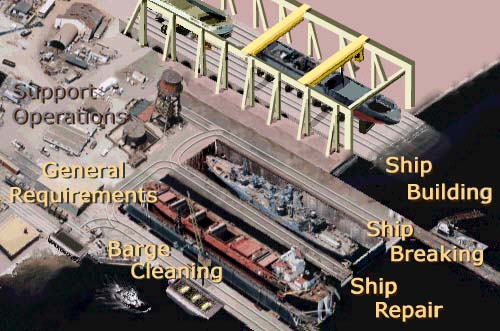
Figure 1: Illustration of the many ship repair operations that require PPE.
The first step in the development of a PPE program is to conduct a comprehensive hazard assessment. [1915.152(b)

The Non-mandatory Guidelines for Hazard Assessment contain examples of procedures for a hazard assessment. [1915 Subpart I Appendix A]

The following section addresses:
Note: Confined space entry is one of the leading hazards associated with barge cleaning. Review the Shipbreaking: Confined/Enclosed Spaces and Other Dangerous Atmospheres chapter for information on how to protect workers from this hazard.

Conducting a Hazard Assessment
A determination of whether hazards are present or are likely to be present must be conducted. [1915.152(b)] If such hazards are present or are likely to be present the employer shall select the type of PPE.

Hazards to evaluate may include:
  • Impact (falling objects, struck-by hazards, impact tools)
  • Puncture and cuts (tools, knives, slag, nails, wire rope, sheet metal)
  • Compression/Crushing (gears, struck-by hazards, shifting loads)
  • Chemical (solvents, corrosives, paints, fumes)
  • Heat/Cold (welding, burning, environmental temperatures)
  • Burns (thermal, chemical)
  • Vibration (pneumatic tools)
  • Dust (heavy metals, silica)
  • Light (optical) radiation (arc welding, lasers)
  • Excessive noise (abrasive blasting, needle gunning, scaling, grinding, metal straightening)
  • Falling (from elevations, into water)
  • Drowning
Maritime Labor/Industry Recommendation
  • It is recommended that the PPE hazard assessment be part of a broader assessment (such as Job Safety Analysis) which includes a demolition plan, engineering, administrative, and other hazard controls.
Back to Top Back to Top


Documenting the Hazard Assessment
The hazard assessments must be documented [1915.152(b)(4)] and include the following information:
  • Occupation
  • Dates of the hazard assessment
  • Name of the person performing the hazard assessment
Maritime Labor/Industry Recommendation
  • It is recommended that a written PPE Program that describes how the employer meets each element of the standard.
Back to Top Back to Top
 

eTools Home : Shipyard Employment Scope | Glossary | Additional Resources | Viewing / Printing Instructions | Credits

Back to Top Back to Top www.osha.gov www.dol.gov

Contact Us | Freedom of Information Act | Customer Survey
Privacy and Security Statement | Disclaimers
Occupational Safety & Health Administration
200 Constitution Avenue, NW
Washington, DC 20210