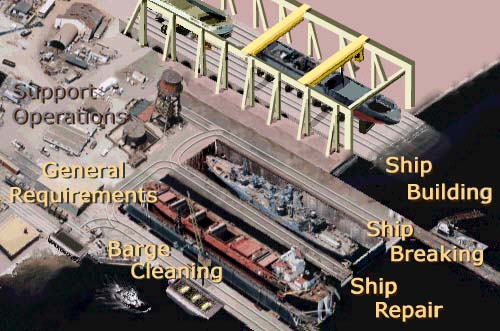
Hoisting and hauling equipment is used to move heavy loads. Hoisting and
hauling equipment may consist of mobile or
stationary cranes and derricks and marine railway
installations.
Note: Winches and moving parts on hoisting and hauling equipment must
be guarded. [29 CFR 1915.115(b) and
29 CFR 1915.131(d)]
| Cranes
and Derricks |

Figure 1: Improper practice - Worker exposed to overhead load.

Figure 2: Crane swing radius guarded with barriers.

Figure 3: Crane swinging freely suspended load over water (limits side loading of crane boom).

Figure 4: Crane operator stays in position at all times while load is suspended.
Potential Hazard:
Workers can be injured by falling loads, falling
booms overturning equipment
being caught in moving machinery parts, and being struck by moving
machinery or loads.
Requirements and Example Solutions:
-
Derricks and cranes used on vessels must be tested
and certified in accordance with the standards provided in 29 CFR
1919. [29 CFR 1915.115(a)(1)]
-
Maximum manufacturer's rated safe working loads
must be posted and must not be exceeded. [29 CFR 1915.115(c)(1)
and
(c)(2)]
-
The various working radii of the boom and the
maximum and minimum radii at which the boom may be safely used with
and without outriggers shall be conspicuously posted near the controls
and shall be visible to the operator. A radius indicator shall be
provided. [29 CFR 1915.115(c)(1)]
-
Special precautions should be taken when placing a
crane on a vessel (barge) due to [ANSI B30.8-1982 Section
8-1.2.2(3).]:
-
Wave movement
-
Barge size or stability
-
Shifting crane
-
Swing radius must be guarded. [29 CFR 1915.115(d)]
When
crawler, locomotive, and truck cranes are used:
- Side loading of booms shall be limited to freely suspended loads.
Cranes shall not be used for dragging loads sideways. [29 CFR 1910.180(h)(3)(iv)]
-
Neither the load nor the boom shall be lowered below
the point where less than two full wraps of rope remain on their
respective drums. [29 CFR 1910.180(h)(3)(x)]
- When two or more cranes are used to lift one load,
one designated person shall be responsible for the operation. This
person shall
be required to analyze the operation and instruct all personnel
involved in the proper positioning, rigging of the load, and the
movements to be made. [29 CFR 1910.180(h)(3)(xii)]
- The operator shall not be permitted to leave his or her position at the controls while the load is suspended.
[29 CFR 1910.180(h)(4)(i)]
Additional Resources:
Back to Top |
| Marine Railways |

Figure 5: Workers must stay clear during movement of marine railway cradles.

Figure 6: Marine railway tugger presents machinery and breaking line potential hazards.
Potential Hazards:
Workers can be injured by being struck by moving cradle, machinery
parts, and breaking lines.
Requirements and Example Solutions:
-
The cradle or carriage on the marine railway must
be positively blocked or secured when in the hauled position to
prevent it from being accidentally released. [29 CFR 1915.115(e)(1)]
Back to Top |
| Powered Industrial Trucks |

Figure 7: Powered industrial truck presents traffic and struck-by potential
hazards.
Potential Hazards:
Workers can be injured due to lift trucks tipping over, shifting deck
plates, dropped loads, or by being struck by moving lift trucks.
Requirements and Example Solutions:
Powered industrial trucks are used throughout the shipyard to move
material while on the vessel and in the shops. Example elements applicable
to Powered Industrial Trucks include:
- Inspection
- Maintenance
- Training [29 CFR 1915.120]
- Overhead protection
- Warning devices
- Operational
Refer to the
Powered Industrial Trucks
Safety and Health Topics Page for a more in-depth
discussion.
Additional Resources:
Back to Top |
|