|
|
PPE Selection - Heat: Safety Goggles
Safety
goggles are used as primary protection to shield the eyes from heat hazards. Goggles form a protective seal around
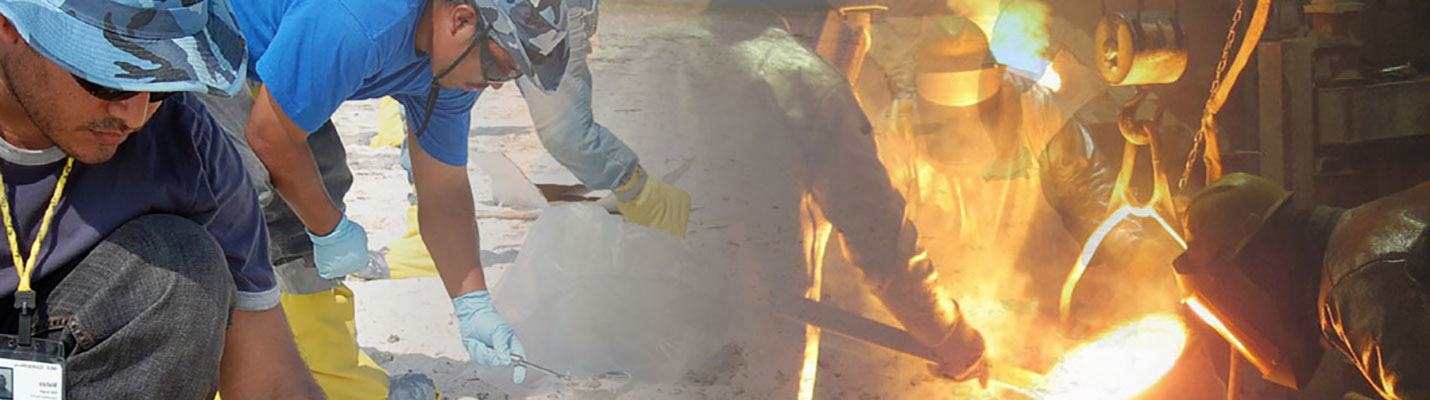
the eyes, preventing objects or liquids from entering under or around the goggles. This is especially important when working with or around
molten metals that may splash.
When employees
are exposed to high temperatures, additional protection beyond that
offered by primary protectors may be required. Use
safety goggles in combination with a heat-reflective
face shield for severe temperatures exposure. Consider specific lens, frame, and ventilation options
when selecting safety goggles.
| Lenses |
Safety goggles
lenses are
designed and tested to resist moderate impact.
|
- Clear lenses:
- Are available with removable lenses
- May incorporate
prescription lenses
- Do not provide special protection against optical
radiation
|

Fig. 1:
Clear,
Removable
Lenses |
|
-
Filter lenses:
- Provide
eye protection for performing tasks involving
intense light.
- Available with removable lens types
- May incorporate
prescription lenses
- Filter lens
requirements
|

Fig.
2:
Filter Lenses |
|
- Special
purpose lenses:
- Are used for
particular visual tasks that may include
exposure to high temperatures
- May be
photochromic
- May not correspond
to specific filtered lens shades
|
 |
| Frames |
Safety goggle
frames must be properly fitted to the
worker's face to form a protective seal around
the eyes. Poorly fitted goggles will not offer
the necessary protection.
|
- Eyecup safety goggles:
- Cover the eye sockets
completely
- Are available with direct
or indirect ventilation
- May be rigid or flexible
|

Fig.
3: Eye Cup
Goggles |
|
- Cover safety goggles:
- May be
worn over corrective spectacles without
disturbing the adjustment of the spectacles
- Are available in direct,
indirect, or non-ventilated types
- May be rigid or flexible
|

Fig.
4: Cover
Goggles |
|
|
 |
| Ventilation |
Ventilated goggles
allow air circulation while providing protection against
airborne particles, dust, liquids, or light.
|
- Direct ventilation:
- Resist direct passage of
large particles into the goggle
- Prevent fogging
by allowing air circulation
|

Fig.
5:
Direct-ventilated
Goggles |
|
- Indirect ventilation:
- Prevent fogging
by allowing air circulation
- Protect against liquid or
chemical splash entry
|

Fig.
6:
Indirect-ventilated
Goggles |
|
- Non-ventilated
goggles:
- Do not allow the passage of
air into the goggle
- Prevent splash
entry
- May fog and require frequent lens cleaning
|

Fig.
7:
Non-ventilated
goggles |
|
|
 |
|